




Current Climate brings you the latest sustainability business news every Monday. Sign up to get it in your inbox.
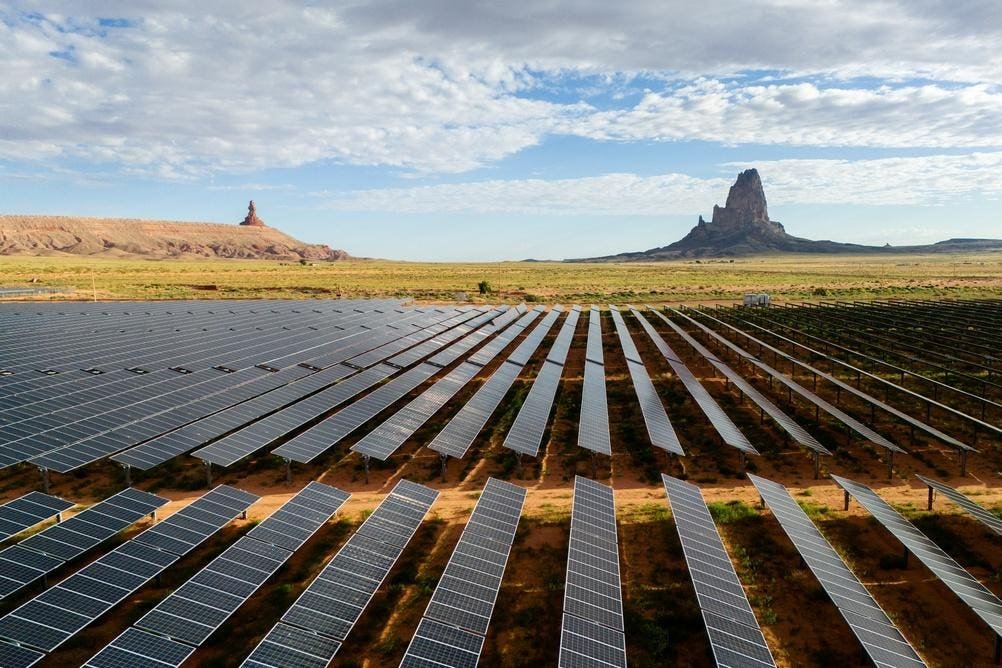
WCome back to Current Climate. Rising demands for power from data centers and the electrification of everything, exacerbated by a spike in crude oil prices stemming from the war in Iran, have pushed up utility bills for months, but also brought a boom in large-scale solar installations. In fact, solar overtook coal for the first time as a source of electricity generation in the US in May.
During the month, solar generated 12.8 percent of the country’s electricity, while coal-fired plants fell to just 12.2 percent, near an all-time low, according to data compiled by energy think tank Ember. It’s a remarkable change given that coal was about 20% of US electricity generation in May 2021, while solar was only 5.4% at that time. Its share will expand further as new projects such as New Mexico’s 3.7 gigawatt SunZia wind farm that opened last week, the nation’s largest, come online.
The solar boom is accelerating, despite the Trump administration’s efforts to roll back federal clean energy incentives and return to coal and coal-based energy, due to the rapid deployment of large battery energy storage systems that allow utilities to maintain steady supplies of renewable electricity. As a result, solar and battery storage installations accounted for more than 90% of new energy added to the US grid in the first quarter of 2026, according to the Solar Energy Industries Association.
Nowhere is the rise of solar power more evident than in California. While solar surpassed coal nationally last month, in the Golden State, it has overtaken natural gas, the top U.S. energy source, so far this year, according to data from the Energy Information Administration.
“California Independent System Operator (CAISO) solar electricity generation in the first five months of 2026 increased by 21% compared to the same period in 2024, and natural gas generation decreased by 60%,” the EIA report said. “At CAISO, utility-scale solar produced more electricity than natural gas on a daily basis on 82% of days in the first five months of 2026, up from 21% in 2024 and 2025.”
This growth is due in part to the fact that, despite abundant domestic supplies of natural gas, there is a multi-year waiting list for utilities to acquire new gas turbines. Meanwhile, the cost and time required to install solar and battery systems continue to fall.
For decades, environmentalists have advocated a transition to clean energy to curb harmful carbon emissions. Financial benefits are now an even bigger incentive.
The big read
Forget Elon’s data centers in space. This startup wants to float them in the sea
Among big future businesses, Elon Musk is selling investors in the newly public SpaceX is his plan to put data centers in space: solar satellites, scattered in a huge network, processing information in space and broadcasting to Earth. As far as positions go, it has the clean geometry of a Musk bull case. It’s the kind of “I want to die on Mars, not on impact” sci-fi idea that the fledgling billionaire is famous for. And it’s highly timed: the AI powering frenzy is in overdrive, but the land-based data centers they need are becoming an unwelcome threat to many communities, driving up utility rates, creating noise and pollution, and producing little local economic benefit.
SpaceX hopes to begin launching orbital data centers in 2028, though it is IPO filing does not provide cost estimates for such a system. But it does include the kind of caveat found in a securities filing like a runway explosion: The plan involves “significant technical complexity, unproven technologies or technologies that do not exist or may require significant advancement, and such initiatives may not achieve commercial viability.”
SpaceX’s lawyers meant it as a warning. Musk could probably plaster that on the lobby wall.
But if the goal is simply to move data centers off land and operate at a lower cost, there’s a much better option: the ocean. It’s a long way from taxpayers, zoning fights and the sudden arrival of over-the-top neighbors. And it can be a climate-friendly energy source and an inexpensive way to cool massive data centers.
This is where Panthalassa wants to go. The Portland, Oregon startup, backed by Peter Thiel and a string of Silicon Valley venture firms, has spent the past decade developing floating data centers that generate their own electricity from open ocean waves and are cooled by cold seawater. It expects commercial units to be operational in 2027, a year before SpaceX says it can start putting computing satellites into orbit, with all of those titles subject to caveats.
Read more here
Hot topic
General Motors battery chief Kurt Kelty is moving away from LFP (lithium iron phosphate) batteries to cells rich in sodium ions and manganese
GM plans to sell sodium-ion batteries for energy storage and manganese-rich batteries for pickups and SUVs. Will the LFP batteries you make with LG in the US end up in your electric vehicles?
We manufacture LFP cells at Ultium, which is a joint venture with LG. We are essentially a contract manufacturer. The output just goes to LG. We have nothing to do with where it will be released. We don’t put it in the systems. We undertake its construction. The supply chain is defined by LG. this is their cell.
There are no plans today to put them on our vehicles.
LFP is the dominant battery used in Chinese EVs. Can the materials and components needed be sourced from the US?
LFP’s supply chain is entirely outside of China. There is no way you can compete with LFP if you are trying to source from North America. There are no good sources of cathode material or anode material for that matter. With sodium ions, we have a real advantage here because the US has the largest resource on earth for sodium. Sodium ion is available anywhere. You could get it in any country you want to make it. So it’s abundant from the start and we’re working with suppliers right now to supply cathode.
So the cathode – NFPP is the name of the cathode we use – currently only comes from China. So we source it from China, but we also work with the domestic supply base here. When I say domestically, in North America, we work with a lot of partners here. We try to help them. We invest small dollar amounts. We’re also doing joint development deals to try to highlight the North American supply base.
When I say domestically, in North America, we work with a lot of partners here. We try to help them. We invest small dollar amounts. We’re also doing joint development deals to try to highlight the North American supply base.
Some Chinese EV manufacturers are putting sodium ion batteries in EVs. You use this chemistry to store energy, but could it eventually end up in cars?
You are looking at our roadmap in a good way.
It comes back to the right chemistry for the right application. Sodium ion is not the right chemistry for electric cars today. The only time it makes sense is for very cold temperatures, like if you’re driving a car in minus 40 degrees Celsius. Sodium ion would be good for this. But other than that, if the energy density is too low and the cost is too high, putting it in an EV doesn’t make sense.
But it makes sense in one [energy storage] application because we’re looking at that full system cost, total cost of ownership. Now in EVs, one of the beauties of this is that sodium ions could eventually be deployed in an EV application. It will need some development work.
So let’s start with one [energy storage] application, but there is an opportunity in the future to develop into EVs. That’s not the intention today, but he has that opportunity.
Is the lithium manganese battery you announced for heavier vehicles like pickups and SUVs?
It’s great for trucks and SUVs, those applications, because we have a little more space than in small vehicles. The energy density is not as great as [lithium-ion]so we need space in the vehicles. But if you compare it to LFP, we’re at a similar price, but we get 30% to 35% more energy density than that. So it’s a great chemistry for the use we have for it, SUVs and trucks.
What else are we reading?
Our ocean has shielded us from the worst of climate change. Now he has a fever (The Guardian)
Trump pays $765 million to kill 4 more offshore wind leases (Heat map)
Invenergy eye geothermal leases after Trump checks offshore wind (Bloomberg)
The Trump administration is abandoning the fight against wind energy as clean energy production increases (Inside Climate News)
