




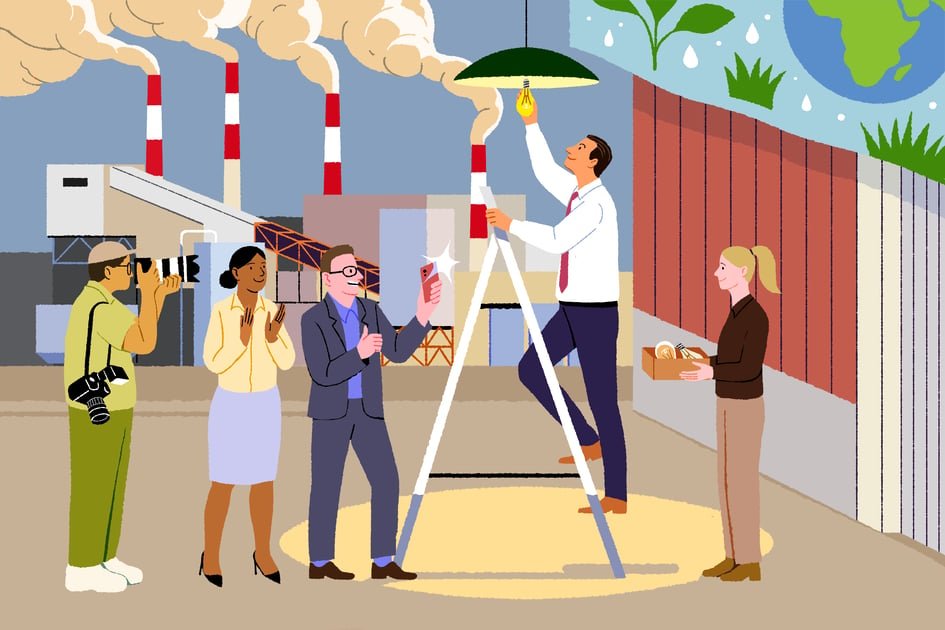
But when Kellogg’s Aaron Yoon and his colleagues examined data on thousands of emissions reduction initiatives at large companies, found that the majority were quick payback (ie, short payback) projects. Most of the projects concerned the improvement of energy efficiency in buildings. That’s not exactly transformative.
If you imagine ambitious emissions-reduction projects, “you’d think of blue hydrogen or wind farms,” says Yoon, an associate professor of accounting and information management. “You wouldn’t think about LEDs and changing light bulbs.”
The median investment per project was $127,000, they found, far below the roughly $10 million to $20 million that Yoon expected a project might need to really help a company achieve its goals.
“It was an unexpected find,” he says. “Companies don’t really do that much.”
The results counter a common argument among researchers and policymakers that people should cut loose on companies because they invest in large, complex projects that take years to pay off.
“Contrary to popular belief, companies’ initiatives to reduce emissions are not focused on the long term,” says Yoon. “It’s generally the very quick and dirty stuff.”
These relatively easy fixes are not likely to result in the most lifetime emissions reductions overall. To achieve a significant reduction in emissions, companies should instead integrate longer-term projects into their strategy, a major implication of the study.
“In our paper, we found that companies with a mix of short-term and long-term projects achieved the greatest CO2 savings,” he says.
Short term thinking
Unlike corporate financial statements, which are audited and submitted to regulators, the details of companies’ efforts to reduce emissions are largely unaudited and unsecured.
“We are in the nascent stages of carbon accounting,” says Yoon. “Generally, people just take companies at their word.”
Some companies report their activities voluntarily to independent organizations that manage environmental impact disclosures, such as CDP (formerly the Carbon Disclosure Project). The reports include details such as how much the companies are investing in each project and the expected reduction in emissions.
Yoon and his colleagues, Catrina Achilles and Michael Wolff at the University of Göttingen and Peter Limbach at the University of Bielefeld, explored the CDP data to gain insight into the types of projects that companies pursued and how effective they were. The data included information on 9,937 emissions reduction projects from 2011 to 2021 reported by 455 large US companies, many of them in the S&P 500.
For part of their analysis, the researchers focused on the projects’ payback period: the time it would take a project to allow a business to recoup its initial investment. For example, a project designed to improve a business’s energy efficiency may cost a certain amount up front, but the increased efficiency would likely allow a business to recoup that cost over time.
Yoon and his colleagues found that 63% of the projects in which the companies invested had a payback period of 3 years or less, while only 10% of the projects had a payback period of more than 10 years. In other words, businesses mostly chose projects that offered short-term profits.
The researchers also found that most businesses’ investments in emissions reduction projects were relatively small.
16% of all projects required no investment. Among projects that required investment, the average amount was about $9 million, mainly due to a small fraction of projects that required significant investment. But the median amount, representing a more typical investment, was only about $127,000.
Overall, companies’ total annual investment in emissions reduction projects amounted to less than 1 percent of the previous year’s profit.
Many of these companies “may struggle to meet their zero commitments,” Yoon says. “We have to think carefully about whether they are motivated to make long-term investments.”
LEDs and air leaks
The researchers then analyzed the types of projects the companies chose.
About three-quarters fall into the category of energy efficiency in buildings or production, typically associated with lights such as LED upgrades. Other projects typically focused on identifying leaks and optimizing the process, such as reducing production lead time.
For the most part, these types of projects offered companies affordable and immediate carbon savings. And they tended to help businesses save more carbon annually per dollar of investment than longer-term projects did — at least over the short investment period.
“It’s just a faster way to reduce a reasonable amount of emissions,” Yoon says. These projects also had a higher average net present value, meaning they were expected to generate more cash flow. “Financially, short-term payback projects are much more attractive, especially since most CEOs are concerned about next year’s return,” he says.
But the picture changed when the team looked at lifetime carbon savings. In this metric, long-term projects outperformed short-term ones.
The researchers estimated that the sweet spot for optimizing emissions reduction is investing in a mix of 48 percent short-term and 52 percent long-term projects. Based on CDP data, the average ratio at each firm was 61 percent in the short term to 39 percent in the long term.
A collective effort
Pushing businesses toward long-term efforts may require a different mindset from government and investors, according to Yoon. But that could mean shareholders have to be willing to accept lower returns, at least in the short term. And members of society who buy goods and services from these companies will also have to give up certain luxuries and comforts.
“We live in an interesting world,” he says. People say, “Hey, climate change is important,” and companies say, “We need to get to net zero.” But when you look at the companies, they don’t really do much. And when you look at investors, they’re generally not willing to give up any return.”
For example, consider fast food companies that use a lot of beef, which is extremely unfriendly to the climate. Are consumers and investors ready to push their favorite hamburger chain to switch to veggie burgers so it can cut emissions? Or are people willing to stop using AI production models like ChatGPT that require excessive amounts of water to cool data centers?
“How much are we willing to give up? And do we have the right incentives to encourage company managers to take on projects that could get us to net zero?” Yun says. “These are the big questions we have to ask ourselves.”
