




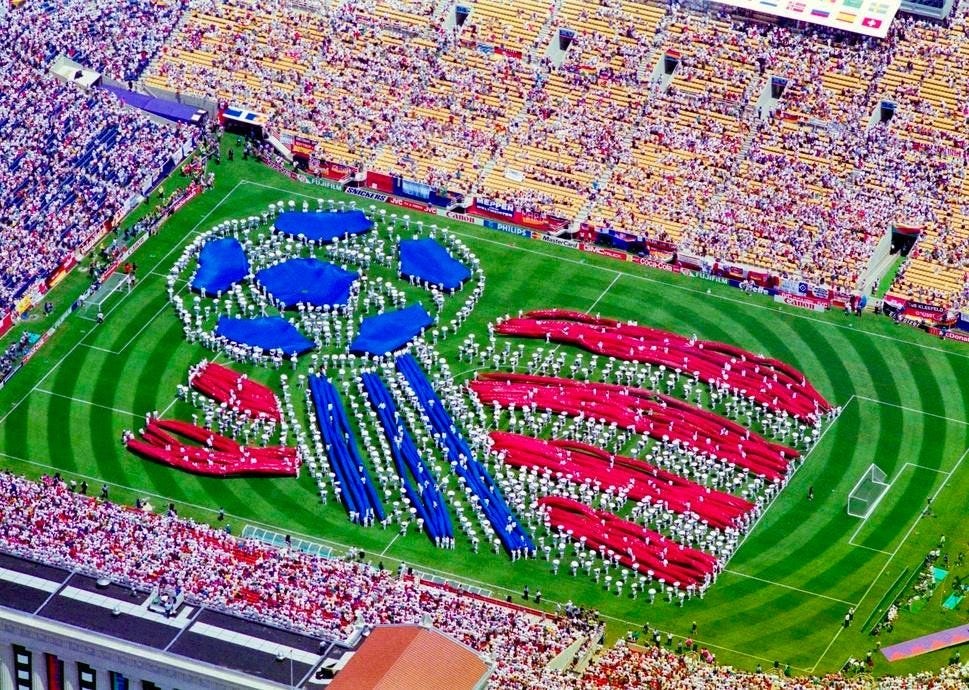
Aerial view of the World Cup logo formed by artists during the opening ceremony for the 1994 FIFA World Cup Final on June 17, 1994 at Soldier Field Stadium in Chicago, Illinois, United States. (Photo by Todd Rosenberg/Allsport/Getty Images)
Getty Images
Taylor Swift’s Eras Tour was a smashing success, but by no means sparked domestic or global economic growth. The opposite is more likely. More on the Swift tour in a bit.
For now, it is useful to point out an obvious truth that gets lost in Keynesian economic religion: No act of saving ever takes away from demand. All demand is a result of production, so unless producers are literally stuffing the consumable fruits of their labor into coffee cans, their production is reflected in consumption.
This is worth remembering amid perhaps reasonable World Cup excitement. A recent one New York Post heading told a predictably bogus story: “World Cup expected to spark a $45 billion global economic boom – like the ‘Taylor Swift effect’ on steroids.” Okay, total nonsense.
Without throwing cold water on the Eras Tour or the World Cup, there will be no global economic boom from the latter, except in the false measure of economic health that is Gross Domestic Product (GDP). GDP is a creation of Keynesians who believe that economic activity is driven by consumption. No, consumption is the result.
If consumption were the driver of economic growth, then the world economy would always be booming. This is because as humans, our desires are limitless.
What the Keynesians miss is that while our wants are unlimited, our ability to fulfill our wants is extremely limited. Yes, we can only consume as much as we have produced first. And the less we produce, the less we can consume.
It’s a simple reminder that consumption doesn’t fuel economic growth simply because of growth it has already happenedso the consumption. To suggest, as economists who worship at the altar of GDP (ie 99.9999% of GDP) do, that it will increase thanks to $45 billion in global spending on the World Cup is double counting. Sorry, but all the projected spending amid World Cup excitement in stadiums, sporting goods stores, bars, restaurants, airports, hotels, t-shirt shops and everywhere else is a result of economic growth that has already happened.
To be clear, it’s a beautiful development result, as was all the consumer excitement surrounding the Eras Tour. The brilliant message of the demand for tickets to see Taylor Swift AND all things World Cup is that thanks to an increasingly liberalized global economy, the people of the world have increasing amounts of wealth to consume for the comforts of life. Again, beautiful.
Nevertheless, it is the beautiful “seen” of the production.
Just the same, the “invisible” of all excessive spending on Seasons and the World Cup is the saving that wasn’t made. Regarding these savings, they in no way detract from consumption. Banks, brokerage firms and financial intermediaries do not rent savings, nor do they save to look fondly on money.
What is saved is either loaned out to others who might want to see Taylor Swift or football, or loaned out to businesses with an eye on hiring and other growth initiatives, or invested in entirely new ideas that, in automating previously human operations, will increase production even more and, with it, even greater amounts of consumption.
This is why this opinion piece speculates that the cost effect of growth in the form of high demand for all things Swift and World Cup is a relative sleeper growth as opposed to a promoter. Nothing against consumption always following production, but there is consumption at concerts and football, or the diversion of savings to new ideas that expand the economy. The difference between the two speaks to differences in economic growth that likely signal reduced growth due to Seasons and the World Cup.
