




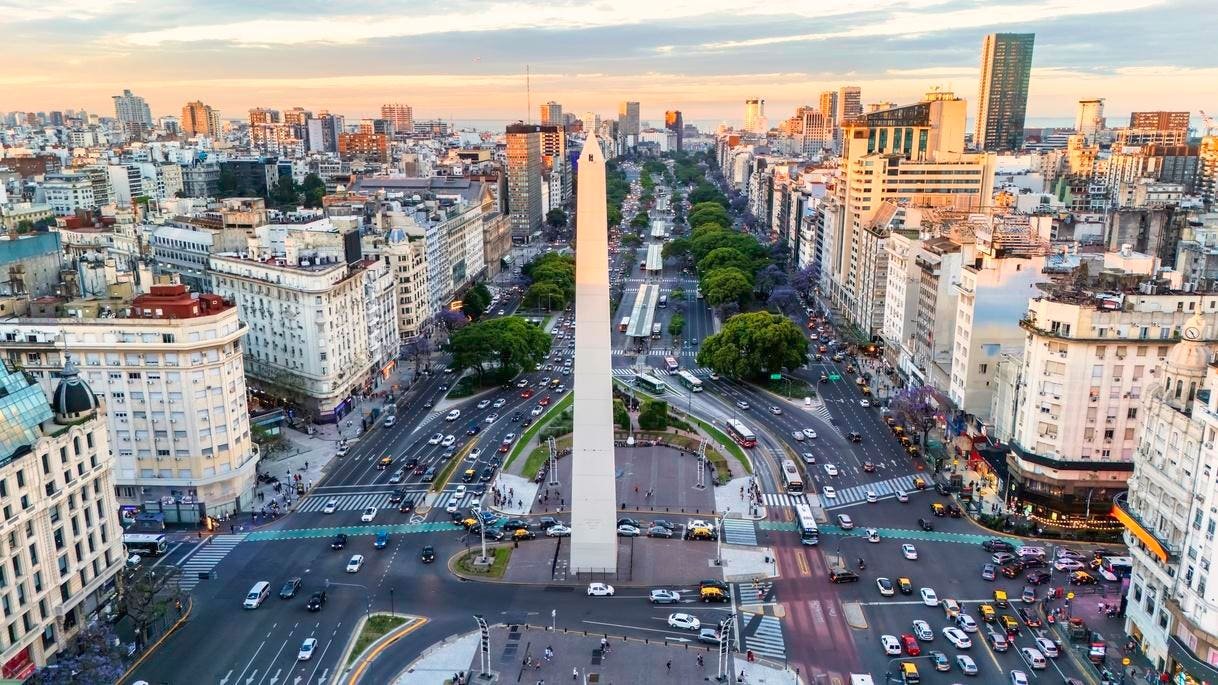
Photograph of downtown Buenos Aires, the ‘Paris of South America’. Could Argentina become a new Plan B for Americans looking for a second spare home?
getty
For decades, Americans looking for a second home—or a second passport—often focused on Europe. Portugal, Spain, Italy and Malta attracted retirees, digital nomads, entrepreneurs and families looking for a better quality of life and an insurance policy against political or economic uncertainty at home.
The landscape is changing.
Portugal recently doubled the naturalization timeline for many non-European applicants from five years to ten. Spain suspended the golden visa program. Italy has stricter citizenship by descent rules. Malta’s citizenship-by-investment scheme has been effectively struck down by the European courts.
In this context, one country is increasingly standing out as an overlooked alternative: Argentina.
And at the center of the attraction is Buenos Aires, often called the “Paris of South America.”
With elegant European-style architecture, café-lined boulevards, vibrant nightlife, a comparatively low cost of living and a path to citizenship that can be started after just two years of legal residence, Argentina is quietly becoming one of the most interesting expats destinations in the western hemisphere.
However, what really separates Argentina from many competing destinations is its immigration policy.
Lawyer Martín Hecht of Argentina.
Martin Hecht
Argentine Immigration Policy
According to Buenos Aires immigration lawyer Martín Hecht, Argentina’s citizenship framework remains unusually accessible. According to Argentina’s Law 346, foreign residents can apply for citizenship after two years of continuous legal residence. This timeline is remarkably short by international standards.
There are several common existing immigration paths available that may result in citizenship. One of the most popular is the rentista visa, designed for people with passive monthly income. In many cases, applicants can qualify by demonstrating an income equivalent to approximately US$1,500 per month.
Digital nomad visas are another growing category, particularly attractive because Argentina’s time zone closely aligns with North America, making remote work relatively easy for Americans and Canadians.
There are also work visas, family reunification pathways, student visas and transitional visas. However, these visas are generally stepping stones and not permanent solutions. Most long-term migrants eventually transition to temporary residence and later to permanent residence. After accumulating two years of uninterrupted physical presence in Argentina, as mentioned, they may become eligible to apply for Argentine citizenship.
Healthcare is one traction. Argentina has a well-developed private health care system available at a comparatively affordable monthly cost, making it particularly attractive to retirees and remote workers alike.
Importantly for Americans, Argentina de facto allows dual citizenship, meaning that many applicants do not necessarily have to surrender their US citizenship.
Jennifer Farquharson, Canadian lawyer in Buenos Aires
Andy Semotiuk
Jennifer Farquharson, a Canadian lawyer with the Norte Sur Group in Buenos Aires, noted that “Argentina’s new Citizenship by Investment (CBI) program is in its final implementation phase with an expected launch in late 2026. The program will offer qualified foreign investors a direct path to Argentine citizenship and a very strong passport.” He added, “If it collapses, the game changer will be the amendment to Argentina’s National Tax Code, which removed automatic tax residency for naturalized citizens under the program.” *
The potential new policy is similar to the US EB-5 green card program aimed at attracting foreign investors to stimulate the economy.
However, according to recent reports from Rueters and IMMilei’s management wants to be readmitted to the US ESTA (Visa Waiver) program. The point is that the US and the IMF do not love citizenship by investment programs. Thus, for Argentina, remaining in the G20 with a “strong passport” and US visa-free entry must be balanced against continuing the CBI program. We’ll see what happens here.
Not perfect but good enough nonetheless
Of course, Argentina is not perfect.
The country struggles with inflation, political instability and periodic economic crises. Knowledge of the Spanish language is useful, especially during official immigration procedures. However, many Argentinians speak some English, which makes things easier. As always, however, living abroad always requires adaptation and patience.
But for many Americans increasingly frustrated by rising costs, worries about crime, social polarization and long wait times to immigrate elsewhere, Argentina offers something increasingly rare: opportunity combined with lifestyle.
An American from Cleveland
For an American from Cleveland, Ohio, this opportunity was life-changing.
Photo by Mike Nearshore
Mike Nearshore
Mike Nearshore first visited Argentina at the age of 24 after a friend convinced him to travel there. At the time, Mike was selling Buick cars in Cleveland and had never seriously considered moving overseas.
Then he arrived in Buenos Aires.
On his first night, he attended a party in Palermo, one of the city’s trendiest districts. About fifty people were there. What immediately struck him was how welcoming everyone seemed.
“Every single person came up and introduced themselves,” he recalls.
That first night changed the course of his life.
Mike described feeling something in Buenos Aires that he no longer felt in the United States: freedom, peace, security, and optimism.
He was struck by how clean the city felt and how comfortable people were walking around late at night. He enjoyed the coffee culture, the slower pace of life and especially Argentina’s famous asado barbecue tradition.
Most importantly, he felt comfortable.
Back in Cleveland, Mike realized he no longer wanted the life he was living. He worked for another six months to save enough money for a one-way plane ticket and returned to Argentina determined to give the country a chance.
Initially, his plan was simple: stay three months and see what happened.
What happened was that it never really left.
Mike shared an apartment with his friend Donnie in Palermo, the neighborhood where many foreigners and Americans settle. He joined a basketball team, made friends and eventually met a girl. While living there, he worked remotely as an account executive for a UK-based AI company, effectively becoming a digital nomad. He later found full-time employment in Buenos Aires.
Today, Mike has his own apartment, a stable relationship, a circle of friends and a life he says he never imagined possible.
Preferring Argentina
The reasons he gives for preferring Argentina are clear.
First, he says the cost of living is dramatically lower than in the United States. Rent, food, entertainment, transportation, and healthcare can all be significantly cheaper than in major American cities.
Second, he appreciates the social atmosphere. Argentinians, especially in Buenos Aires, are known for their warmth, sociability, and emphasis on friendships and family life.
Third, Mike repeatedly emphasizes the sense of personal safety and peace of mind he experiences there.
“Walking down the street is not a threat,” he explained.
Buenos Aires itself plays an important role in Argentina’s appeal.
The city looks like a mix of Paris and Madrid more than what many imagine Latin America to be. Grand boulevards, French-inspired apartment buildings, historic cafes, bookstores, tango clubs and leafy neighborhoods give the city a distinctly European character.
With approximately 4.5 million residents in the city and approximately 10 million people flowing into the metropolitan area during working hours, Buenos Aires is large enough to provide world class amenities while maintaining a strong neighborhood culture.
Palermo—particularly Palermo Hollywood and Palermo Chico—has become especially popular with foreigners, remote workers, and younger expats. Restaurants, co-working spaces, parks and nightlife make it attractive to people looking for affordability and quality of life.
Outside of Buenos Aires, Argentina offers remarkable geographic diversity.
Mendoza, near the Andes mountains, enjoys about 300 days of sunshine a year and produces much of the country’s famous Malbec wine. Patagonia offers glaciers, mountains and some of the most spectacular natural scenery in the world. Iguazú, to the north, features subtropical rainforest and world-famous waterfalls.
Mike’s story shows why the country is attracting attention.
What started as a vacation became a permanent move, a new relationship, a new career path and possibly, eventually, a second passport.
For him, Buenos Aires was not just another destination.
It became home.
* In an earlier version of this article, Jennifer Farquharson was incorrectly cited as the source of a report that Milei’s administration wanted her readmitted to the US ESTA (Visa Waiver) program. In fact, the information came from Reuters and IMI, not her. Additionally, Farquharson’s quote in this story omitted her comment on the benefit of the recently approved amendment to Argentina’s National Tax Code. These errors have been corrected in this revision of the article and we apologize to Ms Farquharson for the misquotes.
