




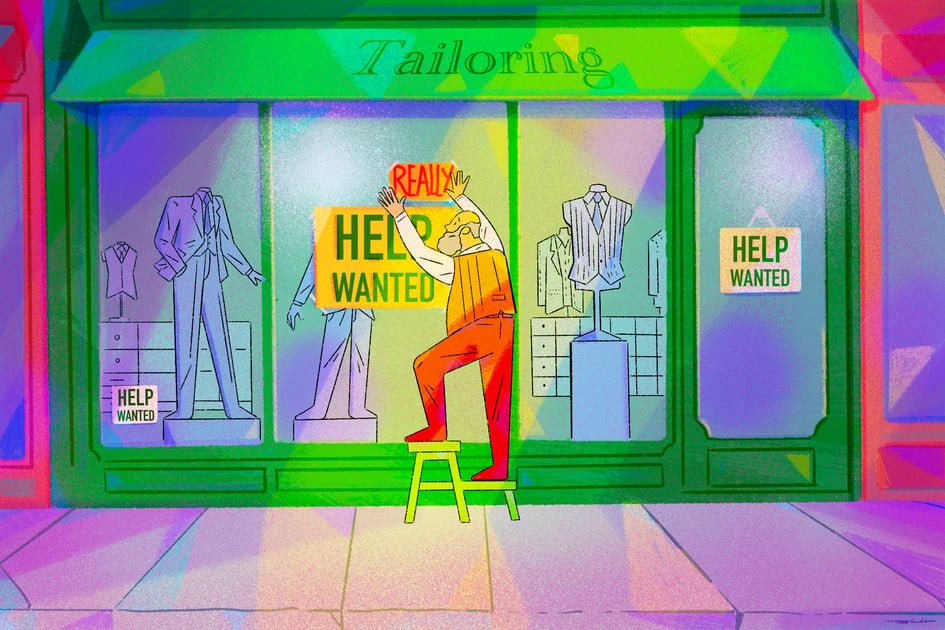
The National Federation of Independent Business, for example, found in it January 2026 report that 88 percent of small businesses looking to hire workers reported that there were few or no qualified candidates to fill open positions.
Economic theory—and common sense—suggests an easy solution for these employers: offer higher wages. But in many cases, companies don’t bite. “There are people looking for work,” he says Benjamin Friedrichassociate professor of strategy at Kellogg. “If companies say they can’t find workers, there’s a price that could clear that market.”
To find out why many companies don’t take this approach, Friedrich—along with his colleagues Alison Zhao, also of Kellogg, and Michal Zator of the University of Notre Dame—created a mathematical model to identify the potential forces driving these restrictions at work.
The researchers found that the most likely reason for companies’ hiring difficulties is their own inaccurate understanding of the value of open roles. Companies set wages too low to attract workers and then take too long to correct the mistake, which ultimately creates hiring gaps. Friedrich and colleagues found that this explanation matched actual recruitment patterns.
“This inefficiency could really hurt productivity – it could mean the wrong companies are struggling [to hire]says Friedrich. In other words, if poorly managed companies can’t fill vacancies, that’s one thing — but if even healthy businesses shoot themselves in the foot, “that’s a loss for the overall economy.”
Possible explanations
Friedrich and his colleagues started by creating a mathematical model that focuses on a well-understood phenomenon that causes recruitment difficulties: “search frictions.”
This term refers to the fact that a company looking to fill a vacancy “can’t see all the possible candidates [for the job] at the same time,” explains Friedrich. Because every qualified candidate doesn’t promote themselves for every opening, companies have to work with what they get. Sometimes, this is not a good thing, which causes jobs to go unfilled.
However, search frictions did not provide a good enough explanation for the recruitment difficulties that the researchers observed in the real world. According to this version of the model, slow-growing firms with lower wages will face the most hiring difficulties. But when the researchers analyzed data from Germany’s Federal Employment Agency, which surveyed about 40,000 businesses between 1993 and 2019, “it was just the opposite,” says Friedrich. The evidence showed that fastest growing Companies had the most trouble—and longer searches were associated with higher wages, not lower.
This mismatch told the researchers that something was missing in their model, so they added three new factors to see if they could better explain why companies often don’t raise wages to fill open jobs.
The first factor suggests that a firm may not advertise higher wages for an opening to avoid increasing employee demand.
The second notes that it is very difficult to reduce wages once they have been set at a certain level. This can make businesses reluctant to offer high wages to attract job seekers.
The third factor reflects that companies may not have information about the other job options that candidates may have. If a company does not know that potential candidates may be making other offers for better pay, it will not feel the need to raise wages for its own vacancies.
Too low, too late
When the researchers plugged these three factors into the model, its predictions fit real-world data much better.
First, the model correctly predicted that firms would delay raising wages in order to fill “peripheral” roles less related to their core business. An auto manufacturer, for example, may know much less about how to successfully hire an accountant than it does about hiring technicians, Friedrich says. “These [might have hired an accountant] five years ago, and now who knows what the continuing rates are?’
The model also accurately predicted that the less concentrated a firm’s potential workforce, the more difficulty it would have in setting an attractive wage to cover openings. For example, a software company that tends to hire mostly software engineers has a highly concentrated workforce. And the company may have an easier time realizing it needs to raise wages when it can’t find the skilled workers it needs.
However, a restaurant looking to hire wait staff will likely be competing with other types of businesses, such as warehouses and retail stores, to hire less skilled job seekers. This lower concentration of labor means that any of these companies are less likely to learn how to set wages at a level that will quickly fill openings. They are also slow to raise those advertised wages in response to hiring difficulties.
This is especially difficult for smaller companies. “The big companies are pretty well informed,” says Friedrich. “It’s the smaller mom-and-pop shops, maybe the smaller retail stores or some similar lower-skilled workplaces, that don’t immediately get the message.”
Friedrich says their model’s predictions, validated by patterns in the survey data, tell a clearer story about why companies often don’t raise wages to prevent or quickly resolve hiring difficulties: Faced with uncertainty, firms choose low starting wages to avoid overpaying, then slow to update those offers. This “information friction” prolongs hiring gaps, including among attractive firms, and can lead firms to ultimately set wages even higher than they might have if they had acted earlier.
“Maybe I don’t know how tough the competition is out there – and because I don’t want to overpay, my strategy is to feel the temperature of the market first by offering a low salary,” explains Friedrich. “If they reject me, I will adjust the wages gradually. But I will struggle [to fill vacancies] in the meantime, and I’ll end up paying more in the end anyway.”
Salary intelligence is needed
Friedrich sees the research as proof of concept for the role of information frictions in job constraints. He hopes other researchers will study them further.
“The next wave of research can look at specific segments of the labor market and ask how strong the friction is,” he says.
In the meantime, businesses hoping to improve their hiring can start by investing in “salary intelligence” tools and services to get up-to-date information on competitive pay rates. These services can be expensive, but are often worth the cost, especially for fast-growing companies. “Access to this information is very important when you have a lot of profit opportunities now,” says Friedrich.
Meanwhile, policymakers could provide more timely and comprehensive public reporting on wages, as well as support wage transparency legislation—both of which would make wage information more accessible to businesses that cannot afford to pay for it.
“Public wage statistics are so crude and quite backward,” says Friedrich. “They make life quite difficult for smaller businesses. The private sector is showing that it is possible to collect more information in real time, so I think more could be done.”
