











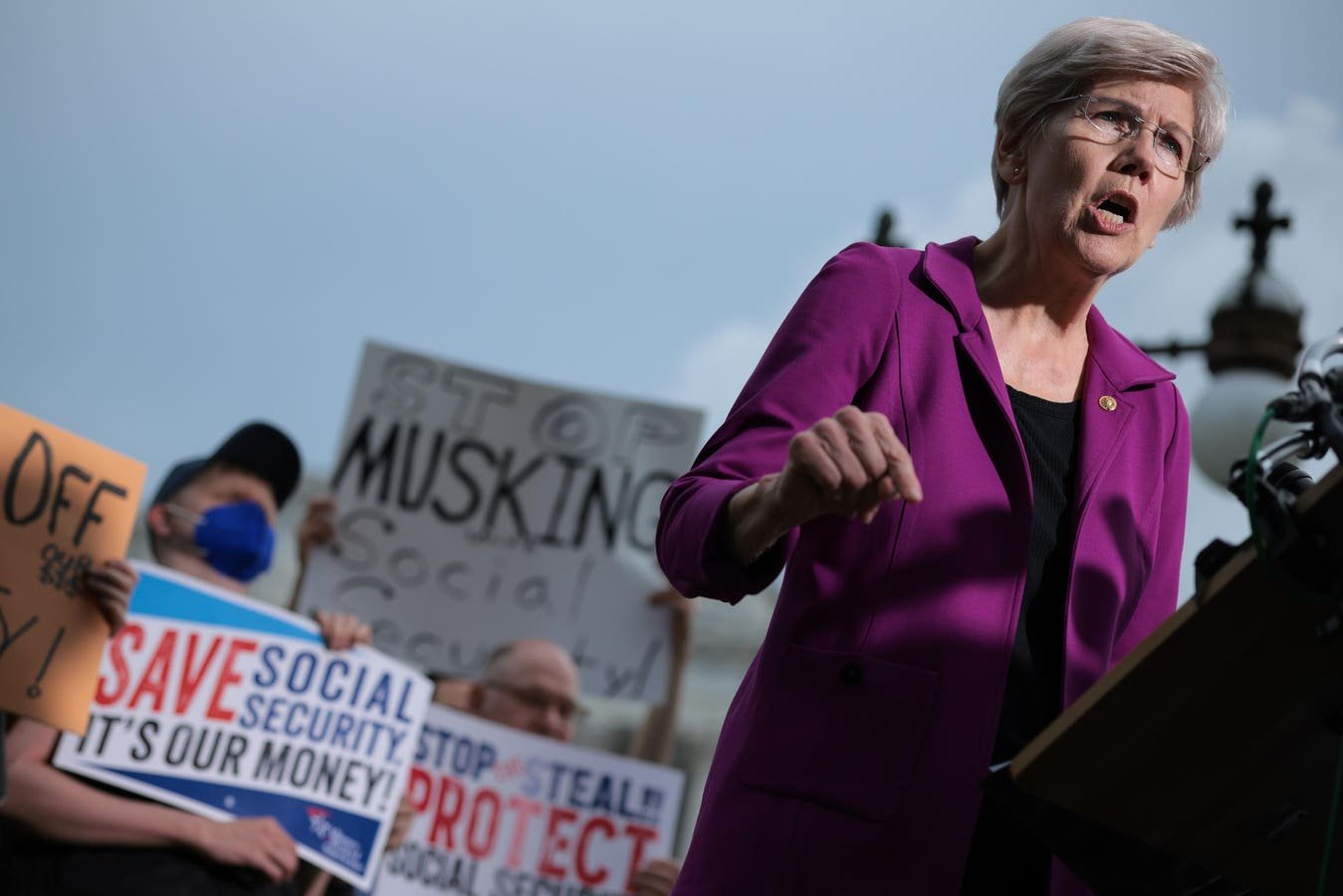
WASHINGTON, DC – MAY 05: US Senator Elizabeth Warren (D-MA) speaks during a press conference on Social Security in front of the US Capitol on May 5, 2025 in Washington, DC. Democratic members of Congress have spoken out about how President Donald Trump and Elon Musk’s Department of Government Efficiency (DOGE) cuts are affecting Social Security. (Photo by Kayla Bartkowski/Getty Images)
Getty Images
Social Security might have been a good idea in 1936, when the elderly faced the collapse of asset values in the Great Depression—including the devaluation of their bank savings in 1933—while their grown children were also out of work and struggling to feed their own children. The initial tax rate was 1% paid by both employer and employee, or 2.0% combined. It reflected a world in which about 6.3% of the population was over 65, compared to 18.9% today, or 22.0% in 2040.
It might have been a good idea in 1950, when the ratio of payers to payees was 16.5:1 and the tax rate had risen to 3.0% combined.
But it’s certainly not a good idea in 2026 or for the foreseeable next fifty years. Currently, there are approximately 2.7 workers paying into the system for every beneficiary. By 2035, this is expected to drop to 2.3. The combined payroll tax to be paid on this is now 15.30%, not 3.0% in 1950. But that doesn’t cover the bill. Income from payroll taxes covered 91.2% of spending in 2024, and that percentage will decline. The Social Security system itself draws from its retirement savings, as it has since 2010.
Very soon the Social Security retirement fund (known as the Social Security trust fund) will run out. The Congressional Budget Office now expects that Trust Fund to be depleted by 2032, at which point taxes will either rise or benefits will be cut, by as much as 28%. But this “Trust Fund” is itself a figment of Congress’s imagination. It’s basically a commitment by the Federal Government to fund Social Security payments. Since the Federal Government already runs a large deficit, the only way to finance them is to issue more debt. So, indirectly, Social Security is already financed by debt issuance. There is no external “capital supply” from which it draws.
Today, this is a fundamentally insane system. Most Social Security recipients do not need it. Boomers today are the wealthiest generation. The biggest Social Security payments go to those who paid the most into the system – in other words, the people who had the highest earnings during their careers and who likely have the most assets and other resources to draw on in retirement.
As push comes to shove, you’ll hear more and more talk about how to “fix” Social Security — such as recent proposals to lift the cap on top earners. The Tax Foundation called this “Biggest tax increase in decades – and still wouldn’t save Social Security.” Another “fix” would be to issue a lump sum payment, a kind of universal basic income for older people, which would have the effect of reducing payments to people who probably need it least – those who had the highest incomes during their working years.
But I think we need to forget all this talk about “saving” and “fixing” something that is basically insane – 2.3 workers per pensioner – and completely inappropriate for the current and foreseeable situation.
I suspect Social Security they will basically go up in flames through a process of initial state bankruptcy leading to currency devaluation – a pattern that is already quite evident today. The US federal government, despite having deficits of 6% of GDP for the foreseeable future, she will never default on her debt. But the currency can lose value, as it has already lost value, but even more so when things get serious.
Basically, the US Social Security system may end up like the Soviet pension system. You still get paid, but the money is no longer worth anything. In other words, just like today, but much more.
The likely replacement would be some sort of “provident fund” system, basically a sort of universal 401(k) system invested in real-world private sector assets. There would be no more payroll tax (as we know it) and no social security. There may even be some kind of need-based welfare program for the elderly. This combination of a main Provident Fund system, with a back-up social welfare system, is already common worldwide, including systems in Singapore, Mexico, India and … Kenya.
By one calculation, if retirees today could invest in a private sector account the same amount of money they paid in payroll taxes during their working lives, the average account would be worth about $3.7 million today and would pay about $15,523 a month – and when you die, the remaining assets would go to your children, who would add them to their own private accounts, making the pile of wealth even bigger. That’s perhaps a little too rosy, given that US stock values are around their highest in history. However, it shows how much better a private account could be.
Not everyone would enjoy such benefits. But even if things weren’t as good in the future – even if they were only 25% as good – they’d still be pretty good. There wouldn’t be many people who were somehow lagging behind.
Presumably, this would require some sort of legal structure that protects these investments for a person’s entire working life. They would not be untouchable in divorce, bankruptcy or other legal challenges or fraudsters. It must last until the age of 65 and beyond. Whether pension fund contributions would be “compulsory” (like payroll taxes today) or not, or what the contribution rate should be, is another interesting question. We could leave the setting of a mandatory levy rate to state governments, further removing the federal government from the whole business.
However, I believe we should see a move away from relying on financial assets for 20+ years of retirement overall. Disasters happen. The question of what to do with the elderly has been part of human society forever – even back to the hunter-gatherer days. And the answer has always been the same: The elderly live with their grown children or extended family, while some rely on other sources, such as church charity. Somewhere between the death of the old system – including Social Security – and the birth of the new, we may see a revamp of this ancient pension plan. This is it what happened across Russia and Eastern Europe in the 1990s after the collapse of the Soviet Union – and that might not be a bad thing.
All of this can help us return to the Founders’ vision of Limited Government – a United States with no payroll taxes and no income taxes. The Federal Government, which today is basically a big fire engine that siphons money from workers and hands it to the elderly (Social Security and Medicare), would again follow its constitutional mandate to get out of the welfare business altogether. That’s cheap: In 1913, the federal government spent about 2.5% of GDP, compared to about 23% today. With such low spending needs, the entire bill could be covered by a modest federal sales tax or, even better in my opinion, little federal VAT of about 4%.


