










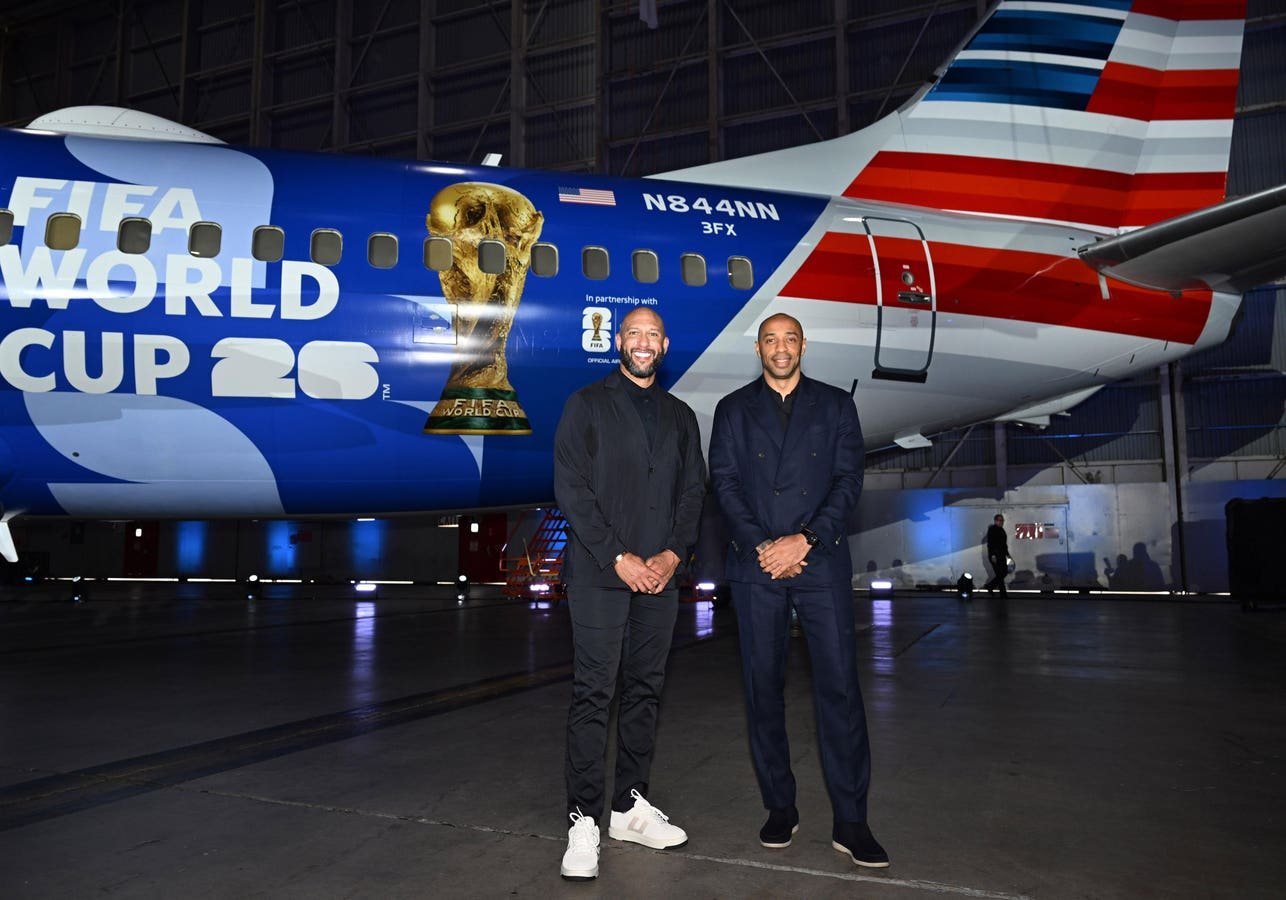
MIAMI, FLORIDA – APRIL 02: (LR) Tim Howard and Thierry Henry celebrate American Airlines as the Official North American Airline Supplier of the FIFA World Cup 26™, in partnership with Qatar Airways at Miami International Airport on April 2, 2026 in Miami, Florida. (Photo by Michael Simon/Getty Images for American Airlines)
Getty Images for American Airlines
Every day, hundreds of posts flood my inbox and it’s my job to give each one a look. Most are thrown in the trash. But every now and then, one catches my eye, like a note from CreatorIQ about which brands are winning the World Cup. The usual suspects were there: Adidas, Nike and Puma, in that order. What I didn’t expect to see was Cole Haan and Dior as the first winners on the list.
This got me curious: What role do these luxury brands play in the World Cup and how did they come out on top in terms of public opinion around it? And if Dior and Cole Haan are breaking even, what other luxury brands are leveraging the World Cup to reach consumers? Alex Rawitz, Head of Research and Insights at CreatorIQ, kindly obliged to answer my questions.
Because FIFA strictly controls which brands can officially appear at the World Cup, luxury brands have come up with a solution: tap the networks of social media creators. And luxury brands—creators of culture in the broadest sense—can’t afford to miss out on what’s shaping up to be the ultimate cultural event of 2026.
“The World Cup goes beyond football or sports in general,” Rawitz explained. “It’s a stage for culture and storytelling, creating moments and discourse that are remembered for generations. Of course, every brand in the world wants a piece of the pie.”
Traveling in luxurious style
Chanel, Louis Vuitton, Hermès and Dior struck gold with creator posts documenting what the players wore and carried as they headed to host cities in the US, Canada and Mexico. “The result has become the luxury industry’s equivalent of the Met Gala, generating millions of earned impressions for luxury brands,” said CreatorIQ.
The defining moment when the airport became the new red carpet happened as the French national football team took off from Le Bourget airport. Chanel took top honors, setting the record for the post with the highest EMV across the luxury dataset with a TikTok post that generated more than 700,000 impressions and $109,000 in EMV. Overall, Chanel followed Dior as the number two World Cup brand by EMV, earning over $500,000 with 3.8 million impressions and 315,000 engagements.
And it wasn’t just the French team that made the best dressed list. Spain’s Lamine Yamal opted for a Chanel jacket and handbag, while Portuguese star Cristiano Ronaldo arrived in Gucci and Norway’s fan favorite Erling Haaland carried a limited-edition Hermès Birkin “Endless Road” bag.
“For luxury brands, player arrivals have become one of the most valuable uncontrollable media moments in the fashion calendar,” CreatorIQ reported. “Brands with strong affinity with athletes, whether through official ambassador relationships or simply cultural alignment with style-conscious players, should treat tournament arrival windows as strategic earned media opportunities.”
Burberry scores by activating its social network
Burberry, the English luxury brand, left nothing to chance. CreatorIQ noted that it “stands out as a luxury house that has proven to run a World Cup-specific paid creator campaign.”
England midfielder Morgan Rodgers became the focus of Burberry’s strategy through a Dizzy magazine profile that positioned him as a new kind of English footballer — and dressed him head-to-toe in Burberry. This feature, along with Teen Vogue featuring Thai actor and Burberry brand ambassador Bright Vachirawit as a soccer fan, took Burberry to number three in EMV at $496,000 with over 5 million impressions.
“Burberry’s World Cup strategy proves that luxury brands don’t need official FIFA partnerships or mass market ambassadors to generate meaningful creator EMV at a major tournament,” the company explained. “What they need is the right athlete and a credible editorial voice.”
Marc Jacobs goes to Dallas
Marc Jacobs — recently sold by LVMH to WHP Global and G-III Apparel Group — anchored its World Cup retail activation at its Dallas store near AT&T Stadium that hosts World Cup games. The brand’s NorthPark Center store enticed in-store shoppers with limited-edition soccer ball-inspired bags representing various World Cup countries, including the Netherlands, Japan, England and Argentina. The totes were not available online.
In addition, Marc Jacobs dressed six USA players along with fashion model Imaan Hammam for one Fashion spread photos, adding cultural cache to both the team and the brand. To date, Marc Jacobs has generated 2 million impressions and $200,000 in EMV across the World Cup.
CreatorIQ observed that the brand’s NorthPark retail activation “demonstrates a scalable model for luxury brands to create host city EMVs at major sporting events: a product activation that is geo-specific, tournament-relevant and designed to be photographed.”
Yves Saint Laurent makes history
“The luxury brands that generate the most buzz on social media do so because athletes and creators organically choose them,” said CreatorIQ. “This represents both an affirmation of the strength of the brand’s long-term value and a signal of significant unrealized opportunity.”
Yves Saint Laurent was one brand that didn’t let this opportunity go unfulfilled — and it did so in an unexpected way. In 1998, YSL staged a catwalk show at the Stade de France before the France-Brazil World Cup final. Creators resurrected that memory by publishing content around this historic event that demonstrated the brand’s long-standing sporting good faith. YSL generated $466k in EMV and 2.6 million impressions at this year’s World Cup, capitalizing on a real moment long before social media arrived on the scene.
“As the soccer-fashion discourse reaches an all-time high, brands that have genuine historical intersections with the sport are finding these strengths spontaneously reactivated,” the company explained.
World Cup 2026 Cultural moment
CreatorIQ provides the data that shows which brands are winning the social media world cup across the creator ecosystem. But the bigger story is the cultural context: luxury no longer sits outside or alongside sport. Sport has become an arena where luxury brands create identity, aspiration and belonging.
“Sports stopped being a luxury sponsor and started being something that lives within luxury,” said Federica Levato, senior partner at Bain & Company. “More than a third of luxury consumers already view major sporting events as status-driven social occasions.
“It all fits into the biggest change: luxury is being redefined around lived moments rather than objects, with experiences now outnumbering goods by around one and a half times. A World Cup is no longer a media market: it’s a stage where brands compete to feel the life worth living,” he concluded.
See also:


