




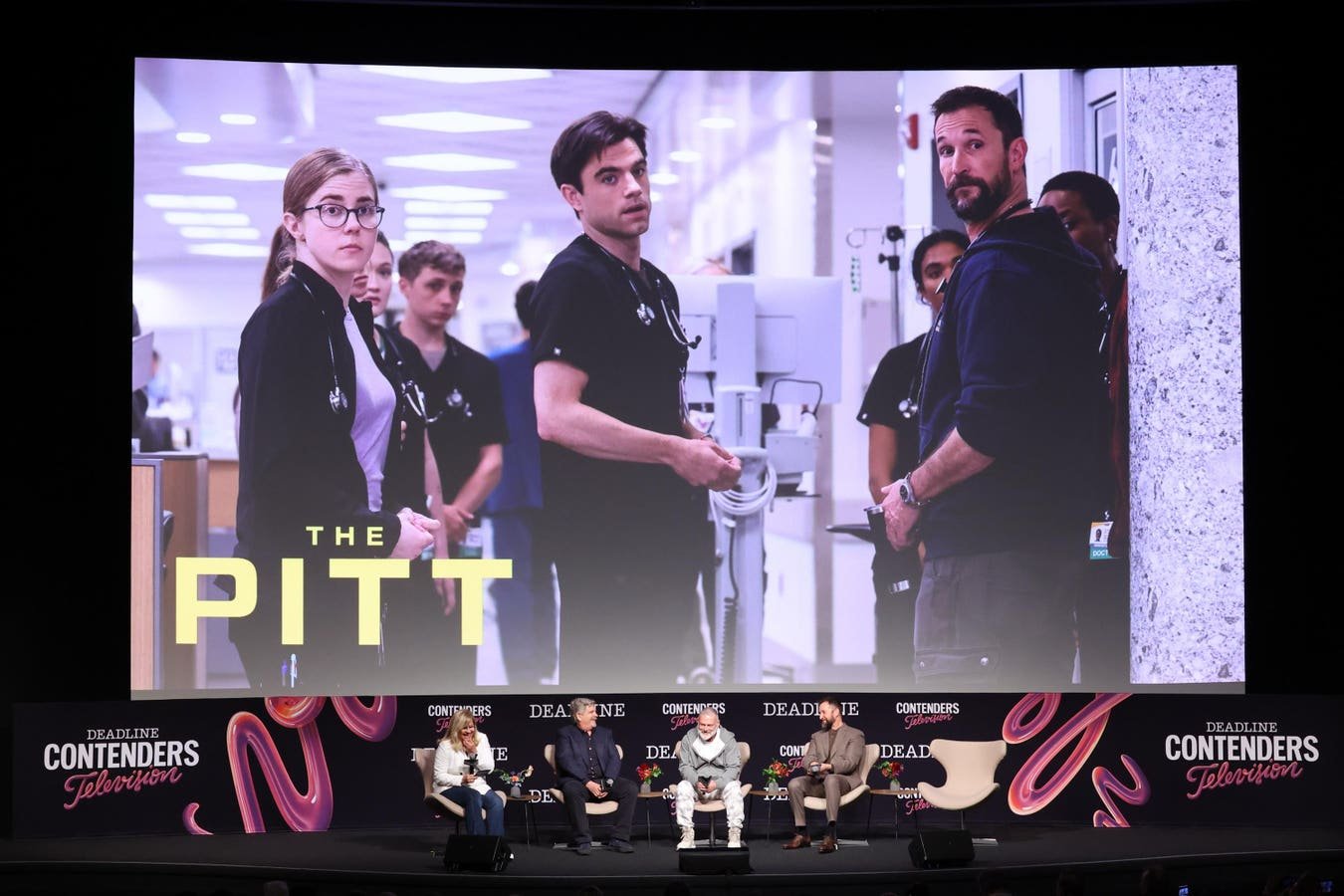
Lynette Rice, John Wells, R. Scott Gemmill, Noah Wyle speak at a panel about “The Pitt” at Deadline Contenders Television 2025 held at the Directors Guild of America on April 5, 2025 in Los Angeles, California. (Photo by Rich Polk/Deadline via Getty Images)
Deadline via Getty Images
Every week, millions of Americans volunteer an hour to watch health-related stories.
No other public health campaign reaches so many people, gets so much attention, or holds it for so long. Although we don’t think of television as a public health intervention, we should.
“The Pitt” has been recognized as one of the best dramas on television, with 25 Emmy nominations. Regardless of how many awards it ultimately wins in September, the series has already accomplished something more meaningful: It has helped millions of Americans prepare for some of life’s most difficult moments.
Public health professionals have always relied on science to discover what saves lives. We study disease, evaluate interventions, communicate risk and develop evidence-based recommendations to help people live longer, healthier lives.
Facts tell us what to do, but stories give us the courage to do it.
This is why television has become one of the most powerful—and most neglected—interventions in the nation’s public health. Every year, public health agencies spend billions of dollars trying to help Americans make healthier decisions. We publish reports, launch awareness campaigns, produce public service announcements and build websites.
These efforts matter, but information alone rarely changes people the way stories do.
For decades, television has quietly done what public health often struggles to accomplish: it has turned information into understanding, empathy, and action.
Long before streaming services and binge-watching, television became America’s health classroom. the “very special episodes” of the 1980s and 1990s introduced families to conversations many struggled to have themselves. Smoking. HIV/AIDS. Drunk driving. Eating disorders. Teenage pregnancy. Sexual assault. Suicide. Substance use.
These episodes weren’t just training. they gave the families permission to talk. Parents and children watched together. They discussed difficult topics around the dinner tables. Sometimes they disagreed. Sometimes they cried. But millions of Americans were learning—not from lectures, but from stories.
Then came ‘ER’.
For 15 seasons, viewers welcomed the doctors into their homes every Thursday night. Along the way, they learned about trauma systems, organ donation, HIV, emergency contraception, medical ethics, disaster response, physician burnout, and the extraordinary complexity of emergency medicine.
People didn’t need to attend medical school to better understand health care. They were just watching TV.
For two exciting seasons, “The Pitt” carries on this tradition with remarkable authenticity.
He refuses to romanticize medicine. Instead, it invites viewers into the realities that clinicians face every day: overcrowded emergency departments, violence against health care workers, addiction and mental illness, the evolving landscape of reproductive health care, workforce shortages, false and misleading health information, and the emotional toll of patient care.
One episode in particular demonstrates why stories can accomplish what facts alone cannot. In it, ER nurse Dana takes care of a woman who has been sexually assaulted.
The audience witnesses a forensic examination of injuries with extraordinary compassion. Every step is explained, consent is repeatedly sought, and the patient remains in control of every decision. The health care team protects not only the physical elements, but also the dignity.
Public health professionals have spent decades encouraging survivors of sexual assault to seek medical care. Hospitals have created brochures explaining the Sexual Assault Nurse Examiner programs. Advocacy organizations have produced educational videos. The sites carefully describe each step of a forensic examination.
These resources matter, but none of them can replace the empathy and compassion that millions of viewers experienced by spending an hour with Dana and her patient.
For someone who experiences a sexual assault in the future, this episode may reduce fear enough to convince them to seek medical attention. A parent can better understand how to support a child. A friend may know what to say – or what not to say. A young person may decide to become a Sexual Assault Nurse Examiner because they have seen what dignity looks like in health care.
We’ve seen this before. In 1994, millions of Americans met Pedro Zamora on MTV’s “The Real World: San Francisco.” At a time when HIV remained deeply misunderstood and surrounded by fear, Zamora invited viewers into his life with extraordinary honesty.
When he died of AIDS-related complications just hours after the season finale aired, millions mourned someone they felt they knew personally. Research has shown that in addition to statistics and public service announcements circulating about HIV, Zamora’s appearance increased knowledge and helped reduce stigma, particularly among younger viewers.
But television and Hollywood have not always had a positive effect on health. For decades, Hollywood has glamorized smoking. From Humphrey Bogart and James Dean to Leonardo DiCaprio in Titanic, cigarettes have become symbols of confidence, sophistication, rebellion and romance. What seemed like harmless entertainment was, in fact, behavior shaping.
Research consistently found that teens exposed to smoking in movies were significantly more likely to start smoking themselves. Stories didn’t just reflect culture—they shaped it.
Public health advocates took note. They worked with the entertainment industry to rethink how smoking was portrayed on screen, and the major studios—including Disney—adopted policies that drastically reduced smoking in films intended for children.
The result was not censorship, but an acknowledgment that stories have consequences.
I grew up watching cartoon characters smoke. My kids didn’t.
This cultural shift did not happen by accident. It happened because we recognized that what audiences see on screen affects what they believe, what they accept as normal, and ultimately how they behave.
For decades, doctors, researchers, public health professionals and entertainment leaders have worked together to ensure that when millions of Americans watch a television show, they are not just entertained. They also receive accurate, factual information.
Hollywood, Health and Societya program of the USC Annenberg Norman Lear Center, quietly acts as a bridge between science and storytelling. They offer authors free consultations, expert updates and access to the latest data. THE Entertainment Industry Foundation It also connects the creative community with purpose-driven experts and campaigns that help connect important health issues into compelling narratives.
Perhaps it is time to expand our definition of a public health intervention. We readily recognize vaccines, sanitation, fluoridated water, seat belt laws, and smoke control because they improve health. Narration also belongs to this list.
Businesses understand this instinctively. Companies invest billions of dollars every year telling stories because stories shape consumer behavior. Political campaigns spend billions on creating narratives because stories influence elections.
Public health must recognize the same truth. Facts, science and evidence matter. We may be told what to do, but stories give us the courage to do it.
