











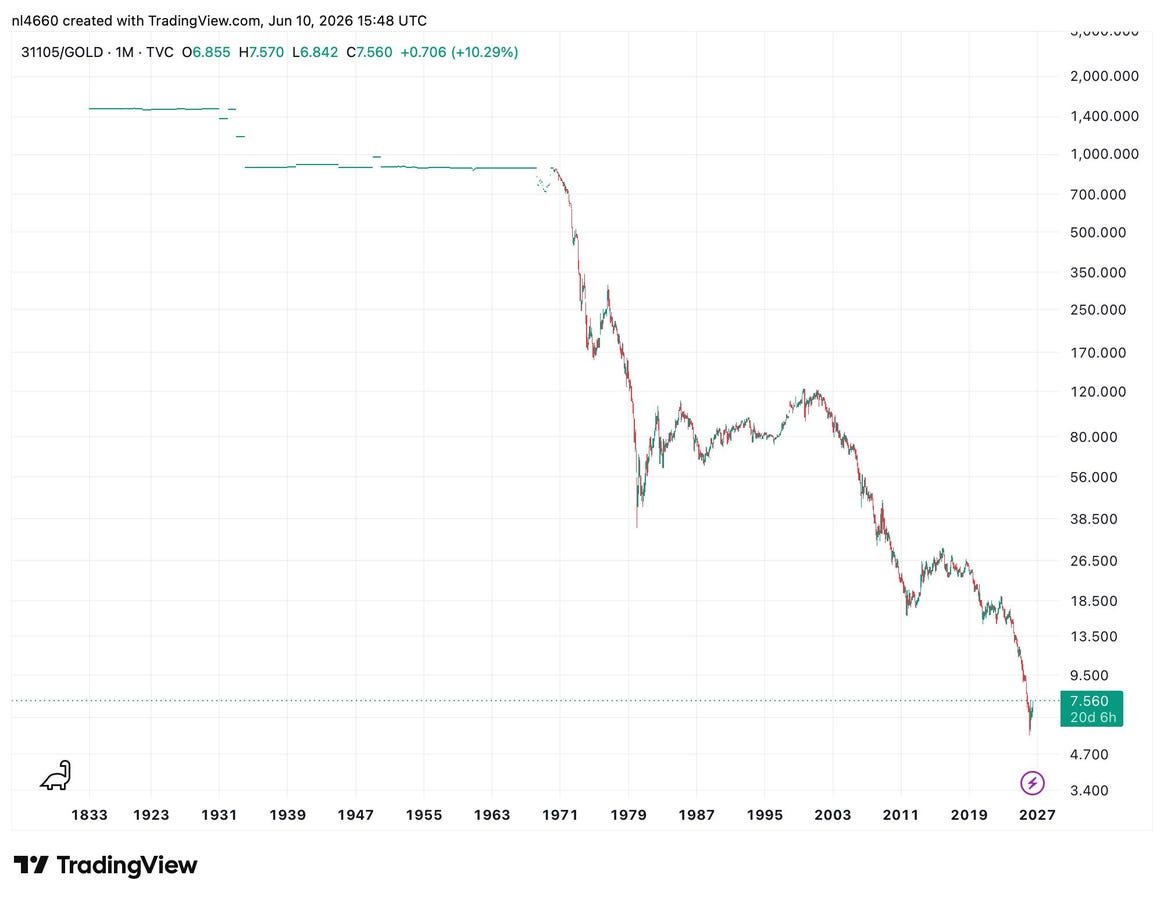
Remember the Federal Reserve’s “2% Inflation Target”? It has been 63 consecutive months since this goal was achieved. In May, the official Consumer Price Index (which has been constantly tweaked since the 1980s to make it look better) was 4.2% higher than last year.
Value of the US dollar, in milligrams of gold, 1900-2026
TradingView.com
But even if the Federal Reserve were able (har!) to achieve this goal, it smells suspiciously like a plan to gradually devalue the currency over time. This makes political sense – a cheaper currency benefits borrowers, at least as long as interest rates do not reflect expectations of continued currency depreciation. Since the government is the biggest debtor, and since many voters are also big debtors, there is a kind of constant political headwind towards the depreciation of the currency.
This CPI target is somewhat informal. It has been mentioned many times, but is not a statutory part of the Federal Reserve process. Other than that element, which added a sense of legitimacy before it became an embarrassment, the Fed is pretty much just making it up as they go along.
This leads to a list of various “rule-based systems”, promoted by various organizations (notably the Cato Institute) who believe they can do better. But can they? I don’t think so.
What is the purpose of floating fiat currencies? Why do they exist? As I describe in My eight-part YouTube series on monetary topicsthe main motivation is macroeconomic manipulationoften turns into state finances. Borrowing of terminology of economist Thomas Humphrey of the Federal Reserve Bank of RichmondI called it the “Mercantilist” approach to money, or the Soft Money Paradigm. There is much similarity with today’s proposals (including those of the Cato Institute) and eighteenth-century mercantilist economists. They will deny it, of course, because it’s embarrassing. But the similarity is there, as Humphrey describes.
Much of what is considered innovation and originality in monetary theory and policy is ancient teaching dressed up in modern forms. Certainly, the increasing application of mathematical modeling has given these concepts greater rigor and precision. Similarly, better data and more robust empirical techniques have improved our statistical estimates of the relevant quantities. However, the basic ideas themselves often remain much the same.
Basically, the mercantilists of the 18th century, and those of today, mostly characterized as some flavor of monetarist or Keynesian, make macroeconomic manipulation their first and highest goal. This is achieved by some sort of manipulable floating fiat currency, possibly accompanied by some sort of deliberate manipulation of the money supply and interest rates. Today, this can take the form of “nominal GDP targeting”, which contains elements of “inflation” and “real economic growth”, which is basically the same as today’s Federal Reserve. “double command”.
Opposite to this is the Classical Paradigm, which aims for a “neutral” currency that is basically an unchanging constant of trade, a fixed “stick” or “numerical”. Practically, this means a currency of constant value. There is a precise definition of currency value.
More than half the countries in the world today have some form of Classical Fixed Value System. It is very common, because it works.
Mostly, these currencies are officially pegged to either the dollar or the euro, which are themselves floating currencies. But for these countries, the result was much more stability and reliability than having their own independently managed floating fiat currency. The countries of Europe had so little success with independently floating fiat currencies that they were abandoned entirely in 1999 in favor of a unified euro based on the Deutsche Mark. The experiences of other countries have generally been worse than this, with clear hyperinflation in dozens of countries since 1950;
The United States, as well as all other major countries in the world, also had a Fixed Value System – not a system of macroeconomic manipulation with floating currencies. The value of their currencies was fixed at gold. In the United States, the dollar value was set at 1505 milligrams of gold (marked as “$20.67/oz”) until 1933, and then to 889 mg (“$35/oz.”) after 1933, until 1971. This is no different, in principle, from the recent currency board between the Bulgarian lev and the euro, at 0.51129 euros per leva.
Whenever you hear some kind of proposal to replace the recent failure of the Federal Reserve, whether it be a “rules-based system” or any kind of system, just ask yourself: What is the value of the currency?
They probably don’t have an answer. It is a floating fiat currency. It has no fixed value.
Floating fiat currencies rise and fall unpredictably in the short term. Who the hell knows. If you think you know what the value will be in a few weeks, you should become a currency trader.
But, we know what the value of these floating fiat currencies will do over a longer period of time. Their values will decrease. A lot.
The dollar that was once worth 889 milligrams of gold when your grandfather was in college in the 1960s is worth about 7 milligrams today. Yes, it’s a big drop.
Between then and now, the Federal Reserve and all the other major central banks have sworn more or less that they were “fighting inflation,” as if it were something external to fight, rather than simply the results of their own mismanagement. For the most part, the people at the Federal Reserve were really of a very high caliber – the best and the brightest. But they failed, as all successors will fail, because failure is certain. Floating fiat currencies always decrease in value over time.
Look at the chart. Think of all the words of all the Fed governors since 1960. Look at the chart again. Now guess what happens if we have the same Fed governors spewing the same kind of talk for another 30 years.
The only real alternative to this travesty is some kind of Fixed Value system – and the best Fixed Value system, throughout human history and continuing today, is a Fixed Value with Gold. Of course this is not perfect (there is no such thing in human affairs), but we know, from centuries of experiencethat it’s close enough that there really isn’t much to complain about.
Britain’s gold-backed government bonds have had low and stable yields for many decades.
Nathan Lewis
All the other proposals for the Fed to do this, that, and the other, within a mercantilist framework of floating fiat currencies – you’ll be hearing a lot of them soon – are just different flavors of failure.


