










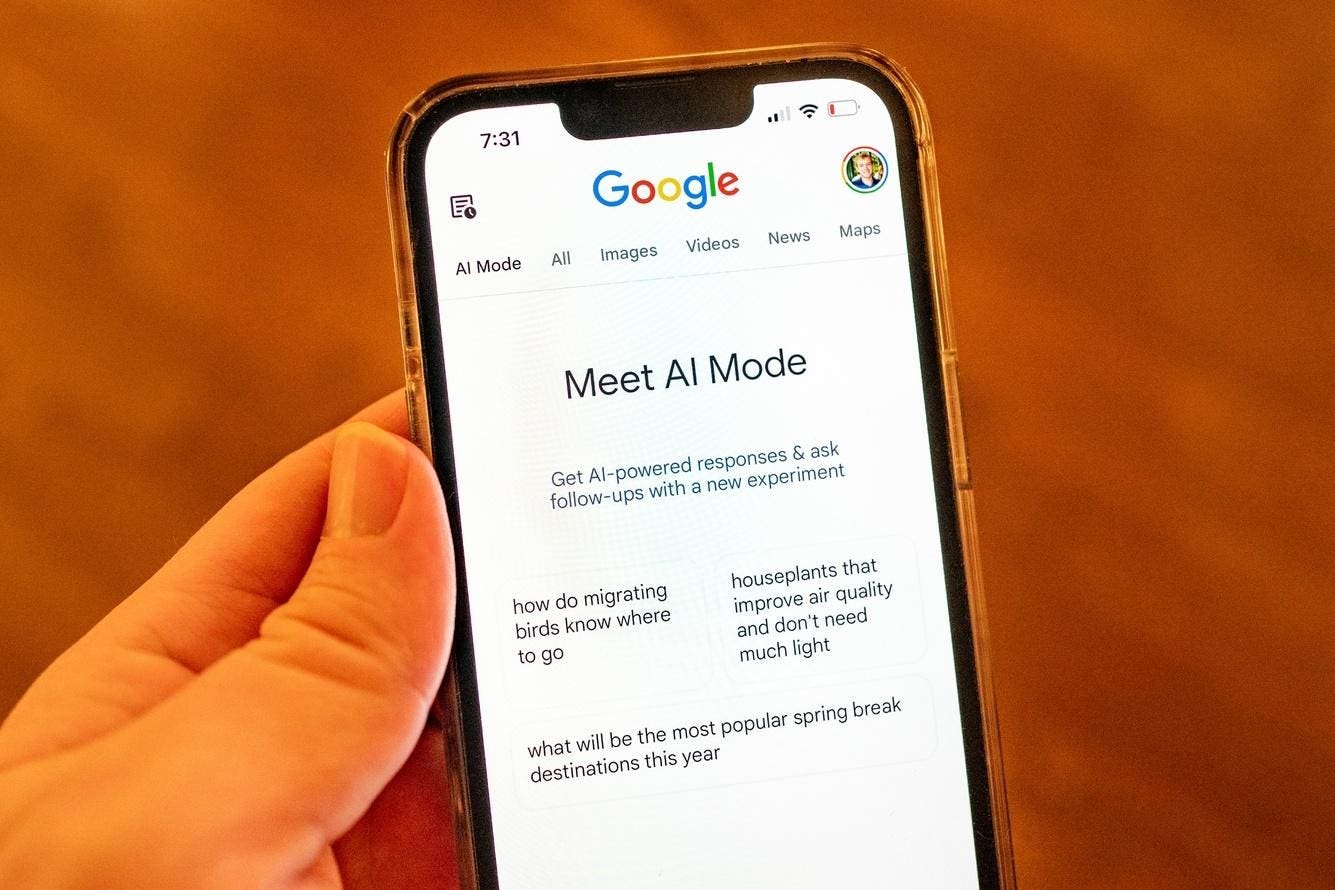
A close-up of a person holding an iPhone using Google AI, an experimental feature that uses artificial intelligence and large language models to process Google search queries, Lafayette, Calif., March 24, 2025. (Photo by Smith Collection/Gado/Getty Images)
Gado via Getty Images
Apple’s Siri AI isn’t very smart. That’s why future iPhones will combine Siri with Google’s highly acclaimed Gemini AI.
Apparently what you just read has been overlooked by the European Union (EU). As news accounts in recent days show, the EU has fined Google $1 billion for “unfairly” favoring “its own services on its widely used search engine.”
Except that Google’s “widely used search engine” is is widely used for many reasons, including that Google’s services are unbeatable. In other words, Google could only de-emphasize its services if it wanted to drive users away from its own “widely used search engine.”
This is worth remembering with a deeper look into the good mind of the EU. This is not so much about Google as about third parties who want their products and services to place more emphasis on Google’s “widely used search engine”.
OK, but third parties can’t have it both ways. Neither can EU regulators.
What makes the favorable position in Google’s “widely used search engine” so desirable for non-Google entities is how popular Google is with people around the world. Which means that Google, to remain Googlemust continue not merely to meet, but lead the needs of users who have a myriad of options. This includes the strong presentation of its unrivaled products. About this, Apple gives instructions.
As popular as the iPhone is, Apple has never hid from Siri’s limitations. Likewise, it hasn’t hidden from the fact that at least for now, it doesn’t have a ChatGPT, Copilot, Gemini, Grok or Meta AI equivalent. Did the latter signal Apple’s decline? Far from it.
As argued here in March, and certainly without knowing what lies ahead in AI or anything else (how many in and out of tech have predicted before and after November 30, 2022?), Apple is brilliantly positioned for the potential commercialization of AI. Rather than spending lavishly on its development, Apple opened up its iPhones and other devices to the genius of others. This once again involves Google and its Gemini AI.
Fully aware that the utility of its products is much greater when combined with technological advances achieved outside its own walls in Cupertino, Apple actively opens up its “widely used” devices to non-Apple technology. This is something EU regulators have clearly uncovered by fining Google $1 billion.
Really, what should Google do? Do EU regulators seriously expect it to favor the technology of others in its widely used search engine, particularly if what is produced by others does not match what has been developed in-house at Google? EU regulators don’t just require Google to choose an anti-consumer path of self-harm, they also require it to harm itself in such a way as to jeopardize the commercial growth of third parties who intend to use Google’s popularity as their own growth strategy.
Which calls for a look at the whistleblowing core of the EU case and the $1 billion fine on Google. The latter implies that by favoring its own services over those of third-party providers, Google is limiting the growth and development of third-party providers. Nothing could be further from the truth. See Apple again.
As evidenced by Apple’s integration of Google’s Gemini into its Siri product, no company can remain great by providing an inferior product. Google’s Gemini will immediately make Apple’s products much more attractive in the market, and thus Google’s suite of products and services will be much more attractive the better they are and regardless of where the improvements come from. Fines are not the answer to the EU’s woes, but third parties are better.


