




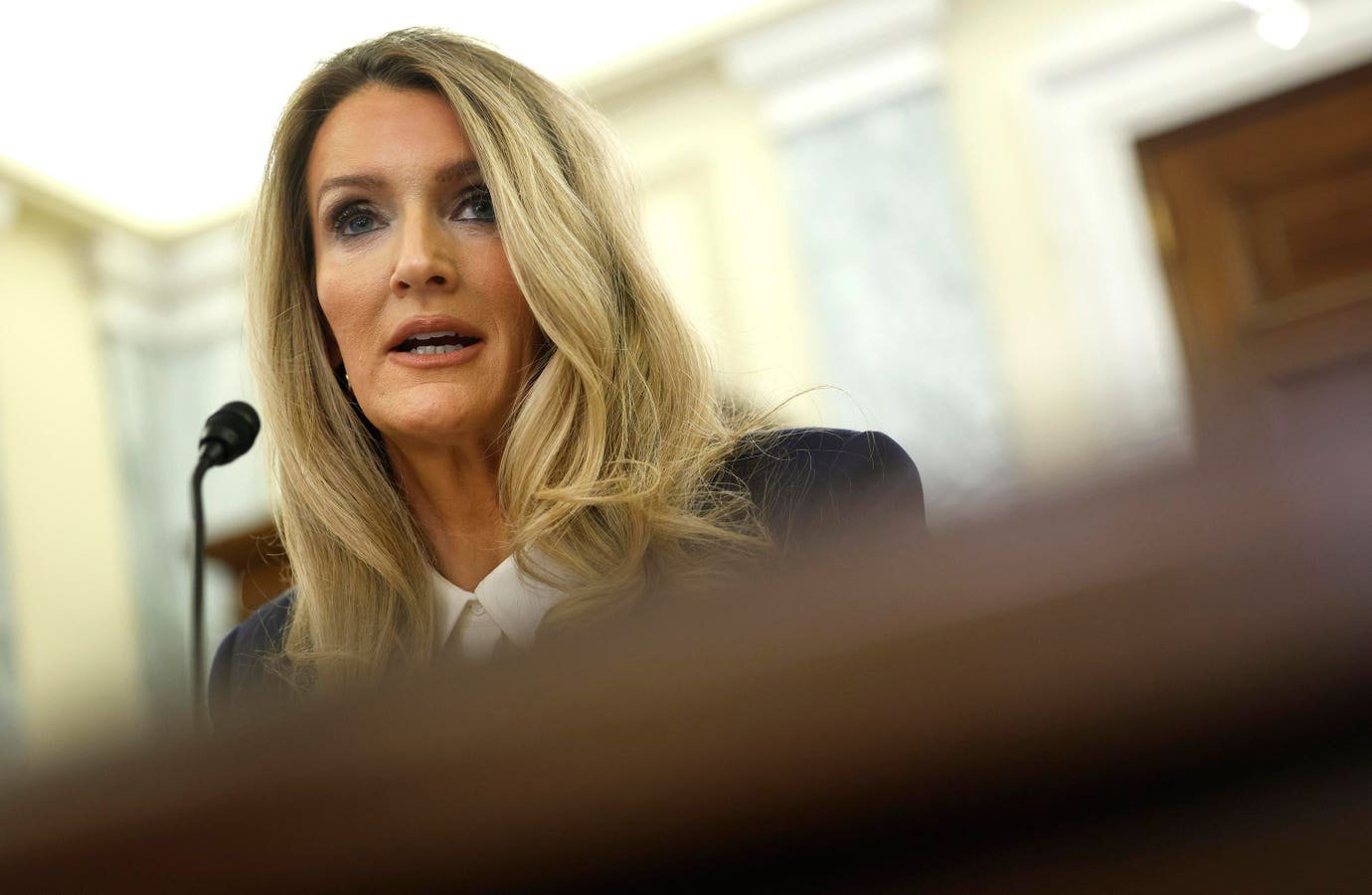
Kelly Loeffler, Administrator of US President Donald Trump’s Small Business Administration. The agency this week issued new guidelines for cracking down on SBA loans.
(Photo by Kevin Dietsch/Getty Images)
The Small Business Administration has finally made its crackdown on small business investors official, and it’s not as sweeping as some involved with SBA-guaranteed loans had feared.
Forbes reported in March that the SBA had quietly begun rejecting loan guarantees for businesses if any of their owners or investors – even a passive investor – had previously backed a business that defaulted on an SBA-guaranteed loan. Then, and then, the SBA didn’t respond Forbes’ asked to confirm or clarify the policy change, which appeared to be a dramatic expansion of the traditional rule: If a deal goes bad, only the borrower who signed the personal guarantee is barred from future SBA loans and other government-backed loans.
Finally yesterday the SBA issued a two-pager guidance document which set its new standards and it appears that the crackdown is not as sweeping as some experts had feared. However, the SBA has left itself plenty of leeway by creating a case-by-case review process for investors who meet certain standards.
“The news and the big bang is that it’s not an automatic no,” said Lynn Ozer, president of Pennsylvania-based MultiFunding LLC, an SBA loan broker. “They’re really talking specifically about these non-controlling minority investors. So it’s a very, very thin definition and they leave themselves open to being able to decide at their own discretion whether or not (a given investor) deserves to be part of another SBA loan.”
“That’s a good thing; the agency is trying to be proactive in helping small businesses,” Ozer added.
Overall, the new guidance is positive news for both investors and small businesses, he said Eric Pacifici, partner at SMB Law Group, an SBA-focused law firm that helps companies navigate the lending waters.
“What they’re responding to is that the investment community was very afraid that if they were on a capital table that defaulted, they would be locked out” of any future SBA loans, Pacifici said. “I even have some clients who were actively trying to get off the cap tables of existing businesses by handing over equity … to maintain eligibility.”
In that regard, Pacifici said, the guidance is a “net benefit” simply because it makes clear what the landscape and rules are for investors under the Trump SBA.
“It allows a lot of people who otherwise don’t have the personal liquidity to buy businesses, which creates more overall liquidity for business owners,” Pacifici said.
The policy change — made at some unclear point since President Donald Trump returned to the White House in 2025 — is key to who is now eligible for the SBA’s 7(a) and 504 loan programs, which were just expanded to $10 million in guaranteed loans available to entrepreneurs. The agency is led by former U.S. Sen. Kelly Loeffler of Georgia, who signed the new guidance.
In the document issued Thursday, the SBA announced that it is establishing a new waiver process for investors who have backed small businesses but have also been involved in one or more defaulted government loans in the past.
To qualify for such a waiver, any investor would have to meet three strict criteria, according to the new guidance:
1. No ownership interests greater than 20% in any company that defaulted on an SBA loan or any other type of federal government loan.
2. The investor cannot have been a loan guarantor or co-borrower on any defaulted SBA loan or government loan.
3. The investor cannot have had “any control over the business” that defaulted on a previous SBA or government loan.
“Once these threshold criteria are met, SBA will evaluate the full circumstances surrounding the loss on a case-by-case basis,” the new guidance document said, adding that any waiver request will be evaluated by SBA’s Fraud Risk Framework. The guidance expires on 1 June 2027.
Before granting or denying a waiver, the SBA will review any applicant’s history of 7(a) and 504 loans for other small businesses, the “number and percentage of defaulted SBA loans,” when those loans defaulted and how much capital the investor has relative to the requested loan amount, the guidance states.
The SBA framed the crackdown on investors as an effort both to “clean up the lax ‘Do What You Do’ underwriting policies of the Biden years to restore the integrity of the program” and to modernize its processes. The case-by-case waiver process, he added, is designed “to support greater access to capital for small businesses.”
However, there are still many unanswered questions about exactly how the new waiver process will work and how often exemptions will be granted.
“My question would be, how many of these exemptions will actually be approved?” asked Scott Oliver, partner at Indianapolis-based law firm Lewis Kappes, who works closely with lenders to approve SBA loans. “I think we’ll learn a lot more about that in the coming months.”
There isn’t much clarity yet on how long such a waiver process might take, Ozer said, noting that it could be as short as a week or perhaps much longer, depending on how many resources and staff the SBA chooses to devote to the process and how inundated it is with waiver requests.
Pacifici said he still advises clients to be cautious, simply because there are still many unknowns about exactly who will qualify — or be denied — for small business investment waivers.
“What if you’re a minority investor and you’re, by dumb luck, on multiple tables of funds and five of them default through no fault of your own?” Pacifitsi asked rhetorically. “If you’re at 50-cap tables as an investor, it’s very likely in that space that you’re pissing in the wind a little bit, and even you know… if you have defaults it’s a bit of a challenge.”
Do you want to be more successful? Contribute to the weekly Forbes Careers newsletter to get insider tips and information.
