




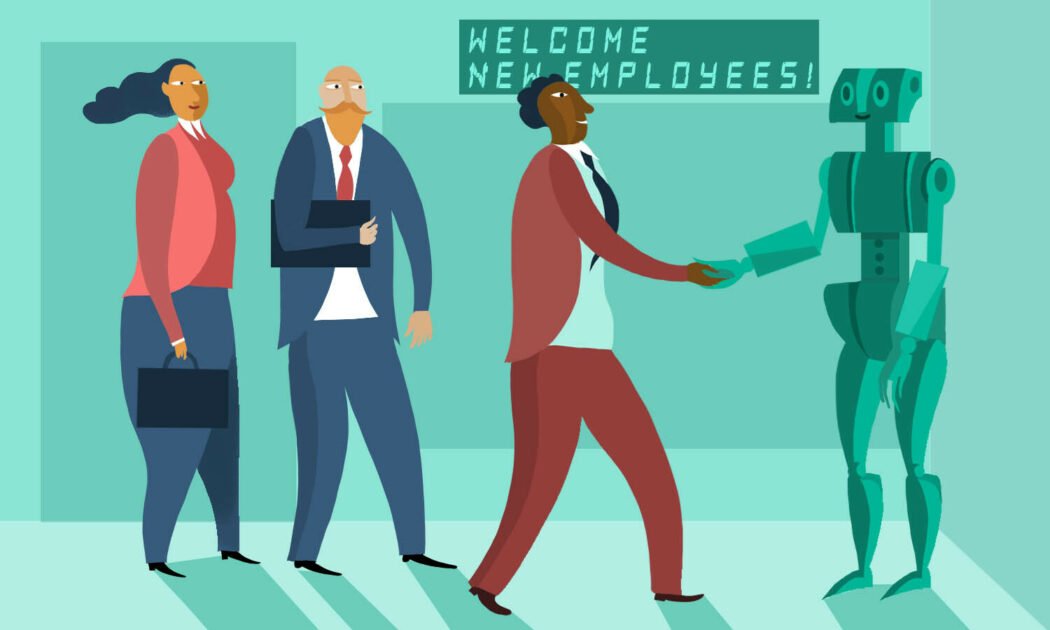
So what will these changes mean for tomorrow’s workers? Of course, no one has a crystal ball — but here are some predictions, based on a survey of Kellogg faculty members.
1. New technology, such as genetic artificial intelligence, will create winners and losers
Many of us anxiously wonder if and how much artificial intelligence will change our jobs. And while the exact results are hard to predict, we can learn lessons from the technological changes of the past.
Recent research from Dimitris Papanikolaou and Bryan Seegmiller (professor and assistant professor of economics, respectively) examined how major innovations introduced between 1981 and 2016 affected workers and their earnings.
Papanikolaou, Seegmiller and their colleagues focused on so-called breakthrough patents—those that were very different from previous patents but had a large influence on future patents. They also took care to distinguish between tools that replace workers and those that complement workers.
The researchers found that when a new tool can perform a task in a worker’s place, all affected workers suffer. “They’re experiencing wage loss, and that’s largely independent of their age, their income level, the field they work in, the type of work they do, or whether they have a college degree,” Papanikolaou says. But when a new technology supplements workers performing a task, the results are more mixed: more experienced and highly paid workers suffer, while new hires appear to benefit.
The researchers also studied the potential effects of artificial intelligence on today’s workers. “Artificial intelligence, as a technology, is leveling the playing field in a profession,” Papanikolaou says. In other words, if everyone can code, a skilled and experienced coder will be less valuable in the job market. The result is that “it will hurt the workers who are best at their jobs.”
2. Remote work will remain — but it won’t completely replace collaboration
Four years after the start of the Covid-19 pandemic, many workers still find themselves connected from home at least part of the time, and these geographically flexible workers are reporting increases in productivity and satisfaction.
However, research from Hyejin Younassociate professor of Management and Organizations, finds that telecommuting has disadvantages when it comes to learning on the job.
In their analysis of more than 17 million scientific publications over the past 45 years, Youn and her colleague found that researchers who collaborated locally were much more likely to gain new knowledge from their teammates than those who collaborated remotely. The trend was particularly strong for science and engineering researchers, as well as novice scholars.
For Youn, these findings suggest that being physically together—reading body language, thinking about a problem on a whiteboard, and working together to use specialized lab equipment—is especially valuable when knowledge has not yet been codified.
Of course, that doesn’t mean remote work should be shunned. Youn suggests companies find the right mix of employees working from home, where they can be productive, and bringing them into the office, where they can collaborate to create new knowledge. Companies focused on innovation should be especially careful to find the right balance.
“Bring people together so they can exchange ideas in person,” he says. “We’re incredibly good at learning from each other, especially in those dark ways that can lead to innovation.”
3. Global cities will continue to see an influx of remote workers—and governments will need to respond
So, what about those times when employees is not in the office together, learning from each other? If the last decade is any indication, some adventurous souls will be heading overseas. Popular global cities including Paris and Venice have seen a wave of foreign arrivals from rich countries, laptops in hand and stars in their eyes, settling in for months or more.
Among the locals, reactions are mixed. Affluent foreigners patronize local shops and restaurants, but bring with them rent increases, traffic and congestion, and cultural changes. For governments, it is difficult to figure out how to balance these costs and benefits.
Some countries, convinced that the good is worth the bad, have actively encouraged foreigners with housing subsidies. Others have taken the opposite approach, flatly restricting would-be expats from buying homes or heavily taxing their property purchases. But which strategy is best?
Neither, according to his research Sergio Rebelo, professor of economics. With his colleagues, Rebelo developed a mathematical model to test different policy approaches. They identified a kind of Goldilocks solution: tax capital gains on property sales for everyone and use the proceeds to help offset the damage caused to local people. This tax-and-transfer approach provides “a win-win solution,” says Rebelo.
The research also highlights some long-term approaches that countries can take as they adapt to their new realities. In Paris, for example, some companies moved their offices to remote areas, making room for tourists and other foreigners in the central areas. It’s a different city — but that’s not necessarily a bad thing. After all, says Rebelo, “cities are like a living organism and they transform organically over time.”
4. Climate change will lead to large redistributions of the workforce
When extreme floods, fires or droughts hit an area, the labor market in that area will naturally be affected. For example, if unusually dry weather destroys a local crop, farm workers may be forced to find new jobs.
But research from Jacopo Ponticelliassociate professor of economics, shows that the economic effects of extreme weather persist far beyond the immediate aftermath, as workers migrate to other areas — and the flow of capital follows.
In a study of data from Brazil, Ponticelli and his colleagues found that areas experiencing unusual dryness experienced sharp declines in farm productivity and employment. In the short term, loans were directed to the affected areas. But when dry conditions persisted for a decade, that economic flow slowed, either because people left or because banks lent less money.
Many workers in these newly arid areas moved, often to urban centers. But the transitions didn’t always go smoothly, the researchers found. While some immigrants found new jobs in agriculture or the service industry, they found it difficult to break into the manufacturing sector, perhaps because they lacked social connections or skills.
Ponticelli argues that policymakers should do more to help displaced workers find work, as such migrations will likely only intensify in the future. “These climate shocks cause a big redistribution of labor,” says Ponticelli. “If we go to drier and drier conditions in these regions, which all the climate models predict, we will see even more of this redistribution.”
5. Workers will continue to be the unwitting subjects of experimentation
If you’ve used a digital platform, there’s a good chance you’ve also experimented. Platforms like Uber and LinkedIn typically thousands of tests are running at any time. And it’s not just customers who have become unwitting guinea pigs. It’s also the millions of people who rely on these apps for gigs.
Hatim Rahmanassistant professor of Management and Organizations, wanted to understand how this status quo came about and what it might mean for workers in the future.
To answer this question, Rahman and his colleagues used data from QuickHire, a pseudonym for one of the world’s largest digital job platforms. They found that between 2004 and 2020, QuickHire went through three “experimental regimes.” At first, the experimentation was clear and conducted only on those who had voluntarily chosen. In the second stage, experimentation became covert, with workers participating in studies without their notification or consent. and in the final stage, experimentation was unlimited, with many experiments running simultaneously and continuously.
Rahman and his colleagues were amazed by how workers handled this final stage: without pushing back or leaving the platform en masse. “Instead of observing a collective exodus of workers, we found that workers responded by resigning,” the researchers wrote.
But organizations are doing themselves a disservice by failing to consider the long-term implications of stealth and unrestricted experimentation, Rahman argues. First, the integrity of the experiments themselves can be undermined by jaded participants who expect any small change they see to be part of some larger test. Experiments can also challenge morale.
This does not mean that platforms should do away with experimentation altogether. Instead, the researchers suggest, steps should be taken to make such tests more transparent and accountable. For example, organizations can form internal boards—or independent, external oversight units—to oversee experimentation and ensure useful, insightful outcomes for both leaders and employees.
