




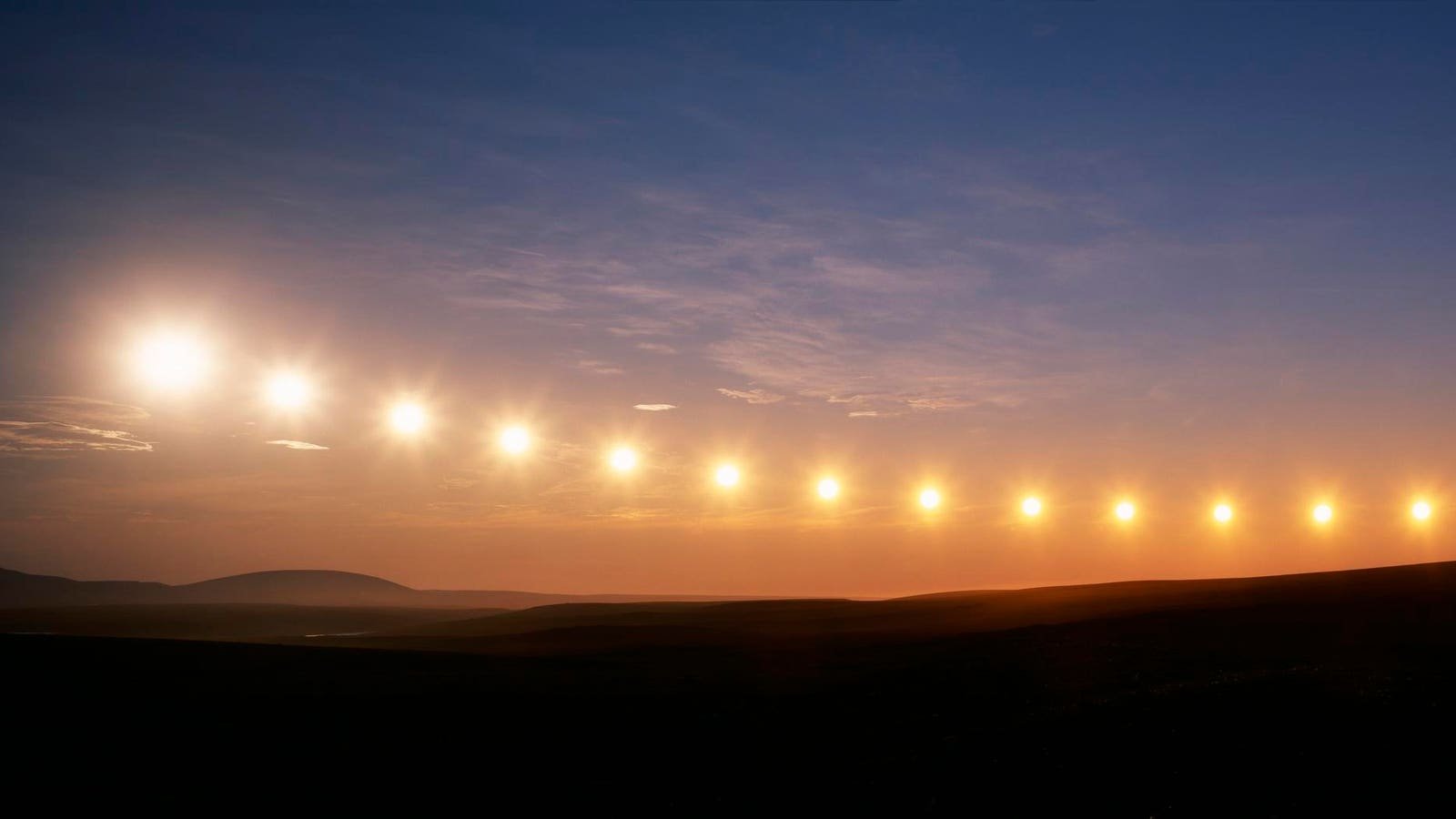
Multiple exposures of the midnight sun passing northward on a summer night 175 miles north of the Arctic Circle. | Location: Toolik Lake, Alaska, USA.
getty
This weekend, the sun will reach its highest point in the northern hemisphere sky, with the sunrise celebrated at Stonehenge, but in the Arctic it will not set. The June solstice occurs on Sunday, June 21, 2026, at 08:24 UTC, marking the astronomical start of summer in the Northern Hemisphere. For most people, this means the longest day of the year. But north of the Arctic Circle, it brings something even stranger and more spectacular – a midnight sun.
Midnight Sun is exactly what it sounds like. It’s the sight of the sun still above the horizon at local midnight, bathing landscapes in a soft, golden light when darkness should have fallen. Instead of rising in the east and setting in the west, the sun seems to circle the horizon in a shallow circle, sinking low but never disappearing.
“In the Arctic Circle at the summer solstice is where you have this moment of the midnight sun, where the sun never actually sets,” said Solan Jensen, a ranger and guide for Quark MissionsArctic cruises, in an interview. “Then you have this huge amount of the planet above the Arctic Circle – including Svalbard – and because you’re so much further north, even before the solstice and very late in the summer, you have this experience of the sun never setting.”
North of the Arctic Circle, the midnight sun shines from the summer solstice.
getty
Why does the Midnight Sun happen?
The sun, of course, does nothing out of the ordinary. It is an optical illusion caused by the tilt of the Earth. The Earth rotates at an angle of about 23.4 degrees as it revolves around the sun. Around the June solstice, the northern hemisphere is tilted toward the sun as much as it is all year. This gives the north its longest days, while the Southern Hemisphere (which is titled away from the sun) experiences its shortest days.
The further north you go, the more extreme the effect becomes. In the Arctic Circle, the sun can stay above the horizon for a full 24 hours around the solstice. Go further north – to northern Norway, Svalbard, northern Greenland, northern Canada or Alaska – and the midnight sun can last for days, weeks or even months.
Think of the Earth as a tilted spinning top surrounding a light bulb. Near the tip of the tilted planet, the Arctic remains at an angle to the light throughout its daily rotation. The result is a sun that circles the sky instead of setting below it.
“We’re so geared to a routine that allows for nighttime and rest,” Jensen said. “There’s this really interesting synergy that happens when you go on an adventure in a remote landscape with wildlife, glaciers, mountains and undeveloped land — and there’s no night.”
Arctic trips around the solstice come with 24-hour wildlife viewing opportunities. “The sun is at its highest point of the year, and the wildlife is taking advantage, too,” Jensen said. “Everything is on the move – feeding, breeding, nesting – and the wildflowers burst out of the tundra for a few weeks.”
The midnight sun is visible in and above the Arctic Circle, 66 degrees north of the equator.
getty
Where to see the Midnight Sun
The classic place to see the midnight sun is anywhere north of the Arctic Circle, which is about 66.5 degrees north. Good options include Tromsø and the Lofoten Islands in Norway, Abisko and Kiruna in Sweden, Finnish Lapland, Svalbard, northern Iceland, Greenland, northern Canada and Utqiaġvik in Alaska.
Strictly speaking, Iceland’s capital, Reykjavík, is just south of the Arctic Circle, so it doesn’t experience true 24-hour midnight sun. However, it still has exceptionally long twilight-filled nights around the solstice, with the sky never going completely dark.
The experience is not just about astronomy. In Arctic communities, the midnight sun changes the rhythm of life. Hiking, kayaking, wildlife watching and photography can happen late into the night.
“I struggle with words to describe it, but there’s this surreality that’s happening right behind my conscious life,” Jensen said. “I know it’s midnight, I know my body is ready to sleep, but I’m awake and I have this experience with daylight — there’s silliness, there’s eerie, and there’s an element of awe.” He added that it’s not unusual to have people up all night on deck during an Arctic cruise.
What happens after the Solstice?
The solstice is the peak of the midnight sun phenomenon, not the end. After this weekend, the sun will slowly begin to retreat southward in the sky and daylight in the northern hemisphere will gradually decrease. In the Arctic, the midnight sun will continue for a little while longer, depending on latitude, before sunsets finally return.
“Fatigue is a very real risk when you’re operating in a place where there’s 24-hour daylight and the midnight sun is there — but there’s also an energy that comes with it,” Jensen said. “If the midnight sun is something you want to experience at its peak, this solstice period at high latitudes is really intense.”
I wish you clear skies and open eyes.
