




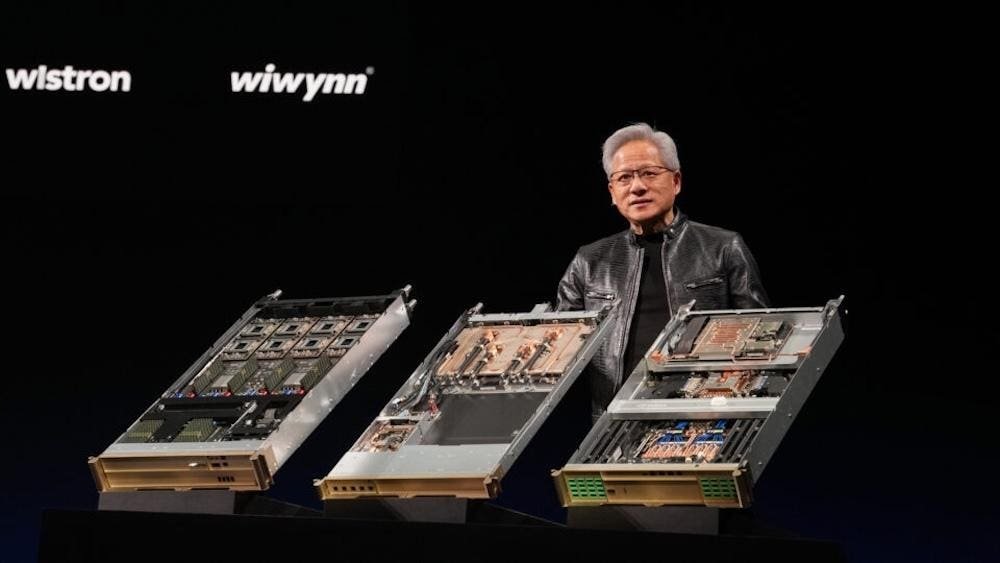
Jensen Huang, CEO, Nvidia
Nvidia
Nvidia CEO Jensen Huang used his Keynote address of GTC Taipei on June 1 to declare that the era of autonomous agents has arrived and backed up the claim with new hardware across the data center, desktop and physical world. Huang announced that the Vera Rubin platform, Nvidia’s next data center system, has arrived full productionand framed almost every product the company unveiled in Taipei around software agents that observe, reason, plan and act with little human input.
The keynote at the Taipei Music Center reflected a shift in how Nvidia describes itself. Huang said the company now sells AI infrastructure rather than just chips, and argued that IT has become a direct source of revenue for businesses that buy it. He pointed to coding platforms where developer engagements have nearly tripled in the first months of 2026 as evidence that agents are already doing useful work. For technology leaders, the announcements chart where data center, enterprise software and PC spending is headed.
Vera Rubin reaches full production
The Vera Rubin is a five-rack system that Nvidia is treating as a large computer for dealer workloads. The platform combines Vera Rubin NVL72 systems, Vera’s new CPU, Groq 3 LPX inference drives, Spectrum-6 Ethernet racks and Vera BlueField-4 STX storage. Each NVL72 rack connects 36 Vera processors and 72 Rubin GPUs via the sixth-generation NVLink switch, with ConnectX-9 network cards and BlueField-4 data processing units handling traffic and security.
Nvidia says the rack offers up to 10x higher inference performance per watt and 10x lower cost per token than its previous generation, and that pairing it with the Groq 3 LPX increases performance per watt by up to 35x for trillion-parameter models. The drive’s cable-less, tube-less and fanless design cuts assembly from two hours to five minutes per PC drive, and the fully liquid-cooled design operates at 45 degrees Celsius to fit into existing data centers.
Huang said Vera Rubin’s supply chain is twice the size of Grace Blackwell’s previous effort, with 150 partners in Taiwan and more than 350 factories in 30 countries. Production shipments begin this fall.
A CPU and software stack built for agents
THE Vera CPU is Nvidia’s first standalone data center processor, with 88 cores and an on-chip fabric the company designed for agents rather than human operators. Huang argued that billions of agents will run continuously and require much lower latency than humans, creating a processor market that didn’t exist before.
Nvidia also moved Spectrum-X Ethernet Photonics is networking in production, describing it as the first 200 gigabit per second Ethernet switch with co-packaged optics and naming CoreWeave, Lambda and Oracle Cloud Infrastructure among the early adopters. A separate box called DSX helps operators design and operate AI factories, and Nvidia said one configuration can fit 40 percent more GPUs with the same power budget.
On the software side, Nvidia introduced an Agent Toolkit that combines models, an agent bundle, and an enterprise runtime, alongside a secure runtime called OpenShell that isolates each agent and enforces policy. The company has released Nemotoron 3 Ultra, a 550 billion expert model parameter blend that it says performs inference five times faster and costs about 30% less than leading open alternatives. Verified Nvidia dealer skills are now available in the Claude Code plugin market and the Hermes Skills Hub.
Nvidia is entering the PC market
Huang announced RTX Sparka chip built with MediaTek that brings 1 step of AI performance to Windows laptops and compact desktops. It combines a Blackwell RTX GPU that has 6,144 CUDA cores with a 20-core Grace CPU, and Nvidia positioned it as the basis for personal computers that run agents locally instead of calling up a cloud server.
The company unveiled a Windows line that includes a laptop, an always-on desktop box, and a desk DGX Station for Windows with the ability to run boundary models of up to 1 trillion parameters in the office. Partners including Asus, Dell, Gigabyte, HP, MSI and Supermicro start shipping DGX Station systems this month. Adobe is rebuilding Photoshop and Premiere for RTX Spark, with versions that Nvidia says run twice as fast and work with agents.
Natural artificial intelligence is moving to the fore
Nvidia has expanded its dealer message into robotics and vehicles. It was launched World 3an open-world foundation model based on a transformer blend design that learns from teleoperation, simulation, and replayed video so that robots can reason about their environment. The company said its Drive Hyperion vehicle platform now reaches services representing about 97% of the global mobility market and introduced Alpamayo 2 Super, an open reasoning model for self-driving research combined with a reinforcement learning trainer and scenario generator. For robotics labs, Nvidia released an open humanoid robot reference design based on the Jetson Thor unit. A set of multimedia tools rounded out the day, including a synthetic video detector Nvidia says marks AI-generated footage with about 92% accuracy in 22 milliseconds.
The Limitations
Most of the performance numbers come from Nvidia and haven’t been independently tested, and Vera Rubin won’t ship in volume until the fall, so buyers can’t yet validate the cost-per-token claims on their own workloads. New Windows machines and RTX Spark systems are also arriving later this year, which leaves their software ecosystem and agent tools unproven outside of controlled demos. Enterprise Agent runtimes raise governance and security issues that products like OpenShell address in principle but have not addressed at production scale. Competition is also intensifying, with AMD pushing Instinct accelerators and cloud providers to expand custom silicon such as AWS Trainium, Google Ironwood and Microsoft Maia.
For technology decision makers, the keynote led to a choice that will define AI budgets. Huang argued that the performance per watt and runtime surrounding the model now matter as much as the chip itself, meaning architecture decisions made next year will shape both capability and cost long after the hardware lands.
