










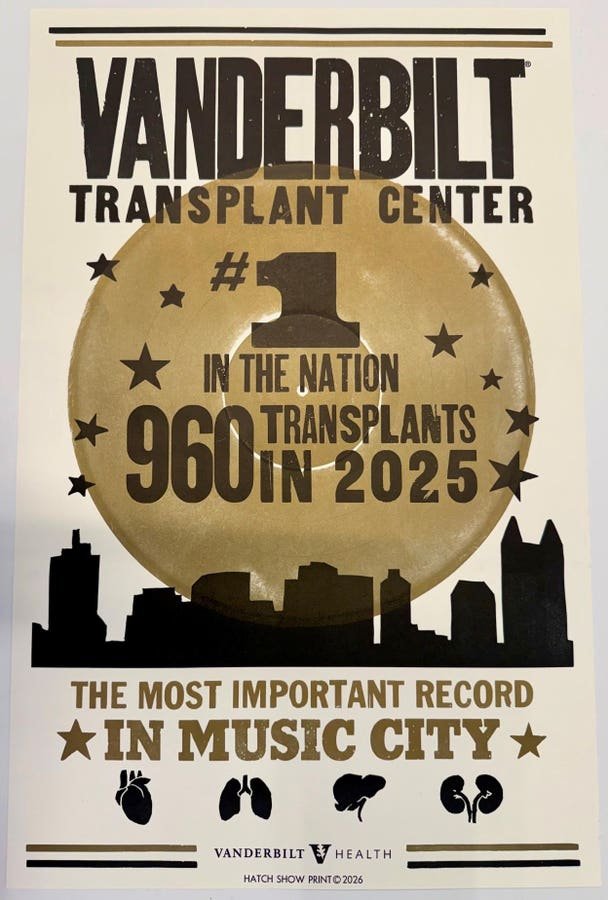
An image of the commemorative poster, created by the historic Hatch Show Print shop in Nashville, in honor of Vanderbilt Transplant Center’s record year. In 2025, Vanderbilt led the nation in completing 960 solid organ transplants.
Bill Frist, MD
This weekend, I opened a big commemorative event for Vanderbilt University’s milestone of becoming the most active organ transplant center in the United States. The commemorative, iconic Hatch Show Print poster unveiled on Friday night aptly described the achievement:
VANDERBILT TRANSPLANT CENTER
#1 IN THE NATION
960 TRANSPLANTS IN 2025
“THE MOST IMPORTANT DISC IN MUSIC TOWN”
In my remarks, I shared the origin story.
The Foundation is set: 1983–1993
Remarks by Bill Frist, MD, Founding Director
June 26, 2026
Vanderbilt Transplant Center Milestone of No. 1 in the Nation
The thread that connects us
I want to start with a man who walked the halls of our medical school at Vanderbilt four decades before I came to Stanford to train under him.
Associate surgeon Dr. Bill Frist (R) with pioneering heart transplant surgeon Dr. Norman Shumway (L) at Stanford in the early 1980s. Dr. Shumway in transplantation provided a foundational model for the successful Vanderbilt Transplant Center started by Dr. Frist.
Bill Frist, MD
Norman Shumway entered Vanderbilt University School of Medicine in 1945 — immersed in the creative culture of Alfred Blalock and Barney Brooks, where experimental surgery was pursued with disciplined boldness. He left with his MD in 1949, later went to Stanford and became what the world now calls the Father of Heart Transplantation. On January 6, 1968, he performed the first human heart transplant in the United States.
In 1983, I arrived at Stanford as his fellow. As my training drew to a close, Dr. Samway, across the operating table one night, said words I have never forgotten:
“Dream big. Master the heart — no one has yet transplanted single lungs. . . . But the big vision is to create a single, multidisciplinary, multi-organ transplant center. That’s what drives transplantation to scale.”
He was sending me home — to Nashville, home of the very medical school where he had trained — to build something the world had never seen.
The Dream and the Plan
The vision was this: instead of separate programs for kidneys, hearts, and later the still experimental lungs and livers—each in its own department—to bring them all under a single interdisciplinary roof with a single, religiously patient-centered mission. Why? Because the knowledge that makes transplantation possible—immunology, rejection, immunosuppression, social work, rehabilitation, donor organ availability—is the same knowledge in all organs.
Let the experts share. Let the pestilence serve every program. Let an ethicist lead each group. Integrate, Collaborate, Integrate. Truly, multidisciplinary.
While at Stanford, I put that vision into a 45-page planning document—part business plan, part clinical plan, part research plan—and sent it to Vice Chancellor Ike Robinson to see if Vanderbilt might be interested. He read it, understood it, committed the seed funding and recruited me to the house in Nashville. The dream suddenly had direction.
The foundation we built on
When I entered the faculty in 1986, I found a stronger foundation than I could have ever hoped for. Dr. Keith Johnson and Dr. Bob Richie had created one of the great kidney transplant programs in the country—1,600 transplants by 1988, the 14th largest program in the country—and with it an institutional depth of knowledge about clinical immunosuppression that became the scientific foundation for everything else. The first kidney transplant at Vanderbilt was performed in 1962 by Dr. William Scott and Dr. Charles Zukoski.
Walter Merrill, with whom I had spent a few days at Stanford in 1984 as he prepared the heart transplant program, was already here, having performed Vanderbilt’s first adult heart transplant in 1985. Walter would become my indispensable, tireless partner in every effort that followed.
Dr. Walter Merrill (L) with the author, Dr. Bill Frist, in April 2025.
Bill Frist, MD
The Center is taking shape
In January 1987, Walter and I performed Tennessee’s first heart-lung transplant — the first successful such operation in the Southeast. Two months later, Tennessee’s first pediatric heart transplant. In 1988, Dr. Hal Helderman and I have been appointed Medical and Surgical Directors, respectively, of the new Vanderbilt Transplant Center.
On September 21, 1989, the center was officially chartered. The document stated: “The Vanderbilt Transplant Center is the first of its kind in the country.” The stated shipment:
“To promote and direct transplant research, medicine, technology, education and public education in transplant matters future as the recognized leader and national authority on multi-organ transplantation in the United States and abroad.”
These words: “the recognized leader and national authority.” Remember this was written in 1989 before we started the lung, before we started the liver. Yes, it was ambitious at the time. However, 37 years later, that’s an accurate description of what’s in that room tonight.
The author and the surgical team performing heart transplants in the early years of the Vanderbilt Transplant Center. Today, the Center is the busiest heart transplant center in the world.
John Howser, Vanderbilt University Medical Center
In our founding year we performed 28 heart transplants — 66 total since 1985 — 111 kidney transplants and 75 bone marrow transplants under Dr. Steven Wolff. We hired the first full-time, center-based, transplant ethicist in the country — Dr. Richard Zaner — and we hired Drs. Steve Dummer to establish a special infectious disease transplant program. Tracy Frazier served as our first chief executive officer, making the big vision operational day-to-day. Our first home was the entire ninth floor of Oxford House. Janie Webb in social work. Jan Muirhead in nursing.
Drs. Bill Frist (L) and Jim Loyd (R) in a transplant in the early 1990s.
John Howser, Vanderbilt University Medical Center
In December 1989, we started our single lung transplant program, working closely with pulmonologist Dr. Jim Loyd, in a field still considered experimental. One of our first lung patients – Pam Everett-Smith, transplanted in 1990 – was in town last week for her 36thu annual wellness check and is in the Guinness Book of Records as the world’s longest living lung recipient.
In 1990, we recruited Dr. Wright Pinson—a genius both in the ED—who quickly built the liver transplant program from scratch. With the launch of the liver program in 1991, every organ envisioned in the original plan was now functional: heart, lungs, kidneys, liver, pancreas, bone marrow — all under one roof, one mission, one culture.
The foundations were built… and they were strong: outcomes outstanding, functionally multidisciplinary, published research bold and productive, obsessively centered on patients and families.
No other university medical center in America had built such a fundamental launch pad for what was to come.
The baton
In 1994 I ran for the United States Senate. Wright Pinson took over and the founding capital was closed.
The author, Senator Frist, with Dr. Wright Pinson at the Vanderbilt Transplant Center’s 1st Celebration on June 26, 2026. Dr. Pinson took over leadership of the VTC after Frist left the Senate, and during his 18-year tenure at the helm, he helped build the program into one of the most important types of transplants in the world. In addition to being an accomplished surgeon, Dr. Pinson is also a talented musician.
Camryn Eaton
Norman Shumway was educated at Vanderbilt. He told us to dream big and build what transplant needed to reach scale. Together we built this foundation. What happened — what we celebrate tonight with the 960 patients transplanted last year and the tens of thousands of patients and families whose lives have changed over time — is the fullest answer we could give to the man who first imagined it.


