










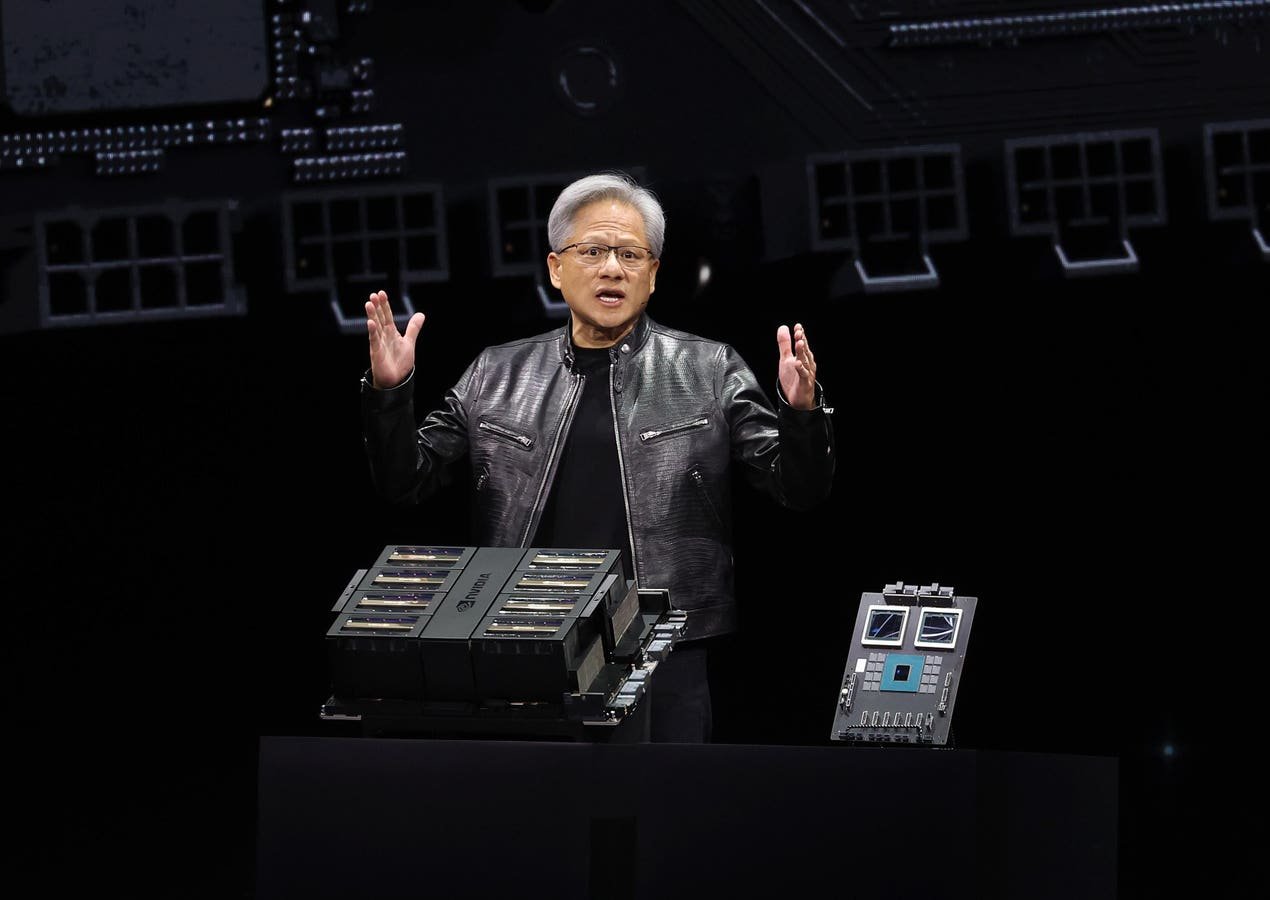
SAN JOSE, CA – MARCH 18: Nvidia CEO Jensen Huang delivers a keynote speech during the Nvidia GTC artificial intelligence conference at the SAP Center on March 18, 2024 in San Jose, California. The developer conference is expected to showcase new chips, software and AI processor technology. (Photo by Justin Sullivan/Getty Images)
Getty Images
If only members of the US political class spent more time in China. If so, the American and Chinese people could perhaps be spared many foolish policies.
Everywhere you look, there’s an Apple Store, a Nike Store, McDonald’s, KFC, Starbucks, and seemingly every other American brand. To produce is to express the desire to consume, and the Chinese are feverishly producing to get all things American.
Remarkable about Chinese reverence for American products is that it extends largely to technology. It’s not just that Apple sells a fifth of its iPhones in China, but that a fast-growing Chinese tech industry is filled with people who believe the American tech world is behind products and services. This has long included Nvidia and its chips that have been so instrumental in a transformative Artificial Intelligence (AI) leap.
Unfortunately, politicians far outside the proverbial arena are not as enthusiastic about foreign production as those inside the arena. Too often they see trade as war, as opposed to what it always and everywhere is: mutual reinforcement.
The trade-as-war theory unfortunately informed the rise of artificial intelligence, along with the infrastructure that made it possible. With artificial intelligence seen by politicians as the next big thing, they began to introduce rules aimed at restricting exports of the most advanced products, lest one country outdo another in AI. The thought was wrong.
That’s because the beauty of commerce is that when it’s free, it’s like every company is headquartered next door. Even better, free trade means that the greatest minds can divide the work on the way to much bigger and much faster productivity leaps. Unfortunately, logic has largely taken a back seat in the AI debate.
Traveling back in time to October 2022, the Biden administration began imposing export controls on Nvidia. The goal was to keep the San Jose, California-based company’s most advanced brands out of China. “National security” was the justification for this vandalism of the economy, a vandalism that played into the hands of the Chinese Communist Party (CCP).
While Chinese technologists once again respected US chips, specifically Nvidia, the CCP embraced the authoritarianism so popular within governments that it wanted Chinese tech companies to buy from Chinese manufacturers. This is why the Biden administration’s export controls were a gift to the CCP.
It’s not just Shenzhen-based Huawei that has made big leaps in chip technology. As Bloomberg it was recently reported that China’s semiconductor inventories are rising in tandem with investment growth. Huawei is leading the charge, the report said, having recently “unveiled a new chip manufacturing method that could enable cutting-edge processors to be made more cheaply – reminiscent of DeepSeek’s revolutionary AI model launch.”
About the great strides being made in China, it is not in itself a bad thing, especially if the markets are reopened so that American and Chinese genius can peacefully work together to work against each other. It’s worth adding that profits are the ultimate lure for competition either way, meaning that Nvidia’s achievements ensured more competition from China and the US (see Cerebras) with or without export controls.
Still, what a waste. And this is not just a sales comment. Rather, it is a commentary that trade is once again mutually enriching. Which means we’ll never know how much greater AI progress would be in China and the US now if politics hadn’t prevented brilliant minds from divvying up the work in an economically muddled past.


