




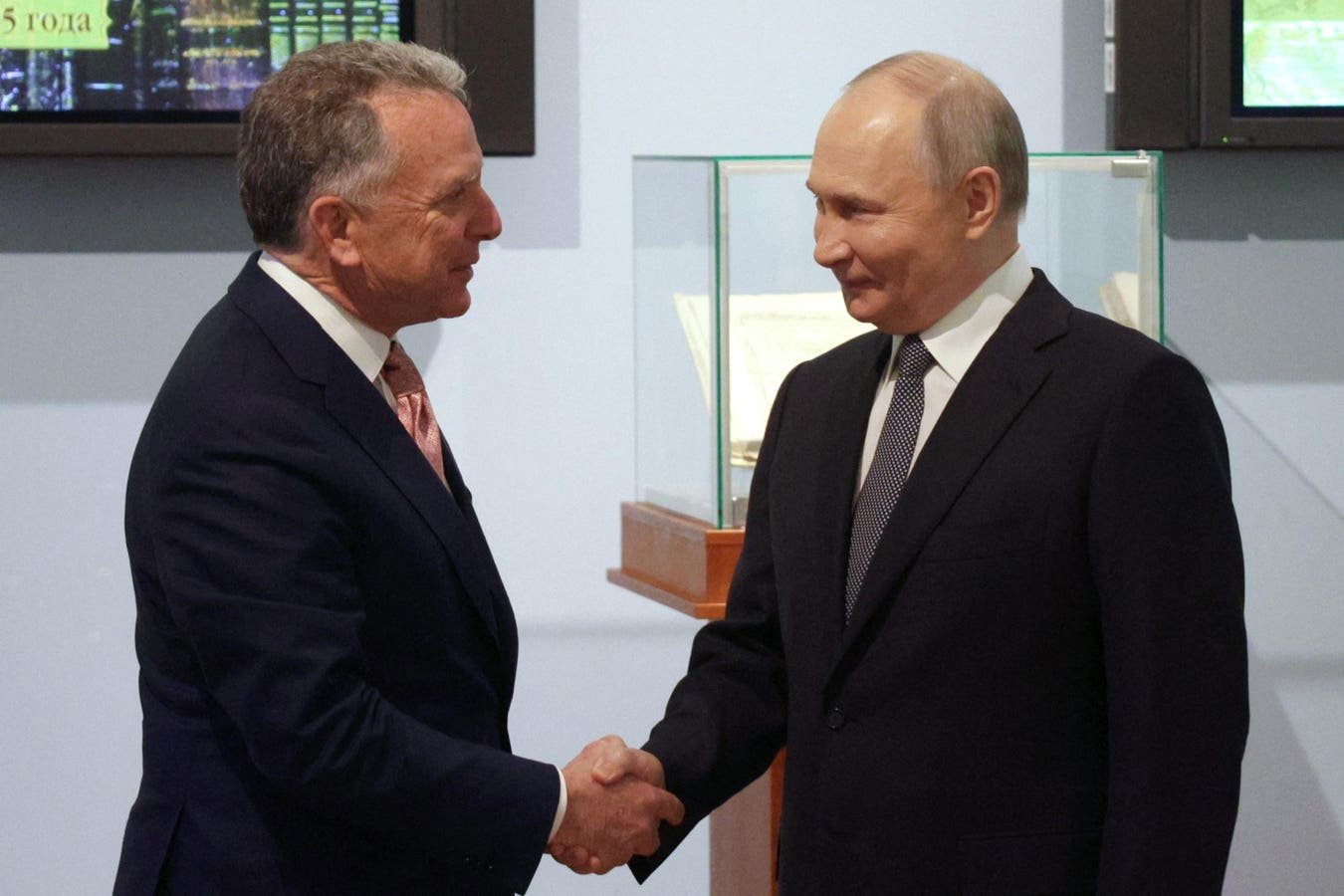
Steve Witkoff, US President Donald Trump’s envoy will meet with President Putin again soon. Fears have been expressed about what Trump’s envoy is offering Putin. (Photo by Gavriil Grigorov / POOL / AFP) (Photo by GAVRIIL GRIGOROV/POOL/AFP via Getty Images)
POOL/AFP via Getty Images
Trump’s Ukraine peace plan appears to be trying to end Ukraine. In The Telegraph on November 28, 2025, an article by Joe Barnes explains that President Donald Trump is taking a unilateral approach to ending the war in Ukraine. According to his report, Trump is ready to recognize Russia’s control of Crimea and other occupied Ukrainian territories as part of a peace deal. Steve Witkoff, Trump’s self-styled peace envoy, and Jared Kushner, Trump’s son-in-law, have reportedly been sent to Moscow to present Trump’s Ukraine peace plan to Vladimir Putin. The Kremlin, for its part, has confirmed that it received a revised strategy after the emergency talks in Geneva, and Putin has publicly stated that eatFormal US recognition of Crimea and the “republics” in Donetsk and Luhansk is a key condition for the negotiations.
In simple terms
The White House appears ready to trade legal recognition of the conquest for a ceasefire. If Trump makes this offer official, he won’t just “end a war.” It will undermine the legal and political framework that the United States itself helped create at the end of World War II. It will also shake up the international rules of engagement between nations for years to come. While Congress may not have the power to directly veto a presidential recognition decision, it can and should send a very clear message before it’s too late.
Ukrainian President Volodomyr Zelenskyy has rejected handing over any Ukrainian land to Russia. (Photo by Mert Gokhankoc/ dia images via Getty Images)
dia images via Getty Images
The main problem: Identifying land seized by force
Trump is not operating in a legal vacuum. It is operating on top of a mountain of existing obligations.
According to the United Nations Charter, all member states – including the United States and Russia – must “refrain … from the threat or use of force against the territorial integrity or political independence of any state.” This is the post-1945 rule against taking land by force.
Following Russia’s annexation of Crimea in 2014, the UN General Assembly endorsed Ukraine’s territorial integrity Resolution, confirming that Crimea remains part of Ukraine and declaring the so-called referendum invalid. After the full-scale invasion in 2022, the UN General Assembly again authorized an attack on Ukraine Resolutionsupporting Ukraine’s internationally recognized borders and insisting that “no territorial acquisition resulting from the threat or use of force shall be recognized as legitimate.”
In addition, the International Law Commission’s articles on Responsibility of states for internationally wrongful acts describe a duty of non-recognition: when a serious violation of a peremptory norm (such as the prohibition of aggression) occurs, other states must neither recognize the resulting situation as legitimate, nor aid or assist in maintaining it.
In the alliance system, the North Atlantic Treaty supports NATO’s “open door” policy: any European country that promotes the principles of the Treaty can be invited to join. No third country has a right of veto.
What Trump’s peace deal proposes
Trump’s Ukraine peace deal that proposes accepting Russia’s annexation of Ukrainian territory, NATO’s freezing of Ukraine under a de facto Russian veto, and quietly burying responsibility for atrocities is not just “different diplomacy.” He completely ignores these commitments. This is not hypothetical. During Trump’s second term, the US has already shifted to a “neutral” stance at the UN, promoting resolutions that avoid blaming Russia and even voting against a Ukrainian-backed text that explicitly condemned Russian aggression – drawing sharp criticism from European allies. Barnes’ reports indicate that the next step may be to move from neutral language to open recognition of Russian gains.
The constitutional arrest
It is true that the US Supreme Court has determined that only the President has the power to recognize foreign states and their territorial boundaries. Congress cannot compel the Executive to adopt a particular recognition stance or oppose the President’s formal recognition decision.
But that’s not the end of the story. Congress still controls the critical levers: the funding that determines what the US government can actually do with any recognition decision, the sanctions and legal definitions that govern how US law deals with Crimea and occupied Donbas, and the public record that determines what America’s policy is supposed to be. This is exactly where a proposal for a short, sharp “sense of Congress” resolution could make such a huge difference.
What a congressional-feeling resolution should say
For once, Congress doesn’t need lofty rhetoric or a lengthy preamble. A clear statement of the red line is needed. Something like this would do the trick:
Congress must act on Trump’s offer to Putin. (Photo by Robert Alexander/Getty Images)
Getty Images
It is the sense of Congress that:
- In accordance with the UN Charter and subsequent resolutions on aggression against Ukraine, the United States must not recognize as legitimate any territorial claim by the Russian Federation to forcibly seized Ukrainian territory, including Crimea and the occupied regions of Donetsk and Luhansk.
- The President and all United States officials should refrain from supporting, endorsing, or implementing any peace proposal that makes a cease-fire conditional on such recognition, restricts Ukraine’s sovereign right to choose its alliances in opposition to The beginning of NATO’s open doorsor offers impunity for war crimes and other serious violations of international law.
- It is the policy of the United States to uphold its treaty commitments and customary duty of non-recognition of territorial conquest and to uphold the sovereignty and territorial integrity of Ukraine within its internationally recognized borders.
What would such an analysis do?
While such a resolution may not be legally binding on Trump, it accomplishes three key things. It sets the baseline by clearly and publicly stating what US policy is, both on paper and in law. It also confirms that Trump’s decision to recognize Russian control over occupied Ukrainian territories deviates from that baseline, rather than being a natural evolution of existing policy. Moreover, it sets the stage for tougher measures later—such as laws strengthening sanctions and designating occupied Ukrainian territories in US law as “Ukrainian territory under Russian occupation,” regardless of what the White House says.
Such a resolution might not physically prevent Witkoff, Kushner or anyone else from sitting down in Moscow and trying to trade pieces of Ukraine with a photo handshake. But it will raise the political cost of any move by the White House to ratify Russia’s land grab, signal to Kiev and European capitals that Congress is not silently complicit, and make it easier, in retrospect, to see who defended the rules and who helped rewrite them for the sake of a quick “win” or a possible Nobel Peace Prize.
Time for action
Trump’s peace plan for Ukraine is out of step with America’s historical policies. For decades, the United States has upheld a clear principle: you cannot change borders through invasion and then expect the world to approve the result. This principle distinguished the post-1945 international order from that of the 1930s. If the current President now chooses to abandon this principle and recognize Russia’s gains in Ukraine, Congress cannot stop him. However, it may make it unequivocally clear that when history reflects on Trump’s proposed Ukraine peace plan, the surrender of Ukrainian territory will be seen as his own. decision— not America’s.
