











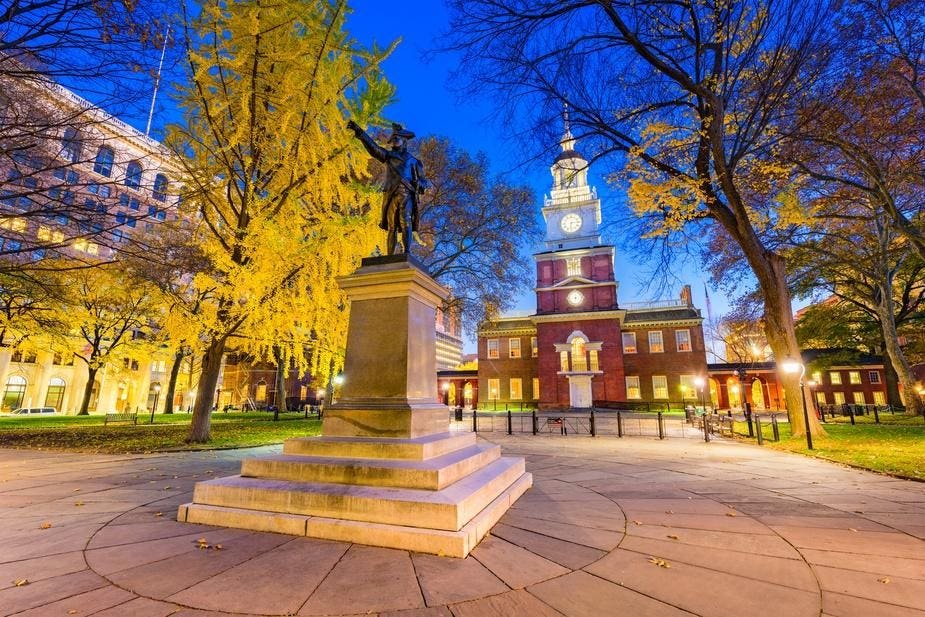
On July 4, Congress formally adopted the Declaration of Independence in Philadelphia, Pennsylvania.
getty
July 4, 2026, marks 250 years since the Continental Congress adopted the Declaration of Independence.
This milestone—the semi-centenary, if you want the official term—is an opportunity to revisit founding history in all its familiar guises: liberty, self-government, equality, revolution, and the break with Great Britain.
But it is also a tax story.
Not just tax history, of course. The American Revolution was also about political power, economic control, and representation. But taxes were central to the conflict. Time and again, Parliament tried to collect revenue from the colonies. And again and again, the colonists objected—not just because they didn’t like paying taxes, but because they believed they were being taxed without consent.
The Declaration of Independence
The Declaration of Independence is exactly what it sounds like: an announcement that the United States has declared its independence from King George III and Great Britain.
But it did not lead to immediate independence. It was written more than a year (442 days) after the first shots were fired in Lexington, Massachusetts in 1775, considered the beginning of the American Revolutionary War. And the Declaration he didn’t marks the end of the Revolutionary War. It was quite the opposite – it meant that the United States was no longer willing to accept British rule.
One of the main objections was that the colonists were being taxed by a Parliament in which they had no elected representatives. In other words, it wasn’t just a fight over whether taxes were too high. It was a fight over whether Parliament had the power to impose them in the first place.
Britain needed money
To understand how taxes became part of the road to independence, it helps to go back to the years after the Seven Years’ War.
The British ruled the colonies from the early 17th century. It was not the only part of the world—or even the only part of America—subject to British colonization. The British also had control over parts of Canada, the Caribbean and South America.
But ruling the world is expensive. Guarding colonies and occasionally invading new territories requires money. And not everyone agrees on who owns which lands, so battles break out from time to time. This is exactly what happened in the mid-18th century, when Great Britain was fighting many countries, most notably France, in the Seven Years’ War. When the war ended in 1763, Great Britain could claim victory over France. However, the years of fighting took a heavy toll, leaving the British government almost bankrupt.
The British government had to raise revenue quickly. What’s better than a series of taxes and duties? And who better to tax than subjects who were far enough away, like the American colonists, to quell the complainers? There was only one problem with this plan: Britain underestimated just how strongly the colonists would react.
The Stamp Act
The first major postwar tax imposed on the colonies was the Stamp Act of 1765.
Stamps, as they apply to taxes, have nothing to do with postage. A stamp is an official confirmation that a tax has been paid or that a rule has been followed. And under the Stamp Act, many printed materials in the colonies—newspapers, legal documents, pamphlets, licenses, and other papers—had to be produced on stamped paper showing that the tax had been paid.
An Emblem of the Effects of the Stamp Act printed in the lower right corner of the Pennsylvania Journal and Weekly Advertiser on October 24, 1765. Pennsylvania, USA, October 24, 1765. (Photo by Fotosearch/Getty Images).
Getty Images
The colonists, of course, hated the tax. Printers, merchants, lawyers, and newspapers were all pushed back, and some tax collectors resigned rather than try to enforce it.
The Stamp Act was repealed the following year, but that did not end the struggle.
The Declaration
The repeal of the Stamp Act may have seemed like a victory for the colonists, and in some ways it was. But it wasn’t a good look for Britain – the colonists had asserted their authority and won. In response, Parliament immediately passed the Declaration declaring that it had the right to pass laws in the colonies “in any case”.
The Townshend Acts
Britain followed the Townshend Acts, which imposed tariffs on imported goods, including glass, lead, paint, paper, and tea. These were indirect taxes, meaning that the colonists did not pay them in the same visible way that they had paid the Stamp Act.
British officials assumed that this would make the taxes easier to swallow. They were wrong.
Engraved portrait of John Dickinson, holding a letter from the patriotic American farmer, a founding father of the United States, an American lawyer and statesman from Philadelphia, Pennsylvania, 1768. From the New York Public Library. (Photo by Smith Collection/Gado/Getty Images)
Getty Images
Colonists still saw duties as taxes. Philadelphia lawyer John Dickinson helped explain the objection in a series of essays entitled “Letters from a Pennsylvania Farmer.” Dickinson argued that Parliament could regulate trade, but rejected the idea that it could tax the colonies to raise revenue without colonial consent, writing: “I answer, I absolutely deny the power of parliament to lay upon these colonies any ‘tax.’
The Tea Law
The Townshend Acts were partially repealed in 1770. The partially repealed part is important. In 1773, Parliament passed the Tea Act, which is sometimes described as a brand new tax. It was not — the tax on imported tea was not abolished under the Townshend Act. Instead, the Tea Act gave the East India Company a commercial advantage, allowing it to sell tea directly to the colonies and undercut colonial merchants.
Colonists realized that the best way to resist the Tea Act was to turn away ships carrying tea headed for the colonies. Colonists were able to do this in Philadelphia and New York, but not in Boston. The Governor of Massachusetts would not allow the ships to return and the settlers would not let them unload at the port. It was a confrontation. To top it off, the colonists boarded the ships and threw the tea—the event you and I call the Boston Tea Party.
The Boston Tea Party did not immediately lead to the Declaration of Independence or the Revolutionary War, although we like to associate them as if they happened in quick succession. The Tea Party took place on December 16, 1773, long before the shooting of Lexington and the Declaration of Independence. However, what the Boston Tea Party quickly did was upset Parliament.
In response, the British attempted to punish the Americans with a series of laws known as the Coercive Acts. Under the Coercive Acts, among other things, the port of Boston was closed to merchant shipping, meetings in the city were restricted, and the British commander of the North American forces was appointed governor of Massachusetts.
The settlers had had enough. He convened the First Continental Congress in Philadelphia on September 5, 1774, to consider their next steps. Resistance to the British grew, leading to the first shots fired in Massachusetts that sparked the Revolutionary War.
Drafting of the Declaration
Today, we tend to remember the Declaration for the lines most of us learned in school: “all men are created equal,” “unalienable rights,” and “Life, Liberty, and the pursuit of Happiness.” But the Declaration was not just a statement of ideals. It was also a list of complaints, such as: “For taxing us without our consent.”
The Continental Congress had already taken the key vote on July 2, 1776, when it passed a resolution declaring the colonies to be “free and independent states.” John Adams believed that July 2nd would be remembered as the great anniversary of American independence.
But it wasn’t that date that stuck (sorry, John).
Two days later, on July 4, Congress formally approved the Declaration. Twelve of the thirteen colonies ratified it that day. New York, which had not yet received instructions from its provincial congress, adopted the Proclamation on July 9.
On July 19, the document took on a new title, “The Unanimous Declaration of the Thirteen United States of America,” and a new appearance after being “encased” in parchment. It was intended to be signed by every member of Congress, but few withdrew, including Dickinson, who hoped the colonies could be reconciled with Britain.
(Wonder what happened to the original? There are six surviving drafts, including Jefferson’s “original draft,” which includes revisions by Franklin, Adams, and Congress and is housed in the Jefferson Papers at the Library of Congress. housed in the National Archives in Washington, DC)
What happened next
Initially, the British response was to rebuke the “deluded Americans” and “their outrageous and unacceptable assertion of independence.” But the Declaration was more than just a document – it set the United States on the road to independence.
In 1783, with the signing of the Treaty of Paris, the United States officially became an independent nation. But the date we most associate with our independence is when those in the Continental Congress were brave enough to officially proclaim it to the world—July 4, 1776.
Of course, our tax system looks very different now. But what remains true is that taxes are one of the clearest ways a government exercises power. A tax law decides who pays, what is subsidized, what is discouraged, how much money moves from individuals and businesses to the government, and what the government does with it.
Two hundred and fifty years later, this is still the tax lesson worth remembering. The founding argument was not that government could never tax. It was that the people being taxed deserved a voice.


