




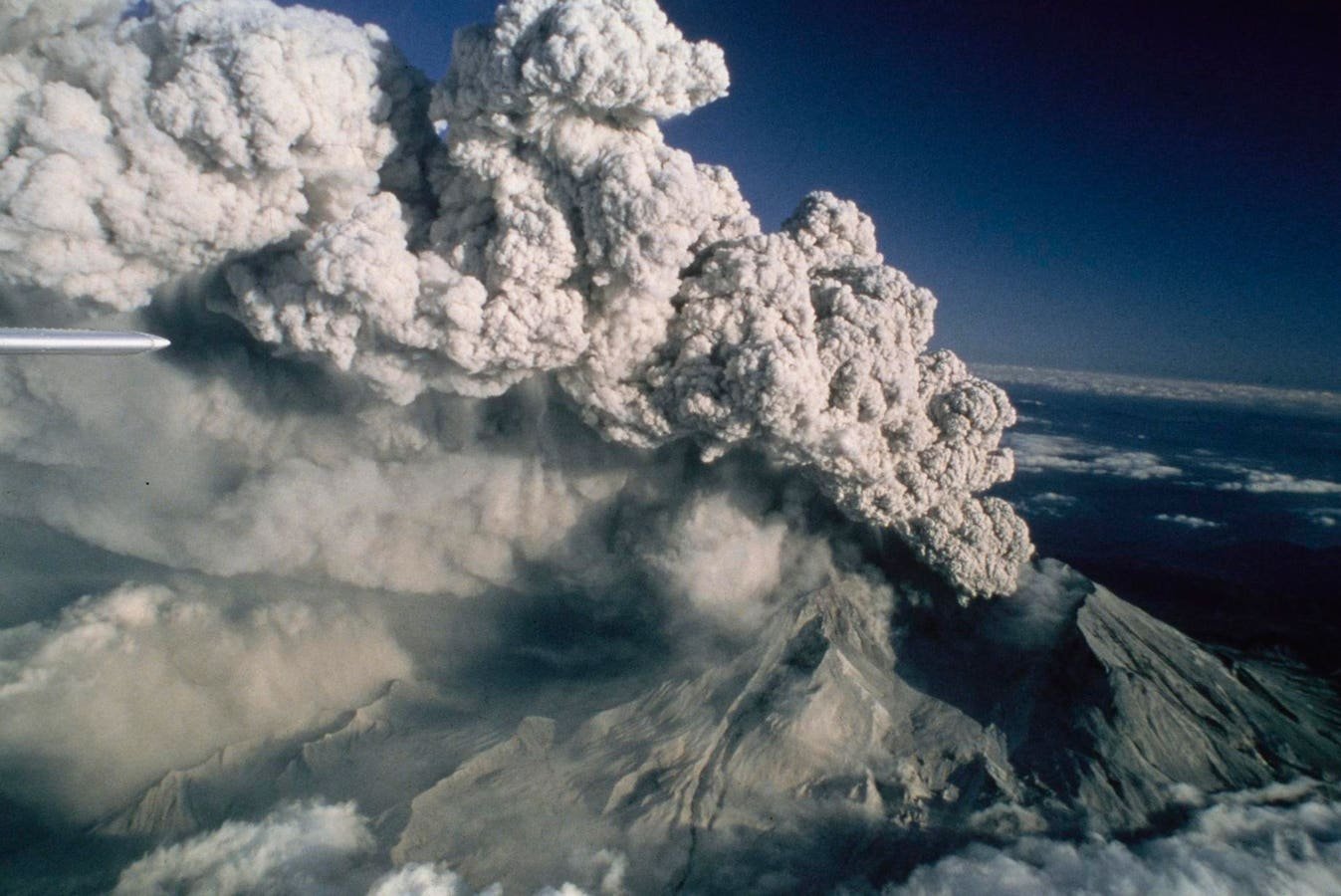
A plume of steam and ash rises above Mount St Helens in Washington in the aftermath of the eruption on May 18, 1980. (Photo by UPI/Bettmann Archive/Getty Images)
Getty Images
How and if a volcano erupts depends on how and when bubbles of water vapor and carbon dioxide form in the rising magma.
This process can be likened to a bottle of champagne: while the bottle is closed and therefore under pressure (like molten rock in magma chamber), the carbon dioxide remains in solution. When the cork is removed from the bottle, the pressure drops and the carbon dioxide bubbles up. These bubbles pull the liquid up with them, forming foam and causing it to explode out of the bottle.
Until now, it was thought that the gas bubbles that lead to a volcanic eruption formed mainly when the ambient pressure dropped while the magma rose. However, this explanation is incomplete and cannot explain the eruption style of some volcanoes.
Now, an international research team, including a scientist from ETH Zurich, has simulated how the magma moves, providing a new explanation for how it erupts on the surface.
The researchers show that gas bubbles can form in rising magma not only due to the pressure drop, but also due to shear forces in the molten rock.
To simulate what happens in a volcano, the researchers took a viscous polymer that resembled the physical properties of molten rock and saturated it with carbon dioxide gas. They then observed what happened if the lava-like liquid was set in motion.
The researchers’ experiments show that the bubbles form mostly near the ends of the duct, where the liquid drags along the walls of the duct. Friction creates shear movements that deform the viscous material and promote bubble nucleation.
“Our experiments showed that motion in the magma due to shear forces is enough to form gas bubbles – even without a pressure drop,” he explains. Olivier BachmannProfessor of Volcanology and Igneous Petrology at ETH Zurich and one of the co-authors.
According to the new findings, magma with a low gas content that appears to be non-explosive could nevertheless lead to a powerful eruption if a large number of bubbles form due to shear forces in the rising magma.
Conversely, shear forces can also cause bubbles to develop and coalesce at an early stage in gas-rich and potentially explosive magma, leading to the formation of “degassing channels” in the magma that reduce the gas pressure.
“We can therefore explain why some viscous magmas flow gently instead of exploding, despite their high gas content – a long-standing puzzle,” says Bachmann.
Diagram summarizing the study’s findings, showing how shear forces in magma flowing through the vent can control how and when gas bubbles form.
Roche et al. 2025/Science/ETH Zürich
A real test for this model is the eruption of Mount Agia Eleni in 1980. Although the magma was gas-rich and therefore potentially explosive, the eruption began by placing a very slow intrusion of lava inside the volcano, slowly deforming the mountain over months. The strong shear forces acting on the magma produced additional gas bubbles that initially allowed gas to be released, explaining the high gas levels measured at the surface. It was only when a landslide opened the vent further and there was a rapid drop in pressure that the volcano erupted.
“To better predict the hazard potential of volcanoes, we need to update our volcanic models and account for shear forces in the conduits,” Bachmann concludes.
The full study, “Shear-induced bubble nucleation in magmas”, was published in the magazine Science and it can be found online here.
Additional material and interviews provided by ETH Zurich.
