




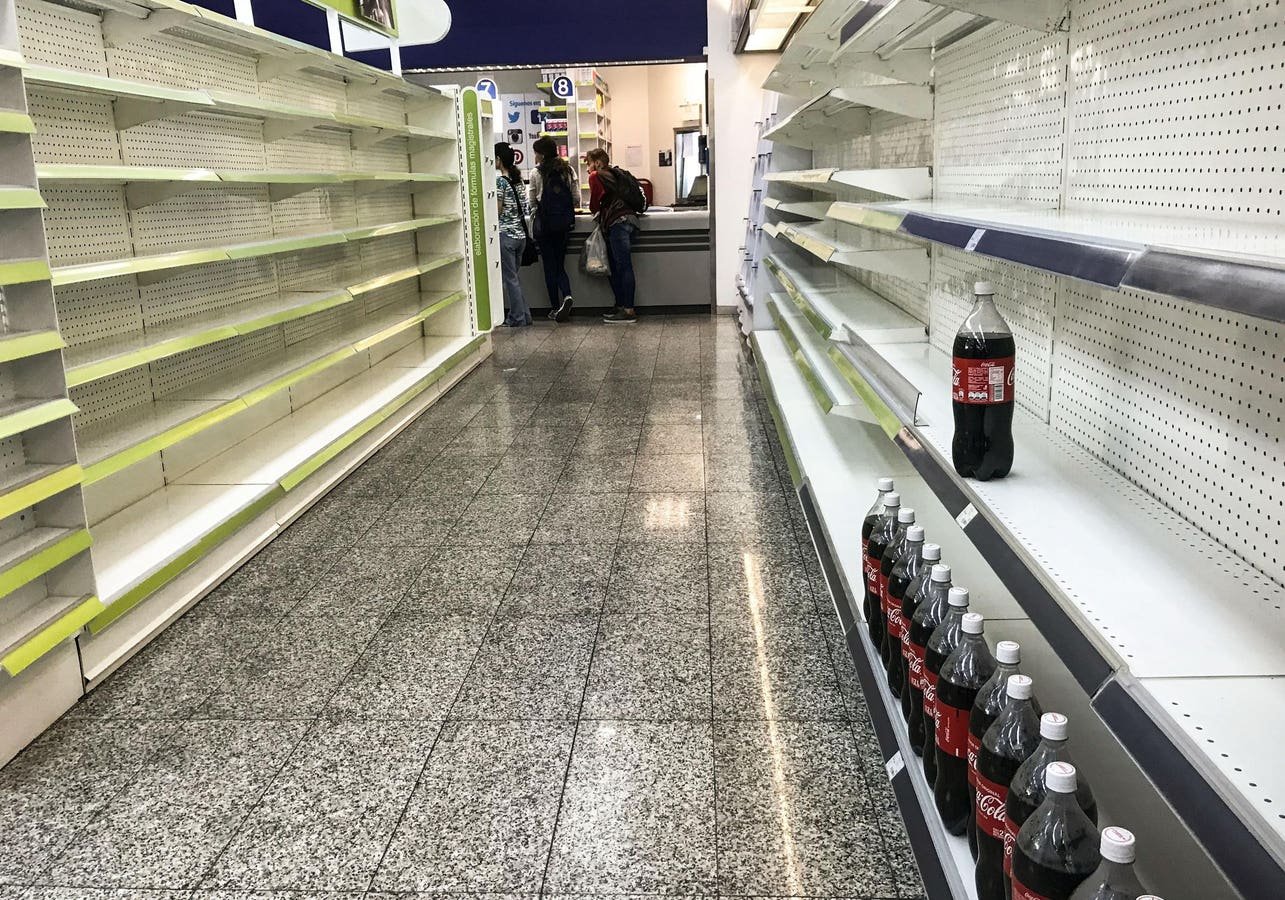
Shortages are most damaging when they involve basic needs, such as housing or groceries. But they need not reduce overall well-being.
AFP via Getty Images
In recent years, the United States has been embroiled in an extensive debate about how policymakers can best reduce prices. Housing has reached crisis levels, and daily necessities feel out of reach for too many families. Voters want relief now, and politicians are responding with an increasingly intrusive playbook.
A recent New York Times guest essay by Stanford economist Neale Mahoney and Bharat Ramamurti observed how Democrats fared well in the November election while running on price controls, something once considered unheard of in genteel economic company. They point to the election of democratic socialist Zohran Mamdani as mayor of New York, who ran on a platform promising that “freeze the rent.” Meanwhile, New Jersey’s new governor, Mickey Sherrill, successfully campaigned freezing of electricity prices. The authors argue that temporary, targeted price caps, combined with supply-side measures, can provide short-term relief to an affordability crisis.
Their argument captures the current mood of the electorate. Voters are frustrated by a political consensus that seems incapable of quickly reducing costs. At the same time, the perceived incompetence of policymakers may stem from deeper confusion in the public debate about what economics can and cannot realistically tell us about price controls.
Why online discussion is so broken
Scroll through social media today and you’ll find an almost theological devotion to the Econ 101 model of supply and demand. The meme version of the model says that price ceilings cause shortages, and in one important sense, that’s true. If you limit the price of a good below the market clearing level, you will have excess demand. Rent control often leads landlords to convert or retire units, just as the gas caps of the 1970s created queues and rationing.
But somewhere along the way, this logic swelled into a much broader and flawed claim, which is that any shortage is necessarily inefficient and must reduce social welfare.
This is not, and never has been, an iron law of economics.
Why Shortages Are Not Automatically ‘Bad Economies’
Consider a luxury good like yachts. Suppose the government imposes a price ceiling that makes yachts cheaper than the market price and a shortage occurs. In a simplistic model this is characterized as “inefficient” because people are willing to buy more yachts at that price than sellers are willing to offer.
But that’s not the end of the story.
If wealthy households that would have bought yachts instead of sports cars, you may indeed have inefficiencies. Resources are shifted from one luxury sector to another with little benefit.
However, this is not the only possibility. Suppose constrained consumers save or invest the money they would have spent. They may be waiting in line to finally own a yacht and meanwhile their dollars are flowing into the capital markets. Workers may lose some jobs in yacht construction, but other workers gain jobs in sectors that benefit from this extra investment. Over time, the economy may experience faster capital accumulation.
This scenario is not guaranteed, but neither is the scenario that economists often assume—that shortages necessarily make society worse off.
Now take the even more extreme case of banning products. This is essentially a price floor set to infinity because the good is not available at any price, creating a shortage so great that the market disappears. If a product is truly harmful, such as asbestos insulation or certain toxic chemicals, then the “lack” is not so much a distortion as a deliberate improvement of public health. The market is eliminated because society is better off with alternatives.
So the existence of a shortage tells us very little in itself. What matters is the opposite. What would people do with their resources in the absence of the blocked market transaction?
Some (though not all) economists know this about shortages. But they rarely emphasize it and the public debate suffers.
Where does this leave the housing debate?
All that said, housing is not a yacht. It is not a luxury good. It is a necessity, and we already have too little of it.
This is why the recent enthusiasm for the rent freeze is indeed misplaced. Price caps make more sense only when we are willing to tolerate less than the object being controlled. With housing, insufficient supply is already part of the fundamental problem, so the rationale for price caps breaks down.
A rent freeze may provide immediate relief to some households, but it also discourages construction and maintenance. The authors of the Times article argue that pairing rent caps with government efforts to expand supply could offset some of the negative side effects of price controls, but history shows that caps are likely to remain while supply reforms lag or are delayed altogether. Temporary controls have a way of creating permanent constituencies. When the product is something harmful, such as asbestos insulation or lead paint, this permanence may be a feature rather than a bug. But when the product is housing, making controls permanent entrenchments a rarity.
If the real goal is to reduce the cost of housing, the only viable path is to build more housing. This should be done through zoning deregulation, faster permitting, lower construction barriers, and perhaps targeted tax reforms.
Similarities with invoices
This supply-side lesson is not unique to housing. Consider the recent tariffs imposed by President Trump. Tariffs raise domestic prices and reduce output in the short run. But their defenders argue that this short-term pain will pay off by boosting U.S. investment and manufacturing over time. As with price controls, the ultimate economic impact is ambiguous. In either case, a short-term drop in output will make it harder to achieve the much longer-term boost to supply that policymakers claim to be seeking.
In addition, with Trump’s tariffs there is an additional problem related to uncertainty. Businesses are reasonably skeptical that these tariffs will remain in place long enough to warrant significant new investment. A deliberate, consensus-based industrial policy that is clearly articulated and reliably durable would be far more effective.
Therefore, a better approach would be direct investment rather than indirect, cyclical efforts to stimulate the economy by manipulating relative prices. If the goal is to increase production capacity, the simplest approach is to directly support investment.
Economists don’t tell the whole story
Economists often present their models as if they were complete descriptions of reality. But supply and demand is only a partial model. It is strong and correct in its field. However, it misses important dynamic results, especially some investment reactions.
Price controls can be harmful, but they are not necessarily harmful online. And the deficiencies and excesses they create can sometimes play a constructive role in politics.
So the right answer is not to exclude price controls from the policy toolbox, nor to embrace them without reservation. It’s about understanding what they do and don’t do.
In the affordability crisis we face today, the only durable way to make necessities affordable is to produce more of them. But that doesn’t mean there aren’t situations where less really is more.
