




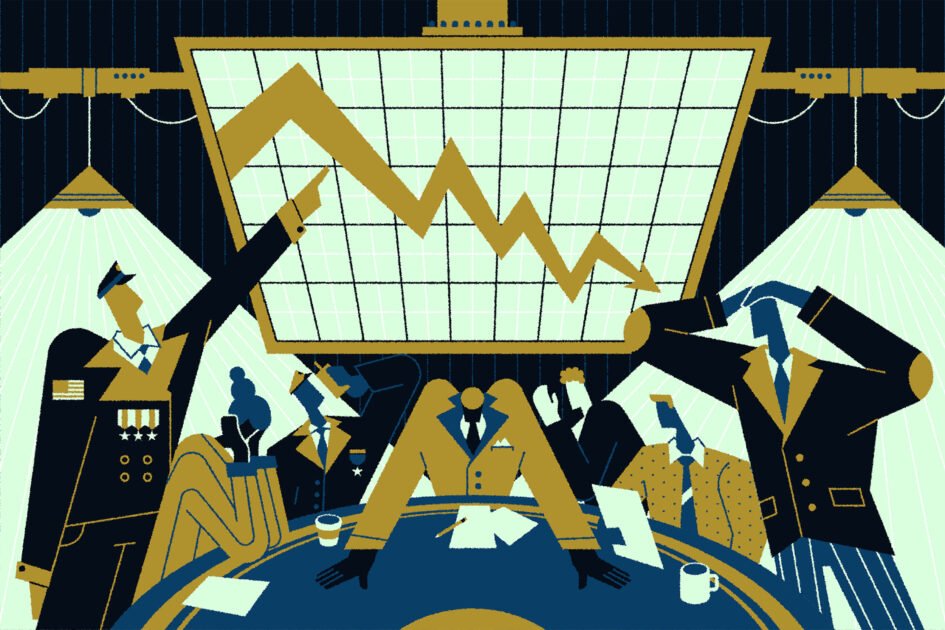
Although it is often the most striking visual effects that grab our attention, when considering the cost of war, it is important to understand how it affects the economy.
“Of course, the economic consequences do not cover all the misery that war causes people,” he says Ephraim BenmelechKellogg professor of economics and economist who studies the economics of conflict and national security. “But ultimately, the loss of human capital—people—and the destruction of property affects a country’s economic well-being and, to some extent, substitutes for some of that misery.”
While there are previous studies that have examined the impact of war on the economy, most have focused on a limited number of wars, regions, or years. Benmelech sought to expand the scope of this earlier work and collaborated with Joao Monteiro of the Einaudi Institute for Economics and Finance to investigate the macroeconomic consequences of wars throughout the world over a period of approximately 75 years.
Benmelech and Monteiro analyzed more than 100 wars in the post-World War II era and found that they resulted in severe and persistent negative effects on the economy of all countries involved in conflict. The consequences included a significant and long-lasting decline in real GDP, the collapse of investment, the deterioration of government finances, and a sharp rise in inflation.
Collectively, the findings make clear that the economic toll of war extends beyond the immediate costs of combat, leaving deep and lasting scars on the wider economy.
“There are some wars you can’t avoid,” says Benmelech. “So it’s important to know what the consequences are. And the quantification of the impact of wars is that wars are bad economic shocks.”
A common pattern in conflicts
For their study, the economists drew from a variety of publicly available records — including the Uppsala Conflict Data Project and the Peace Research Institute Oslo Armed Conflict Data — to identify all wars worldwide that took place from 1946 to 2023.
To qualify as a war, it had to be an armed conflict over a dispute over government or territory, involve at least one state government (or country), and result in at least 25 combat-related deaths per year.
The researchers examined 135 such conflicts in 115 countries.
For each war, they set the start of the conflict as day zero and then looked at what happened to a range of economic indicators for each country involved from five years before to 10 years after the war started.
They also matched each of the countries at war with a selection of 221 countries that were similar in terms of GDP, area, debt, and level of democracy, but were not at war during the same period. By benchmarking the economic performance of warring countries in these control countries, they were able to rule out factors other than war, such as natural disasters or poor governance, that might otherwise have significantly changed a country’s economy.
“This enabled us to show that there were no pre-trends, meaning that we could attribute the decline in economic conditions to the wars themselves,” says Benmelech.
A common pattern emerged among countries at war.
First, the war caused an immediate increase in military spending along with a decrease in spending elsewhere. Military spending on average rose about 9 percent at the start of the war and remained high for three years, the median length of a war.
War then led to the destruction of part of a country’s territory and material assets such as buildings and infrastructure.
And finally, war reduced overall productivity, not only because it interrupted production, but also because it made the misallocation of resources, the displacement or death of people, and the erosion of institutional control more likely.
War actually shrinks both the availability of a country’s assets and the efficiency with which they are used, ultimately reducing its economic output for a long time.
War, what is it good for?
As a result, almost all economic measures the researchers looked at worsened on average, even after adjusting for inflation.
Real GDP fell by about 13 percent, with no evidence of recovery even a decade after the war began. Household consumption fell by around 11%. Investment in the country’s infrastructure, technology and other sectors collapsed, falling by almost 14%. And there was a significant decline in exports (about 13 percent) and imports (about 7 percent).
The war also had a negative effect on the government’s budget. Average revenue fell by about 14 percent and tax revenue by about 9 percent. Although wartime spending remained about the same as before (with military spending up and other spending down), the large drop in revenue still meant that the country’s risk of running a deficit increased by about 9 percent.
In response to all these fiscal pressures, most countries resorted to issuing more currency, which fueled inflation.
“Wars were mainly financed through money printing and inflation,” says Benmelech. “The reason we’re seeing a decline in real GDP is largely because of that inflation. And as we all know, inflation has some very adverse effects on households.”
Indeed, price levels rose by nearly 50 percent and remained high for years after a war began. Inflation, in turn, eroded real debt and significantly devalued the local currency—an effect that persisted 10 years after the start of the war. This not only raised costs and interest rates for people in the country, but also further reduced investment.
A lose-lose situation
But not all wars produced the same results, the researchers found.
For example, there was a striking difference between how intrastate wars (within a country) versus interstate wars (between countries) affected the economy. Real output—the total amount of goods and services a country produced—was reduced by 20 percent in intrastate wars but only 10 percent in interstate wars. This highlights how much more damaging civil wars can be to a country’s economy compared to wars between nations.
“In previous centuries, war was mostly between state entities. But the most common type of war we’ve seen in the second half of the 20th century and the first quarter of the 21st century is intrastate wars between governmental and non-governmental actors,” says Benmelech. “To that extent, it is incredibly important to study these differences, which have been largely neglected in the literature.”
The researchers also found differences for countries that won versus lost a war. About 10 years after the war began, the winners saw a slight (not statistically significant) drop in real output relative to non-war countries, while the losers saw a 24% drop in real output—an estimated loss of $11.7 billion. This suggests that the defeated countries disproportionately bore the economic costs of the war, even though both the winners and losers saw a significant drop in real GDP.
Taken as a whole, the analysis confirmed what many scholars and governments have long reported: “The overall effect of war on the economy is negative,” says Benmelech. Even 10 years after the war began, “everybody seems to be losing.”
Difficult decisions
While the findings illuminate the clear economic downsides of war, they should not necessarily be taken to mean that a country should never engage in a war, according to the researchers. Rather, the survey offers a way for politicians, leaders, and scholars to quantify the impact of war on the economy if and when the time comes.
Europe, for example, has found itself in the difficult position of having to decide how much to invest in its militaries due to the looming threat of war following Russia’s invasion of Ukraine.
“I am not saying that Europe should avoid conflict altogether or, on the other hand, that Europe should necessarily appease Russia at any cost. [to avoid war]”But what the research provides are the numbers so that when decision makers look at them, they can do their own cost-benefit analysis and at least realize what the costs will be.”
*
Infographic illustrations by Michael Meier.
