




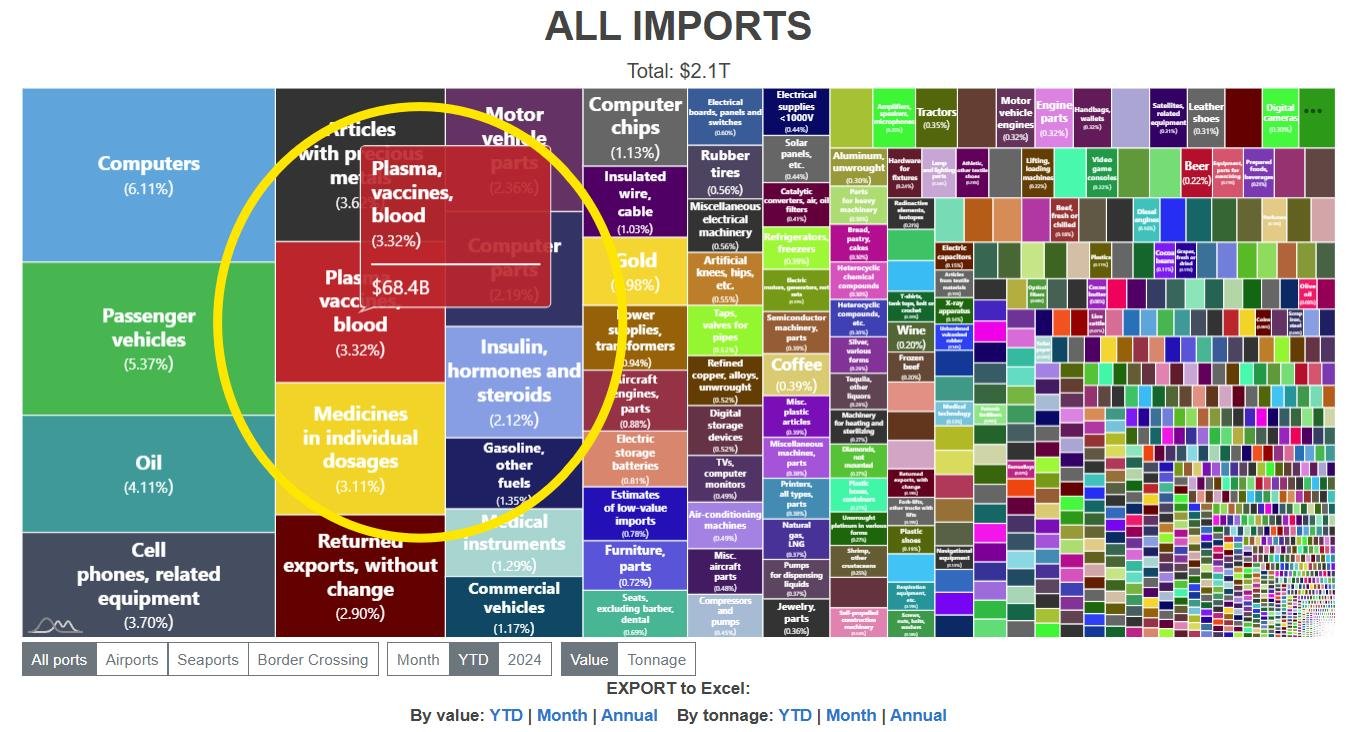
Imports of plasma, vaccines and blood fractions, single-dose drugs and insulin, hormones and steroids are the sixth, seventh and 10th most valuable imports this year, topping $140 billion, according to the latest US Census Bureau data, available only through July due to the government shutdown.
ustradenumbers.com
A freight transport integrator hopes it has a solution to a A $35 billion problem in the fast-growing business of exporting and importing temperature-sensitive pharmaceuticals – waste caused by a lack of temperature control from manufacture to end-use.
Frontier Scientific Solutions last month began flying between Ireland, where nine of the 10 largest and best-known pharmaceuticals in the world and generic brands are manufactured, and North Carolina’s Wilmington International Airport, where it has constructed a 530,000-square-foot warehouse built for the nation’s first “scheduled service” flights for the life science industry.
Backed by $1.5 billion in investment from GIDFrontier is called a cargo integrator because it leases widebody jets from ATSG, Temperature-controlled 767 wide-body aircraft it will use exclusively for steroids, vaccines, hormones, blood plasma, a wide range of pharmaceuticals that now includes GLP-1 drugs such as Ozempic, Wegovy and Trulicity and “active pharmaceutical ingredients” or APIs.
Chicago’s O’Hare International Airport ranks second among hundreds of U.S. airports, seaports and border crossings this year, boosted by booming imports of insulin, hormones and steroids. drugs in single doses. and plasma, vaccines, and blood fractions.
ustradenumbers.com
Imports of GLP-1 drugs, which mimic a natural hormone, have soared this year with their use as weight-loss drugs in addition to their original use as diabetes treatments. Chicago O’Hare International Airport has been a major beneficiary of the rapid development not only of GLP-1 drugs but also of single dose drugs and in the vaccine, plasma and other blood fraction category.
Solving the $35 billion problem isn’t just about the flights and sensors used to monitor temperature stability. In addition, Frontier created a foreign trade zone at the North Carolina coastal airport to close with the one associated with Shannon International Airport on the west coast of Ireland.
Augmenting the traditional benefit of trade zones – no duties are paid until imports leave the FTZ and “enter United States commerce” – the zone offers the ability to streamline the customs clearance process and allow for better timing as tariffs fluctuate.
The United States is, given the size of its economy, a large import market. The United States imported more than $225 billion in just three categories in 2024: single-dose drugs (HS 3003); vaccines, plasma and other blood fractions (HS 3002). and insulin, hormones and steroids (HS 2937). It also has a significant export market.
Most of these imports now arrive on passenger flights, what is called “belly cargo” in the industry, as opposed to trucks or planes that carry no passengers. What Frontier offers is somewhere between the two, offering scheduled service without bundling its customers’ loads with baggage that can lead to unintended damage, and freight service, which can be delayed based on space availability.
“The introduction of a life sciences compatible air corridor changes that dynamic,” said Frontier Transportation president Leandro Moreira. Leandro and I have known each other for over two decades and he bought limited commodity trading data from my company once before joining Frontier.
Ireland caught President Trump’s attention early in his second term as one of the initial “Dirty 15” due to the size of the US trade deficit with the European nation, much of which is linked to the life science industry. These deficits were the foundation of his trade war with Ireland and the rest of the world, based largely on IEEPA pricesthe constitutionality of which will be debated tomorrow before the US Supreme Court.
The goal of the Frontier Scientific Solutions effort, which will have three weekly flights at a time, is to limit the often avoidable “temperature excursions” when the mission exceeds the limits established for safe use. to mitigate expiration date issues related to flight delays or other delays in the supply chain; and to eliminate incidents arising from merging with other imports or exports that may not require the same sensitivity in handling.
“Industry data shows that about 60 percent of temperature excursions occur during airport ground handling, particularly when shipments are placed on the tarmac before loading or after arrival,” Moreira said.
To that end, Frontier Science Solutions is trying to solve a $35 billion waste problem that can’t be easily or reliably solved by conventional “belly cargo” flights, the industry’s biggest failure point: ground handling.
