




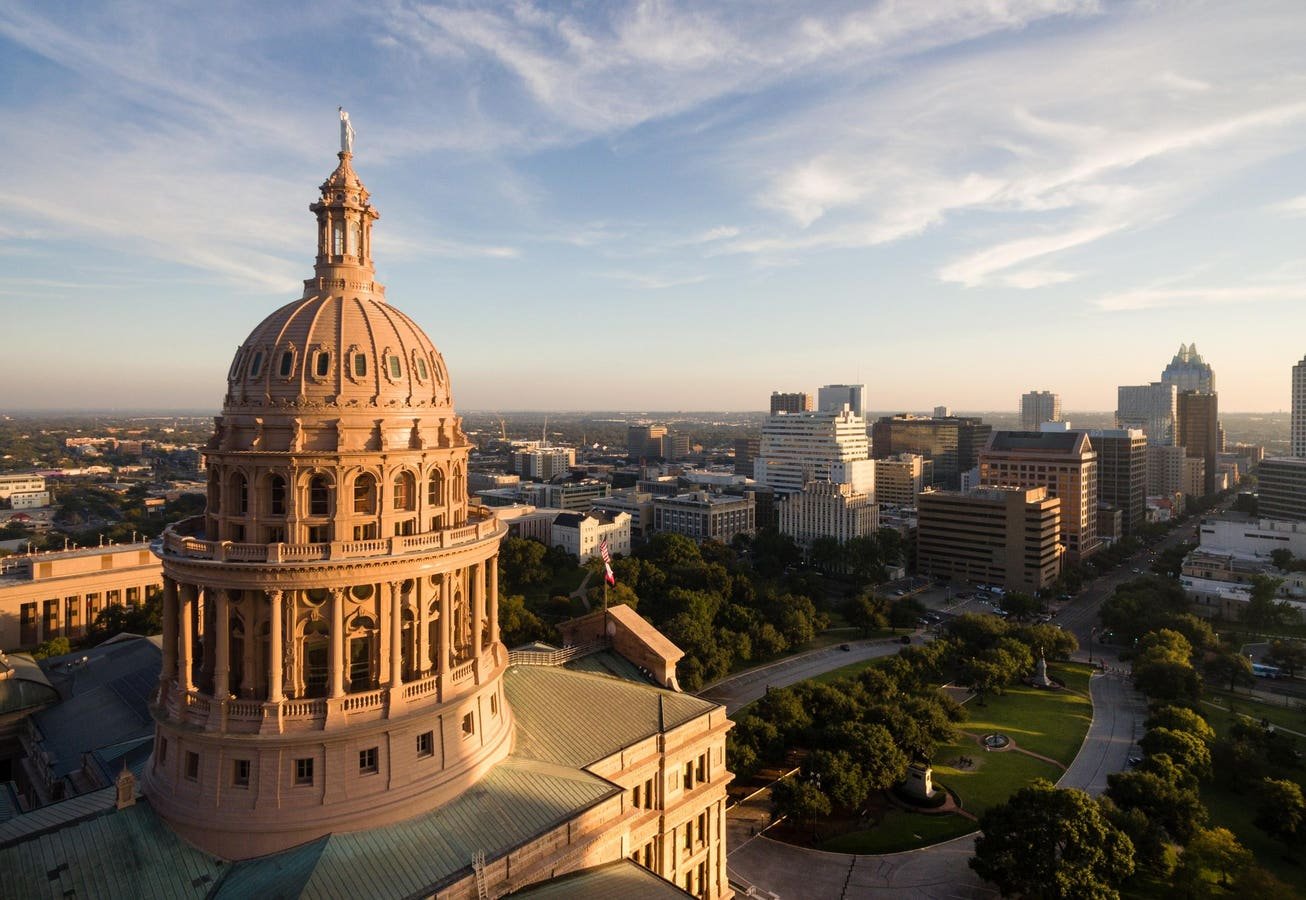
Texas capitol building
getty
Initiatives seeking to raise taxes appeared on this November’s ballot in Austin and Charlotte, two fast-growing cities in two of the nation’s fastest-growing states. For supporters of these proposed tax increases, the results have been mixed. More than 52 percent of voters in Charlotte and other communities in Mecklenburg County approved a 13.7 percent sales tax increase, raising the combined local and state sales tax rate from 7.25 percent to 8.25 percent. Meanwhile, in Austin only 36% of voters voted in favor of Proposition Q, which proposed a 20% property tax increase. Proposal Q was defeated with more than 63% of Austin voters rejecting the measure.
Although Austin and Charlotte share similar political landscapes, with Democrats controlling local government in both areas, the left-leaning electorates in those two cities made conflicting decisions on the tax increases that appeared on the 2025 ballot. But even though the two tax increase measures had different electoral results, recent results from these areas strengthen the case for a reform that was approved by the Texas Senate earlier this year. Additionally, the results from Charlotte and Austin also suggest how this Texas reform, which was reported favorably out of committee in the Texas House but did not receive a vote to send it to Gov. Greg Abbott’s (R-Texas) desk before adjournment, could be improved when reintroduced in Texas or filed elsewhere.
Senate Bill 1209, introduced by Sen. Bryan Hughes (R), would require all ballot measures that seek to raise taxes or authorize new bonds to be placed only on the November ballot. SB 1209 filed to prevent ballot proponents seeking to raise taxes or pass new bonds from placing it on a spring or summer ballot when turnout is significantly lower than in November. In fact, local elections held across Texas last spring while the state legislature was in regular session highlight the very practices that SB 1209 sought to prevent.
“In some of Texas’ biggest, costliest bond elections, voter turnout was anemic, meaning a small fraction of Texans saddled all their neighbors with new debt and higher taxes,” said James Quintero, policy director at the Texas Public Policy Foundation, after the low-turnout spring election. “This is not a good way to make big, important decisions.”
“Bond elections are best decided when the largest number of voters are involved in the decision-making process,” added James Quintero. “Something this obvious should prompt local governments to limit their bond elections to the single election date in November — and that’s it.”
When lawmakers return to Austin for the next regular session in 2027, they may consider strengthening SB 1209 by stipulating that not only must all tax and bond measures appear on the November ballot, but they must also be placed exclusively on November ballots. Lawmakers and Governor Abbott need only point to the election last November and how much smaller the electorate was compared to the election held a year ago in November 2024.
There were 164,504 total votes cast in Austin last November on Proposition Q, with 104,147 Austinites voting against the measure. Just one year earlier, turnout was 41 percent higher, when 233,376 Austin residents voted in November 2024.
The recent election in Charlotte also highlights how much more voters would have a say if tax and bond measures were required to appear only on the November ballot. While 177,735 votes were cast last November to raise the local sales tax, 580,321 Mecklenburg County voters went to the polls a year earlier in November 2024.
If North Carolina lawmakers sent the aforementioned sales tax increase to the ballot in November 2024 instead of 2025, that would have nearly tripled the number of voters who had a chance to weigh in. to pass. Last November, however, it took just 88,868 affirmative votes to pass the sales tax increase, less than a third of the votes needed for passage just 12 months earlier.
Even if the Mecklenburg County sales tax increase had been brought up in the 2024 general election with a higher turnout, less than a quarter of all Mecklenburg residents could bring in a sales tax increase of more than 13 percent. Placing it on the 2025 general election ballot, it required only 7.4 percent of Mecklenburg County residents to vote in favor of the newly enacted sales tax increase, which local media reported is misleadingly advertised as a “one cent” sales tax increase or a “one percent” rate increase, rather than the more than 13% rate increase that the ballot measure actually mandates.
In reporting on SB 1209’s progress last spring as it was being considered in the Texas Legislature, this writer noted that Senator Hughes’ proposal “could be a model that lawmakers elsewhere seek to implement.” The election results in Austin and Charlotte this November are the most recent examples that demonstrate the need for a reform like SB 1209, in addition to how it could be improved, but they are far from the only examples.
