




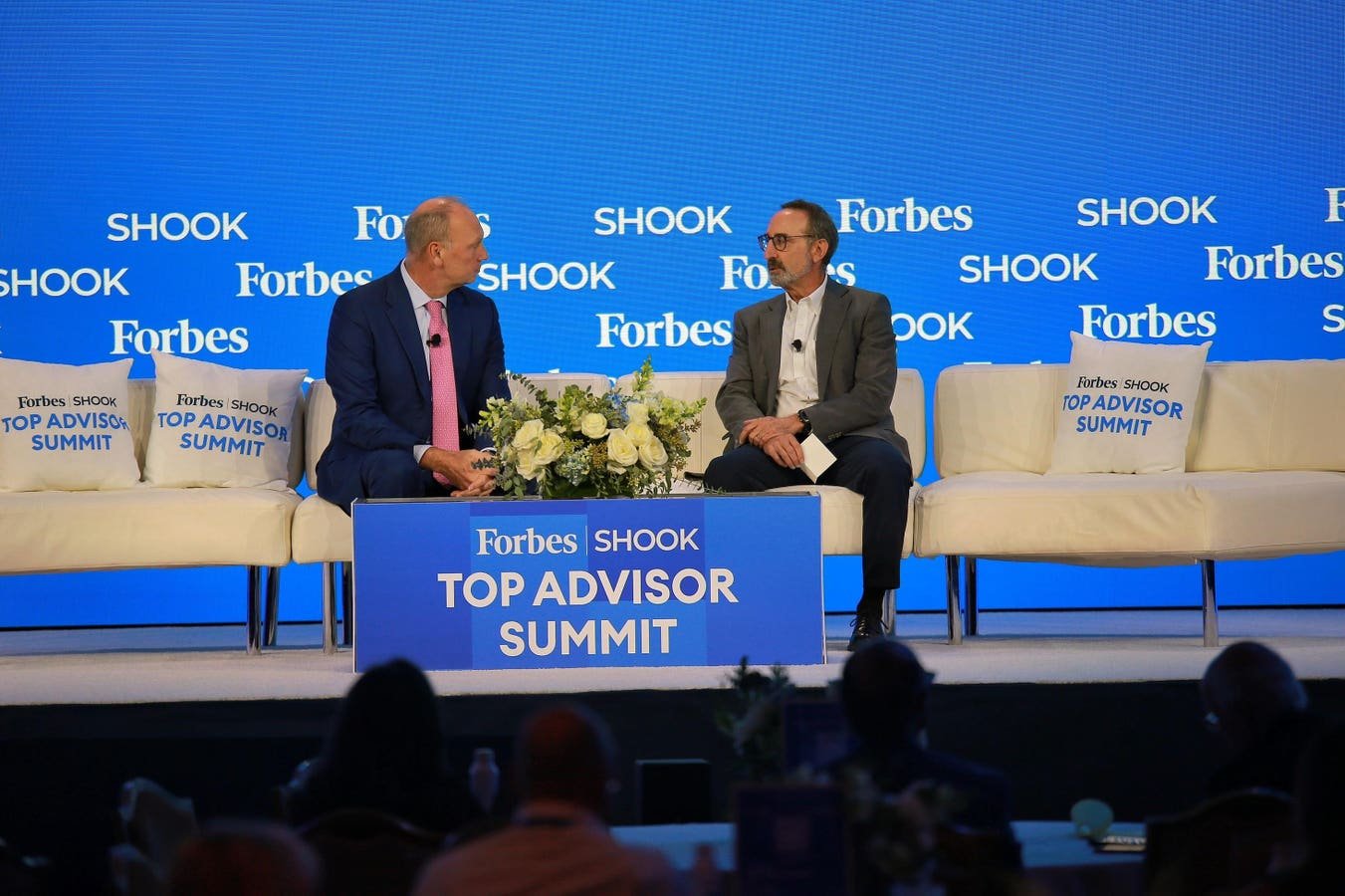
State Street Chief Investment Strategist Michael Arone (left).
Photo of Santa Barbara
State Street chief investment strategist Michael Arone says he’s still bullish on the market heading into 2026 — just not comfortably so.
“I’m uncomfortably bullish,” Arone told a packed room of wealth managers last Thursday at the Forbes/SHOOK Top Advisor Summit at Wynn Las Vegas. “We’ll get stimulus from the One Big Beautiful Bill—with a big tax refund next season, more rate cuts from the Fed and continued double-digit earnings growth,” he said. “This is a powerful combination, but the margin for error is small.”
With the S&P 500 hovering near record highs and trading around 26 times trailing earnings, Arone noted that analysts have indeed raised earnings estimates to third-quarter earnings. “This is unusual and means the risk of disappointment is high,” he said.
The chief strategist at State Street, which just topped $5 trillion in assets under management, still believes the upside case outweighs the risks: “The economy is cooling modestly, inflation is heading in the right direction and Fed policy is moving toward neutral.” Arone expects the Federal Reserve to cut interest rates at every meeting through the end of the year, with two more cuts in 2026. “Policy has been very restrictive at 4.25% to 4.5%,” he said. “They have room to relax without a resurgence of inflation.”
It identified two key risks to its outlook: the potential for inflation to pick up again if growth and labor markets remain stronger than expected, and the risk that extended valuations meet disappointing earnings. He is less concerned about the tariffs, which he said are “a bit excessive” in terms of their economic impact. “The real tariff rate could jump from 2.5% to 15%, and that could reaccelerate inflation somewhat — but so far, we haven’t seen any significant hit to GDP,” Arone said.
For this earnings season, he’ll be watching the corporate outlook more closely than quarterly. “Companies almost always beat estimates … The real story is what executives say about the rest of this year and next,” Arone said. “Given the uncertainty, I expect this outlook to be cautious.”
State Street remains overweight equities and real assets, underweight bonds and underweight cash. Arone still sees stocks as a reliable hedge against inflation, but says investors need to broaden beyond megacaps. “We encourage clients to diversify—in small caps, international stocks and balanced exposure to technology,” he said. “That way you’re still participating in AI and innovation, but you’re not duplicating the same names.” He added that small-cap stocks, meanwhile, are seeing a “triple benefit” from lower interest rates, fiscal stimulus and the potential end of quantitative easing.
Arone also continues to emphasize “real assets” — a basket that includes gold, commodities, natural resources, real estate and infrastructure — as a hedge against inflation and interest rate volatility. “Just holding gold is not a complete hedge against inflation,” he said. “We believe investors should have 10% to 15% of their portfolios in a diversified mix of real assets.”
He frames it as a modernized version of the traditional 60/40 portfolio: “Maybe it’s time to think 60/30/10,” he said, with that final 10% devoted to tangible assets. “Commodities and natural resources have led, but lower borrowing costs could revive interest in real estate and infrastructure.”
Arone described the Fed’s current dilemma as “a dual mandate in tension.” Inflation remains above target, but the labor market is resilient and political pressure to cut interest rates is growing. “They’re in a tough spot, but they’ve done a reasonable job,” he said.
Despite Washington’s impasse, Arone downplayed the latest government shutdown. “In 11 of the last 12 shutdowns, the economy subsequently expanded and the S&P 500 rose five out of five times,” he said. “This is very similar to 2013, when the market fell 4% and then quickly recovered.”
Longer term, he sees the growing federal deficit as a structural headwind that will keep interest rates high and volatility higher. “Interest payments will continue to rise and crowd out growth,” he said. “I’m not suggesting we go back to the 1970s, but we certainly won’t go back to the era of quantitative easing from 2008 to 2022.”
But he believes stocks will hold as long as the economy grows and earnings rise: “They’re still a great long-term hedge against inflation.”
