










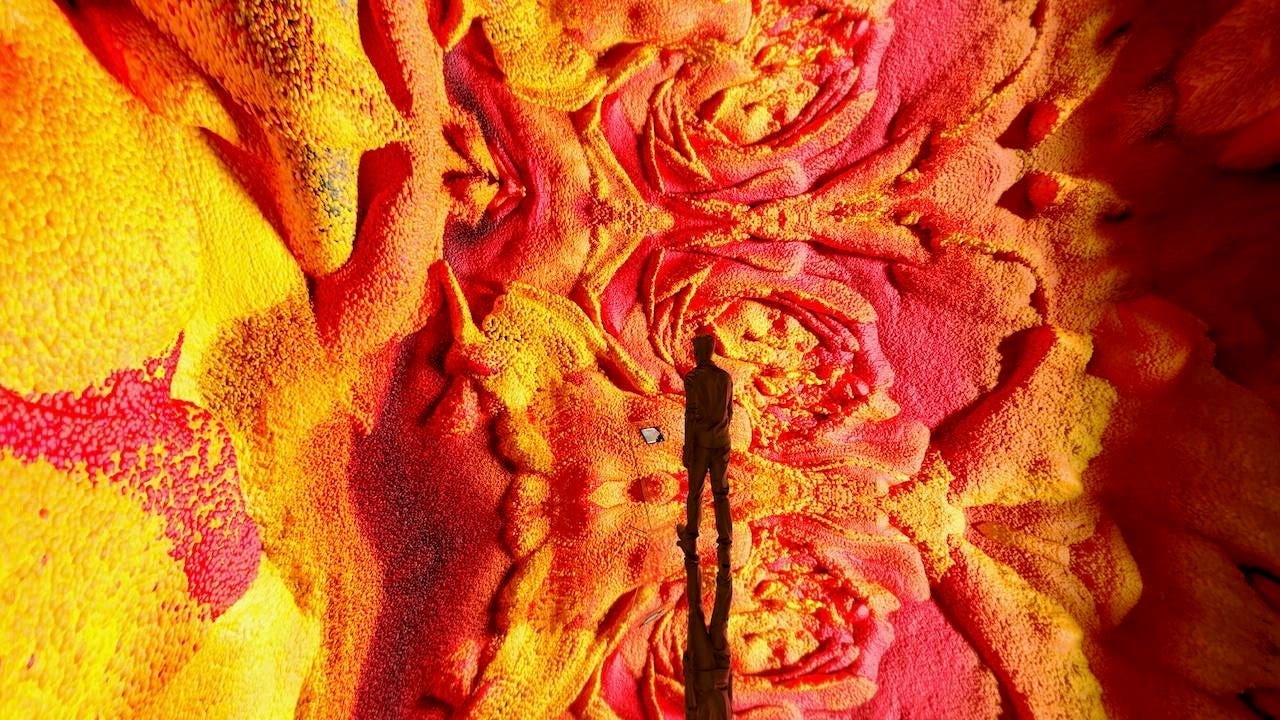
Refik Anadol trained “Archive Dreaming” on massive botanical datasets from Oxford University’s Bodleian Libraries.
Refik Anadol Studios
On a curved LED screen about 12 feet tall and 40 feet wide, shape-shifting digital figures in glowing oranges, reds and yellows bloom and dissolve into each other like flowers from an otherworldly garden.
This is not a hallucination. It’s “Archive Dreaming,” an immersive installation by Refik Anadol, a Turkish-American media artist known for synthesizing machine intelligence and data visualization to create public art, often on a monumental scale. His work has been presented around the world, in New York Museum of Modern Artthe Venice Biennale, the World Economic Forum in Davos, Switzerland, and Google headquarters in Mountain View, California, among other venues.
Over the past several years, Anadol’s creations have emerged from his studio’s “Large Nature Model,” a prototype AI system trained entirely on nature data such as high-resolution images, field recordings, and biosensor signals. Through prompts and autonomous processes, the model transforms the data into dynamic AI data tables that the artist hopes will inspire a new view of the physical world.
“Nature is the most inspiring thing we have as humanity from many, many angles,” Anadol said in an interview. “At Encyclopedia of Lifethere are more than 2.2 million species records that we discovered, but it’s very difficult to see the big picture.”
New home for the humanities at Oxford
‘Archive Dreaming’ will welcome visitors to Oxford University’s public opening on Saturday Stephen A. Schwarzman Center for the Humanitiesa new hub for the university’s humanities programmes: English language and literature, history, linguistics, philology and phonetics, medieval and modern languages, music, philosophy and theology. The center opened for academics in October and is now starting its cultural programming.
“It’s a place where we can all come together to understand what it means to be human in today’s world,” John Fulljames, cultural program director, said in a statement.
To realize ‘Archive Dreaming’, Anadol and his team used a collection of nearly 68,000 botanical images from Oxford’s Bodleian Libraries, one of the oldest and most important library systems in the world.
“This library is a library of heroes,” said the 40-year-old artist, one of the inaugural visiting artistic fellows at the Schwarzman Center. “For anyone who works with data, anyone who knows libraries and loves archives and books and knowledge, it’s one of the most incredible archives in the world. It’s a dream to be able to experiment with this data.”
Digital shapes reminiscent of nature bloom and contract on a huge curved LED screen at the University of Oxford.
David Levene
Anadol used high-resolution images from NASA’s Mars Reconnaissance Orbiter to create immersive Marscapes and transformed neurobiological data such as heart rate, skin conductance and electroencephalograms to depict travelers’ emotional journeys for the first time.
For the Oxford installation, he turned to the university’s Herbaria, a vast collection of botanical specimens, images and illustrations dating from the mid-17th century onwards, used for research, teaching and classification.
His team created AI-generated videos from Herbaria images prompting a diffusion model. These systems slowly refine random visual noise into a coherent image based on patterns learned from data.
But the enchanting colors and shapes swirling in ‘Archive Dreaming’ do more than evoke the majesty and mystery of nature. They also point to the technology’s potential to turn static repositories of information into something that lives and thinks, according to Anadol.
“It is like nature like mind,” he said. “Files are generally frozen entities. With machine intelligence, we’re trying to renew our understanding of how [they] one could imagine.”
Artist Refik Anadol creates art generated by artificial intelligence that he hopes will help people see nature with fresh eyes.
Refik Anadol Studios
Other Schwarzman Center artistic fellows who will access Oxford resources and collaborate with its academics on new work include Grammy and Pulitzer Prize-winning folk musician Rhiannon Giddens; famous British choreographer and director Sir Wayne McGregor; curator of contemporary art Hans Ulrich Obrist; and Tony Award-winning set designer Es Devlin, who has created sets for Beyoncé and Kanye West.
The Schwarzman Center opens to the public as automation touches every aspect of our lives, from the workplace to education, hospitality and design. It incorporates the Oxford Institute for Ethics in Artificial Intelligence, which launched in 2021.
In the art world, the phrase “artificial intelligence” evokes a range of responses, from excitement to fear and contempt. Anadol, though lauded as a pioneer of the art of artificial intelligence, has not been immune categories to create “AI slop”.
AI Art as a milestone and a test
“Choosing an AI artwork to inaugurate an important humanities space is a statement that this technology belongs in the conversation about culture, not outside of it,” Raphaël Millière, associate professor of theoretical philosophy at the institute, said in an interview.
But legalization without scrutiny misses the point, he added.
“It can be tempting to put an impressive piece of AI art in a beautiful room and let the spectacle be all the talk,” Millière said. “That would be a missed opportunity, and not what a place like Oxford is for. What drew me to this collaboration is that Refik was unusually willing to engage with deep and difficult questions about data, writing and the role of AI in his artistic process.”
Anadol believes it is important for artists to be transparent about their use of AI and also for the public to distinguish between the many ways artists incorporate the tools.
“I love all the current AI models and I love working with them,” Anadol said, “but when artists create a model, work with their own datasets, travel around the world and collect petabytes of data, it has to be treated differently.”
This distinction is, increasingly, the focus of his practice.
Anadol co-founded Datalandwhich is billed as the first museum dedicated to the art of artificial intelligence. It is set to open this spring at Grand LA, an entertainment and residential development in downtown Los Angeles designed by Frank Gehry.
“Rejecting all AI technologies as an artistic medium will not protect art, it just limits it,” Anadol said. “Artists who embrace new tools are not replacing the old masters. They just unite them.”
The Stephen A. Schwarzman Center for the Humanities houses facilities for Oxford students, staff and researchers along with performance spaces.
David Levene


