




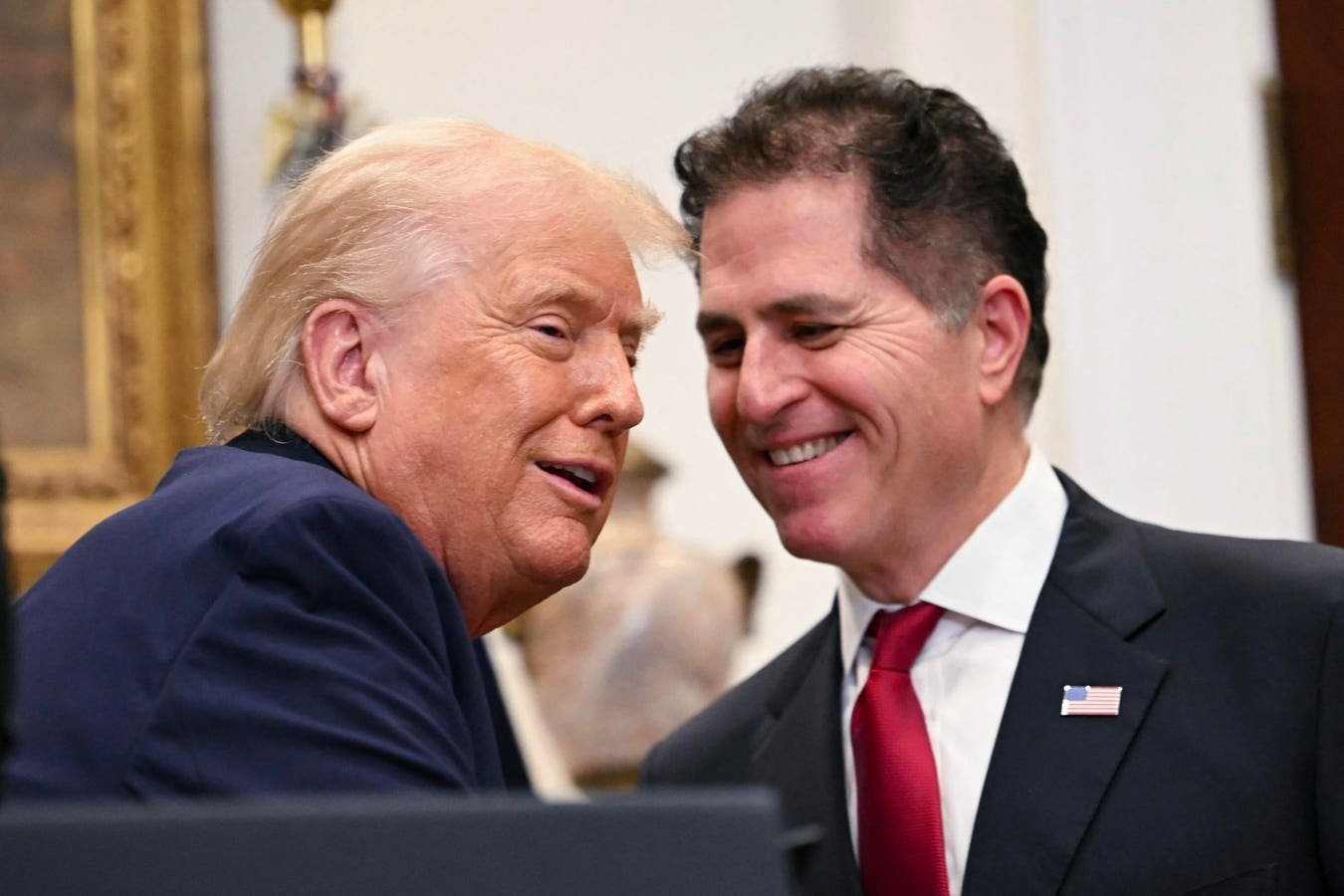
President Donald Trump announced a $6.25 billion donation from Michael and Susan Dell to support the new Trump Accounts children’s investment program.
AFP via Getty Images
When Michael and Susan Dell announced a $6.25 billion pledge to create investment accounts for 25 million children in America—an initiative popularly known as “Trump Accounts”—the news generated a lot of excitement, and for good reason. Rarely do we witness an intervention that simultaneously touches family finances, economic development policy and the broader national savings rate. The Dells’ pledge is an act of philanthropy, but it’s also a macro-economic event.
The gift expands President Trump’s Invest America initiative, a federal program created under the One Big Beautiful Bill of 2025 that established tax-advantaged investment accounts for American minors. The government had already promised a $1,000 seed deposit for newborns between 2025 and 2028. Dell’s pledge adds $250 per child for millions of older children, especially those in households earning less than $150,000 who would otherwise not benefit from government seed funds.
For decades, economists have sounded the alarm about the stagnant accumulation of wealth at the bottom of the distribution. Roughly one in three American households have either zero or negative net worth. Even many middle-income families have little more than a paycheck or a mortgage separating them from financial hardship. In this context, a national program that creates wealth-building accounts for children is a transformative step.
What the commenters are saying
What is certain is that not everyone is applauding. Some critics argue that $250 per child is too small to make a significant difference, even when combined with the federal deposit. They note, correctly, that these amounts will not alone pay for college or close the racial wealth gap. Others have taken a skeptical look at the excitement surrounding billionaire philanthropy, suggesting that large donations align with presidential initiatives blur the line between philanthropy and political influence.
Still others worry that policymakers may substitute private generosity for national reforms aimed at reducing inequality. The Guardian, for example, respondent whether these gifts reflect a trend toward outsourcing public policy functions to the ultra-rich.
But this critical framework, while worth acknowledging, misses the forest for the trees. The real story here is not the exact dollar amount of Dell’s contribution, nor the motivations that critics claim are divine. It is the reorientation of national policy toward saving and long-term wealth building, a shift that is especially important after decades of consumption-driven politics and chronic underinvestment in the nation’s physical infrastructure.
This is why many other commentators were more optimistic. Coverage in the business press underscored the appeal of an initiative that gives millions of families a stake in America’s economic success. Financial planners famous that, unlike 529 plans, these accounts have flexible uses that extend beyond education, allowing withdrawals for a first home, starting a business or other wealth-building activities. Still others praised the psychological impact. When children and their families have even modest investment accounts, they can begin to develop the habits and attitudes related to financial and emotional stability.
Michael Dell himself captured this idea succinctly when he said The aim was to build “hope, opportunity and prosperity for generations to come”. This framework is ambitious, but it reflects a sound reading of economic theory. Policies that expand access to financial markets and expand asset ownership improve household resilience, boost national savings, and contribute to long-term economic growth. These are worthy goals, and the Trump administration deserves credit for pursuing them.
Because saving matters more than ever
For decades, the United States has struggled with one anemic national savings rateeven as aging demographics and rising fiscal obligations put increasing pressure on the economy. Public policy did not help. Tax incentives often encourage consumption over saving, and Washington often treats investment as an afterthought compared to short-term incentives.
That’s why the Trump administration is refocusing on household savings alongside its separate efforts to take over equity positions in private companies, it marks a significant departure from the status quo.
The idea that the federal government should own equity represents a change for a country that has historically favored debt financing and eschewed ownership of public assets. Trump’s push in this direction, however modest, is in line with a growing international consensus. Countries as diverse as Norway, Singapore and the United Arab Emirates have demonstrated the stabilizing and growth-enhancing benefits of sovereign wealth funds. Their experience shows how common ownership of productive capital can strengthen public finances, diversify sources of government revenue, and reduce dependence on taxation and debt.
The Trump Accounts program complements this vision. If the government is starting to act more like an investor, why not bring American families along for the ride? Expanding asset ownership democratizes access to financial returns. It helps align the long-term interests of citizens with the success of the nation’s economy. A population with a financial stake in national growth is in a better position to weather recession and support pro-investment policies that drive prosperity.
Dell’s pledge is exactly the kind of private sector partnership that reinforces the government’s initial investment in this sector. This philanthropic step reinforces a promising policy architecture and accelerates the timeline in which millions of families will experience tangible benefits.
The productive power of even modest wealth
Analysts may dismiss small dollar bills as symbolic rather than substantive. But the evidence shows the opposite.
Economists who study the economics of saving consistently find that even small initial balances can dramatically increase the likelihood that families will continue to save. Guys who they grow up with savings accountseven accounts with relatively low balances, are more likely to attend college, start businesses, and accumulate greater wealth as adults. In this sense, Trump accounts act as “baby steps” into the world of financial markets, helping families build capacity and confidence.
Moreover, when millions of households start saving at the same time, the macroeconomic effects can be significant. Increased national savings help finance investment without relying too heavily on foreign capital. Higher investment boosts productivity, which is the basis for rising wages and living standards. A society with deeper capital markets and broader ownership is more dynamic, more stable and fairer.
Michael Dell’s $6.25 billion contribution should therefore be understood as an injection of seed capital into America’s long-term productive capacity. It reinforces a plan for more universal asset building that, if sustained, could be a generational shift in economic policy.
A step towards a more prosperous future
Encouraging savings in households with little or no net worth isn’t just compassionate, it’s financially sound. It promotes economic independence, reduces inequality of opportunity, and strengthens the macroeconomic foundations on which American prosperity rests.
Critics will continue to debate the motives and magnitudes. They always do. But sometimes, economists and policymakers who focus too narrowly on such issues miss the power to catalyze change. Programs that seem small today can, with time and continuous improvement, develop into pillars of the national economic strategy.
In a political era often defined by division, the Trump bills and Dell’s promise offer something refreshingly constructive. A shared investment in the next generation of Americans is perhaps a first step toward a national savings culture that can ensure the nation’s prosperity for decades to come. This is something worth celebrating.
