










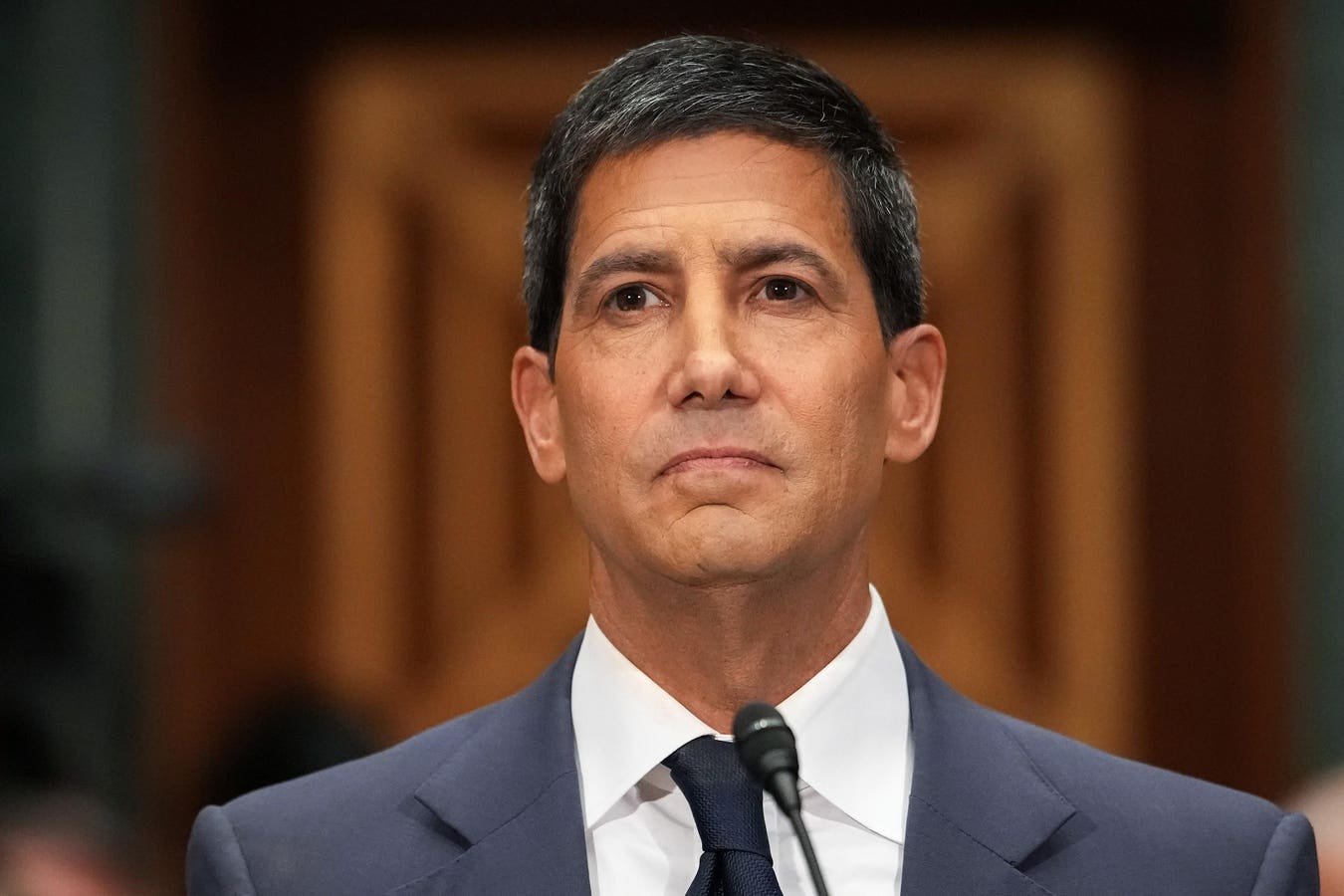
WASHINGTON, DC – APRIL 21: Kevin Warsh, US President Donald Trump’s nominee for Chairman of the Federal Reserve, prepares to testify during a Senate Banking, Housing and Urban Affairs Committee confirmation hearing in the Dirksen Senate Office Building on April 21, 2026 in Washington, DC. President Trump nominated Warsh, a former Federal Reserve Board member, to replace Jerome Powell amid bipartisan concerns about the Justice Department’s criminal investigation into the central bank’s current leader. (Photo by Andrew Harnik/Getty Images)
Getty Images
While Fed Chairman Kevin Warsh has their undivided attention, he can helpfully remind leftists, rightists, libertarians and in-between that market pricing is a global endeavor. Translation, the Fed couldn’t fight what economists mistakenly think of as inflation even if it wanted to.
Consider Apple’s iPhone given its ubiquity in the US and around the world. What perhaps hasn’t been said enough is that the iPhone is the result of components and ingenuity sourced from Apple on six different continents. That’s why it’s so cheap. Absent Apple’s remarkable ability to spread its production across myriad hands and machines around the world, the iPhone would not exist and would not exist because it would be so expensive that the network economic effects of its production would be non-existent.
Please remember this as economists and experts claim that rising prices are evidence of inflation. They haven’t the faintest idea. Not only does a rise in price imply a fall in price as it is, to focus on so-called “monetary policy” when trying to understand the significance of prices is to completely misunderstand what is driving prices down in the first place. What matters is not what the Fed does, but what well-run companies like Apple do to spread production around the world. Just as Henry Ford was able to build cars only for “the great crowd” to the extent that his factories allowed for a massive division of labor, so Apple can put supercomputers in our pockets for the same reason.
Warsh will then have to tell his excited audience that they didn’t fully understand what he meant about the impact of AI on prices. While the addition of billions and trillions of mechanized hands will push the productivity of humans and machines skyward on the path to astonishing amounts of low-cost abundance, the wealth creation implied in the latter portends massive jumps in the cost of hotel suites, massages, rounds of golf, and countless other consumer items. See above. Just as an increase in price implies a decrease in price, so a decrease in prices implies an increase in prices.
What’s important is that the Fed can’t do anything about it. Consider economists’ curious focus on the Fed funds rate as a supposed indicator of “tight” or “easy” money. How could so many well-educated people be so dim, and their so-called knowledge so contrary to reality?
Back to reality, and assuming an AI-driven increase in productivity, credit flows to the United States in search of the latter will soar, regardless of the Fed’s suffering. Never forget that credit is that is produced from a lender and The borrower, the lender through excess resources derived from increased production, and the borrower as a result of expected productivity increase this rate of credit (usually equity, but sometimes the type of loan) in increasing amounts.
Warsh might add that some appreciate his disdain for the Phillips curve, as they should, but that he had to demonstrate that disdain before the productivity leaps that have the potential to make the past seem slow by comparison. Equally important, he should add that no amount of Fed intervention can shrink credit as it is. See previous paragraph. Since it is produced and measured in dollars, in addition to productively putting their dollars into coffee cans, their surplus will be borrowed and invested. Credit is When idle.
Finally, Warsh should inform the uninformed that inflation is a contraction of the monetary unit, higher prices the occasional result. Then he should add that the dollar’s exchange value was never part of the Fed’s portfolio, so the Fed really can’t fight inflation. To believe otherwise is to conflate a discredited Phillips curve with the discredited Keynesian theory that falsely says money saved is money taken out of the economy.


