











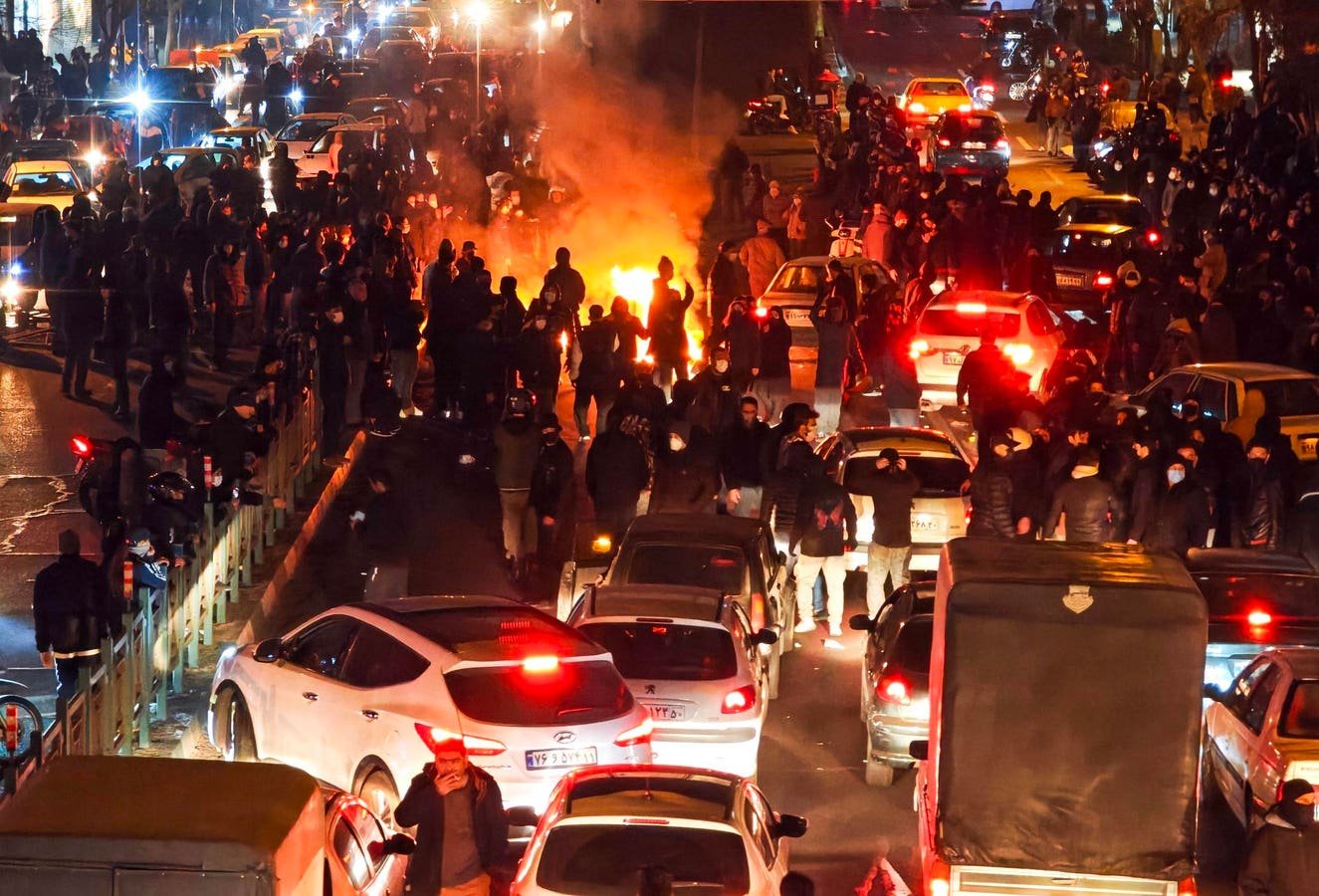
Iran has been experiencing quite a bit of turmoil recently. The reasons for this are “complex” – Iran has many foreign enemies and the situation smacks of an attempt”color revolution” – but the Iranian government has also been doing a lot of things on its own, recently and for a long time. It’s no surprise that even the most patriotic Iranians can be very unhappy today.
TEHRAN, IRAN – JANUARY 8: People gather during a protest on January 8, 2026 in Tehran, Iran. The protests have been ongoing since December, sparked by rising inflation and the collapse of the rial, and have expanded into broader demands for political change. (Photo by Anonymous/Getty Images)
Getty Images
The reasons for this, as promoted on social media, are supposedly “Islamists”, although Iran has been Islamic since the seventh century. The most likely reason is that Iran is also experiencing moderate hyperinflation while also raising already high taxes to unbearable levels.
Iran’s currency, the rial, was once quite reliable. In 2003, it was about 8,000 riyals per dollar. and in 2011, it was around 10,000. A little slip, but nothing too bad. But soon after, the rial collapsed. Until 2019, it took 42,000 rials to buy one dollar. Capital controls then put the currency on lockdown. In early 2026, It reportedly takes over 1.4 million riyals to buy one dollar on the black market. Today’s rial it is only worth about 1/140 of its 2011 value.
According to the Iranian website Bonbast.com, the black market rate has moved from 800,000 to 1,400,000 (+75%) from just June 2025. The official “inflation rate” was 42.5% in December 2025, compared to a year earlier – but even that is considered whitewashed government fiction.
If I were an Iranian citizen, I would be rather unhappy about it. But it gets worse.
Extreme inflation undoubtedly results from Iran’s fiscal deficit of 5.5% of GDP in 2025, continuing a long streak of deficits. Of course, the government wants to solve this, with higher taxes. Recent proposals include an 85% increase in tariffs, an increase in VAT from 10% recently to 12%. and the removal of an inflation adjustment to capital gains; making inflationary nominal increases partially taxable (big deal when even the bogus official CPI is over 40% a year and the currency is worth 1/140 of what it was just a while ago).
This continues a long line of tax increases in Iran. VAT, to take one example, was first introduced to replace a variety of indirect taxes in 2008 at a rate of 3%. In 2011 it rose to 9% (when the currency collapsed). Added a health levy, increasing the effective rate to 10%.
The template corporate tax is 25%. The top personal income tax 30% rate is not that high, but this level was hit in income 4,200 million riyals in 2024which was then about $5,250 and at today’s rates about $3000. Then there is Salary Service Tax a combined 30%.
This would be a terrible charge by any standard. But the amazing thing isthis tax system obviously generates revenue of only 4.9% of GDP!
In other words, it is completely dysfunctional. Nobody pays these taxes. So the government runs a big deficit – even though it doesn’t actually spend that much money. And to finance the large deficit, it prints money, leading to hyperinflation.
Yeah, I’d be a little unhappy about that too.
But, there are some silver linings to this story. Since the present situation is completely unbearable, we can make radical changes. The political time is right. Because the current tax system generates almost no revenue, we don’t have to worry too much about revenue. If our new tax system generated just 10% of GDP in revenue, that would be a huge improvement. If GDP also grew rapidly by 100% – as a result of stabilizing the currency, ending hyperinflation and introducing much lower taxes – then real tax revenue would roughly triple. Three times more revenue, with much lower tax rates.
In fact, many governments have recently done just that, so we know how to do it. Between 1994 and 2008, more than a dozen governments in the former Soviet sphere, including Estonia, Bulgaria, Kazakhstan, Ukraine, and others, experienced dire hyperinflation. They had also adopted Western European rules in taxation, with results like Iran today. The combination of hyperinflation and high taxes was an economic disaster. The solution was to stabilize the currency and also introduce much lower taxes, mainly in the Flat Tax model proposed by the presidential candidate Steve Forbes and other leaders of the time, including Jack Kemp and Dick Army.
Estonia led the way, ending hyperinflation by pegging the value of the currency to the German mark (later the euro) using a currency board system in 1994. Estonia also rejected Western rules on taxes and introduced a single income tax. The figure of 24% seemed radically low at the time. Subsequent governments went even further, with Bulgaria replacing its income tax system, which had a top rate of 50%, eventually with a flat rate of 10%. (You can read about my Bulgaria adventures in my 2019 book The Magic Formula.)
But that is not what I am suggesting for Iran today. Instead, I propose the complete abolition of all income taxes in Iran, leaving only the 10% VAT. Also, payroll taxes should be reduced to 10%. I would probably phase them out completely, over time. These two taxes, with a combination of tariffs and other revenues, should easily generate 10% of GDP in tax revenue. Iran would have no income taxes – like the super-successful Dubai. (Dubai introduced a 9% corporate tax rate in 2023, which doesn’t sound like a good idea to me.)
Iranians understand that the government needs some money to operate and paying 10% VAT is not something you would become a criminal to avoid. They would willingly pay the modest taxes. Basically, with only one tax to enforce, the tax authorities can easily focus their attention on strict management.
Now that the Iranian Rial is basically confetti, we can do whatever we want about the currency. Estonia and Bulgaria replaced their hyperinflationary currencies with currencies pegged to the German mark. This was logical, since they are located in the European neighborhood of Germany. But I don’t think Iran wants to become a debtor of the European Central Bank. Iran of course would like some kind of all-sovereign solution, subservient to no one.
The obvious solution is gold. Iran has a long history of gold-based money. THE Persian Darik it was one of the leading gold coins of the Ancient World. Later, the Golden Dinar it was the currency of the kingdom, during the Golden Years of Saracen civilization. To take a more recent example, when Germany ended its hyperinflation in 1923the rentmark and later the Reichsmark were fixed in gold.
To do this, Iran must pay “cash only”. The government does not spend money unless it receives it first, as tax revenue. Then, there is no pressure on a central bank to issue currency to finance the government. This is how Germany and Japan ended hyperinflation in 1949. The tripling of tax revenues likely to follow major tax reform and currency stabilization would soon solve spending needs.
When people get rich, so does the government. Guess how much better off the Iranian people will be when all income taxes are abolished. Much better.
Guess which government could then become very, very popular.


