




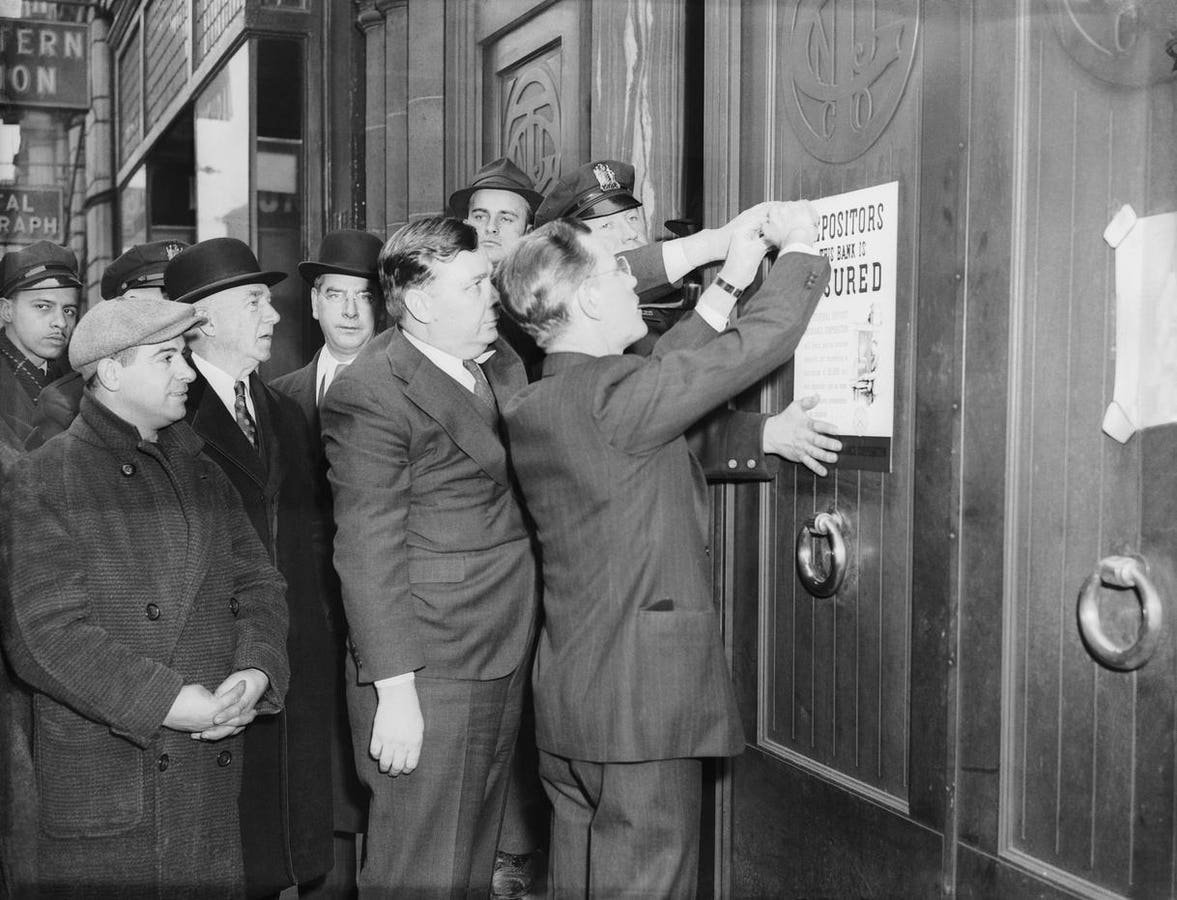
Notice from the Federal Deposit Insurance Corporation that the New Jersey Securities and Trust Guaranty Company has failed is taped to the door of the $23,000,000 bank in Jersey City. Very little will be lost for investors, the FDIC says, since all deposits up to $5,000 are protected by it. It is by far the largest bank failure settled by the FDIC since its inception after the 1933 bank holiday.
Bettmann Archive
Independent Community Bankers of America, the trade association that markets itself as The Nation’s Voice for Community Banksit is officially supporting the newest legislation to expand federal deposit insurance coverage. Before we get to the details of this new bill, it’s worth considering who exactly the ICBA is talking about.
Many community bankers are opposing the new insurance expansion, and ICBA doesn’t exactly have a perfect track record when it comes to supporting unpopular legislation.
Many outside of Washington may not know this story, but ICBA helped put the 2010 Dodd-Frank bill into effect by making a deal with Representative Barney Frank (D-MA).
The deal was simple. Cam Fine, then ICBA president, agreed not to oppose the bill in exchange for two things. First, the new Consumer Financial Protection Bureau will have supervisory authority only over banks with more than $10 billion in assets. In other words, the CFPB will be able to station federal employees (supervisors) at the nation’s largest banks, but not in the more than 5,000 ICBA member banks.
The problem, of course, is that small banks still have to comply with the CFPB’s rules and regulations, and few are happy with that outcome. I’m not sure how many small town community bankers are still big fans of Dodd-Frank, but at least they know who to thank for it.
Community bankers were hooked on FDIC deposit insurance
The second part of the agreement changed the formula used to calculate the fees banks pay to the Federal Deposit Insurance Corporation to cover deposits. The new formula was a win for ICBA members because it increased the share of FDIC insurance premiums paid by the largest banks while reducing the share paid by ICBA members. Dodd-Frank also permanently raised the insurance cap to $250,000, making that part of the deal look even better.
But while the deal certainly saved the “small” banks, collectively, billions a year in direct fees, those fees are only a fraction of the total cost of extending FDIC insurance. And the idea that “the big banks” are paying all these costs is far from reality. Heavy.
For starters, American taxpayers are finally on the hook for any losses that the FDIC insurance program can’t cover. This adds to the well-known moral hazard problem (the incentive for people to take on more risk because they are federally insured) and reduces the incentive for large depositors to carefully monitor what the banks are doing with their money.
Additional direct costs for larger institutions may also filter indirectly to smaller banks increasing the overall cost acquisition of funds. And, of course, the expansion of FDIC insurance further justifies federal regulation.
This last element is perhaps the most often overlooked drawback. But FDIC insurance was basically the original sin in banking in terms of justifying federal regulation, and the regulatory burden has been steadily increasing for nearly a century—with very little to show for it in terms of financial stability.
Either way, the newest approach to raising FDIC insurance limits will only magnify each of these problems, and the costs will ultimately fall on millions of Americans.
Hagerty-Alsobrooks Deposit Insurance Extension
The newest bill to expand FDIC insurance coverage is co-sponsored by Senators Bill Hagerty (R-TN) and Angela Alsobrooks (D-MD). Their effort seems to have the support of Finance Minister Scott Bassett, who recently told a group of community bankers that he was “encouraged to see emerging bipartisan support for increasing FDIC insurance limits on noninterest-bearing transaction accounts.”
The bill is called the Main Street Depositor Protection Act, but that title is populist politics at its best. The bill would increase the FDIC coverage limit from $250,000 to $10 million, for all transaction accounts at banks and credit unions. And it would push most of the direct fees to the biggest banks, just like the Fine-Frank deal in 2010.
But the claim that this increase is intended to protect the average American worker or small business owner is ludicrous.
Using the most recent public data available (June 30, 2025), less than one percent of bank accounts have more than the current FDIC insurance limit ($250,000). At 54 percent, the share of balances over the limit for these accounts is significant, but this fact only further shows who benefits from the increase in the limit. Hint: they are not Main Street depositors.
The typical American—even the typical wealthy American—simply does not anywhere almost $250,000 in a bank account. And those who do can already avoid getting stuck with uninsured balances by spreading their accounts, as well as using mutual deposit networks and “sweep” accounts. So-called small businesses with payroll accounts have the same options.
Community Bankers’ Washington Problem
ICBA wants people to believe that the nation’s small banks are the backbone of America. Likewise, Secretary Bessent claims that “community banks are essential to America’s heartland” and that these banks “provide the capital that binds small towns together.”
At the same time, however, they are telling everyone that it is critical to give these banks more federal support. If federal support is really that important, then America—not just its banks—is in big trouble.
Over the years I have been to countless policy forums where academics and government officials speak fondly of the 1930s enforcement of FDIC insurance. It is past time to let it go.
Yes, federal support helped quell a panic during the Great Depression. Yes, there were fewer bank runs in the FDIC era. But federal policy before the Depression helped create the panic of the 1930s, and federal policy since then has been at least partially responsible for two major meltdowns. However, FDIC coverage (and wider federal support) does not have stopped panicked even by insured customers.
Even worse, FDIC insurance has almost destroyed the incentive for people to create private insurance solutions. The policy combination of increased federal support and Regulation has left markets less competitive and less resilient than they would otherwise be. The approach has created all kinds of rent-seeking elements in the financial sector and left many Americans with the impression that the free enterprise system cannot work in financial markets.
However, the larger impact on the US system is much more serious because there is no objective economic reason not to cover all financial losses. The failure of companies like Walmart, Apple and Amazon, for example, would jeopardize the ability of millions of people to earn a living. Do America’s leaders believe in capitalism or not?
The underlying issue is now much larger than what is the appropriate limit for FDIC insurance caps.
-Jerome Famularo provided research assistance for this article.
