




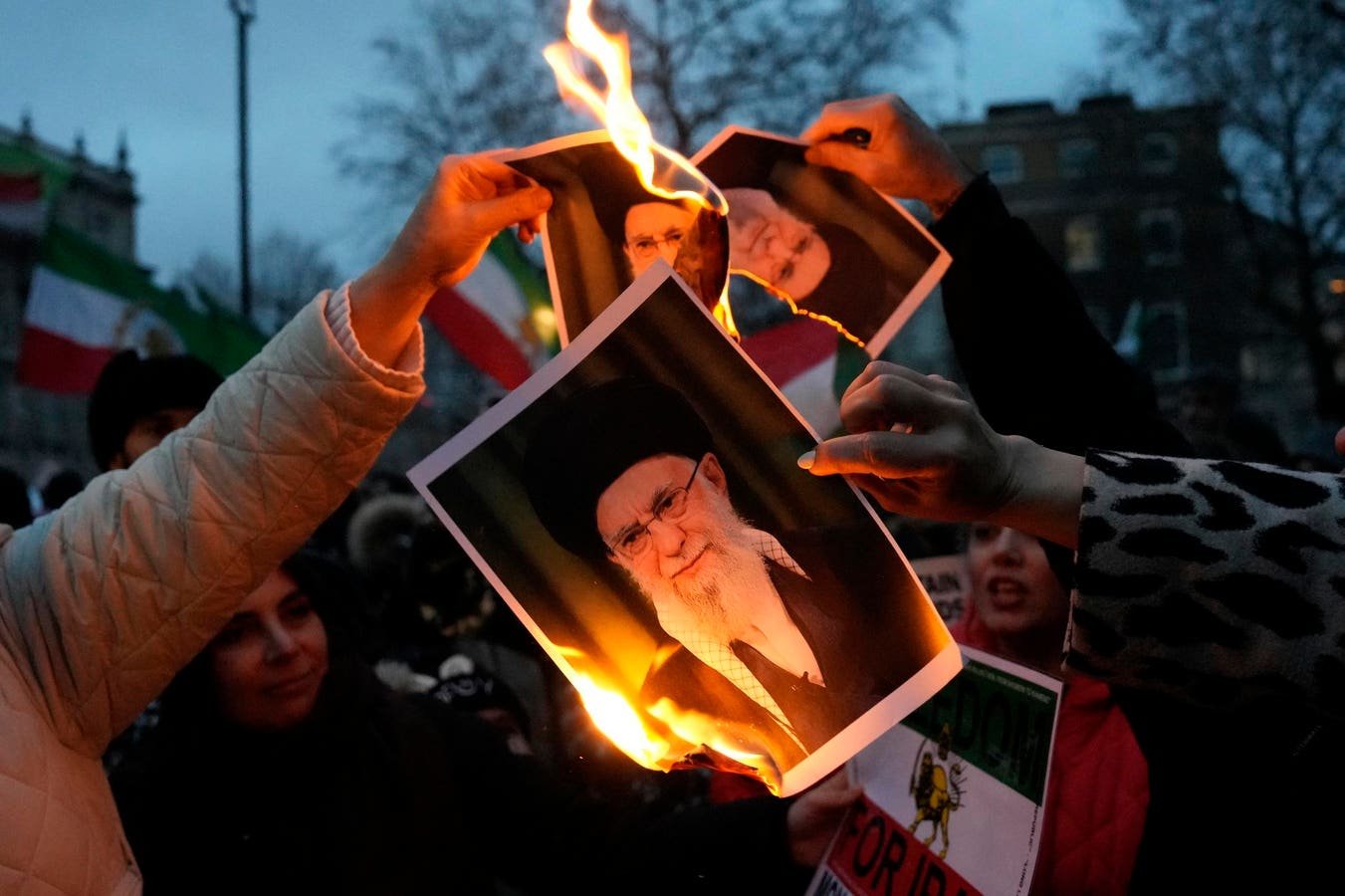
The insurgency has claimed more than 16,000 deaths and many more injured. The regime must go, but will Iran break? (Photo by CARLOS JASSO/AFP via Getty Images)
AFP via Getty Images
This last weekend, an op-ed I wrote about Iran in the Wall Street Journal and received hundreds of angry comments in various media outlets. Some were threatening. Many clearly hadn’t read the piece, but reacted to the provocative headline “A Fractured Iran May Not Be So Bad.” I hereby offer a response in this column to the more coherent reviews.
A moment to rebut a rather high-minded commentator who dismissed my thesis as the ramblings of an “armchair philosopher”. I have covered every country in the immediate area on the ground, including Iran, for nearly three decades, often at the risk of my life – for the Wall Street Journal, Newsweek, Forbes and other top outlets. This means Turkey, Iraq, Syria, the Caucasus, Russia and Central Asia. Armchair;
To address in advance the cause of so much anger in the comments: the idea of accepting fragmentation was offered in the last sentence of the article “for the sake of regional and world peace” after a series of arguments leading to this conclusion. The main argument, however, was fragmentation for the sake of peace among the population – that is, for the benefit of the people being slaughtered by a strong central regime, now and in previous years. And also to warn of bloodshed if civil war follows regime change, bloodshed between nationalists and those fed up with being associated with an ever-unstable country. Which has brought them nothing but grief.
But to start from the beginning. The essay had to be written because no prominent voice addresses the distinct possibility that Iran’s ethnic groups, especially the larger ones with relatives abroad, will secede. Azeris and Kurds for example, who make up over 35% of the population. There are many other minorities, all totaling over 40 percent or more, depending on whose statistics you believe. Why isn’t anyone famous saying all this? Because the mullah regime would use it against the insurgency claiming that it is not a genuine popular phenomenon, but rather something fed from outside to break up Iran. The regime would also use the argument to claim the side of nationalism and divide the opposition between the Persian-Iranians and the others. So no celebrity is talking about the issue. To speak the unspeakable (but true) – for that reason alone it was important to write the op-ed.
Many hotheads objected to my view that Iran’s borders had changed shape over the decades and centuries, and could do so again due to fragmentation. No doubt they read it as an attack on Iran as a culture. But the truth is that Iran’s borders are the result of a series of shaky deals or, worse, decisions made by others. The northern border with Azerbaijan, which separates the Azeris by a border, is actually a result of Russian expansion and retreat largely in the 19th century. The British initially shared possession, first occupying the area further south, but later the whole.
They were responsible for drawing the border with Iraq, mainly for the separation and distribution of the oil reserves in order to control them. This border with Iraq was not formally ratified by treaty until 1974. So interchangeable was it that Saddam Hussein launched a war over it against post-Shah Tehran. Perhaps the most permanent border is the one with Turkey, largely drawn in the 1600s, between Iran’s Safavids (a Turkish dynasty) and the Ottomans (also a Turkish dynasty). That border At most it faltered in the 1930s and finally left Mount Ararat inside Turkey.
This unfortunate situation of ethnic unrest across uneasy borders applies to most other countries in the Middle East—all post-imperial entities—and beyond. Not at least Turkey and to a greater extent Russia. So no one should assume that because your cosmopolitan columnist was born in Istanbul, that therefore this assessment of Iran’s borders is somehow biased and shows a yearning for revanchism from Ankara. Several responses argued for just that. Readers of this column know how often he has criticized Erdogan – and argued that he is taking his country down the same path as Iran. In fact, if the Kurds of Iran are freed, they will do so to join the Kurds of Turkey to create their own country. This is why reports have recently proliferated online that Erdogan has intervened to prevent outside Kurds from supplying weapons to Iran’s Kurds. Other reports claim he has made a deal with President Trump to march troops into Iran to protect the population.
And there’s the rub, because in reality no one outside is actually or effectively helping to defend the populace from the onslaught of the regime. So far about 17 thousand dead and almost twice as many injured. This can only predictably end with the regime surviving in some form and the protesters being mowed down en masse. As I pointed out in the article, Iran is too important geopolitically for the rebellion alone to topple the regime. For Russia, Iran helps geographically complement Central Asia, its trade and pipelines, etc., thus leaving a huge landmass dependent on Moscow’s stranglehold. Also, Tehran supplies Shahed drones for use in Ukraine. In short, Putin is not going to let democracy rule in Iran. Meanwhile, reports are mounting of Iraqi Shia militias coming to aid the regime.
Then there is China: Beijing will not passively lose Iran’s oil having lost Venezuela. And so lately exhibitions show that Chinese military cargo planes – at least 16 – have flown material to Iran, with more to follow. No doubt about the fortification of the regime. Meanwhile who is defending the protesters? All the raucous cheering from afar while the carnage takes over the ground and nothing is done to stop it,,, looks a lot more like an irresponsible armchair than the author. The fact is that as long as Iran remains a major geostrategic player, its people will suffer as a result of outside interference in their destiny. Its size, its location, its oil, its vast military, its ambitions to dominate all combine to ensure this. A collapsed Iran can avoid this fate and spare much of the population from continued tragedy.
Yes, of course, bless the protesters for their tragic courage and endless hope. May they overthrow the vile regime and hold its members accountable for decades of horrors. But how exactly will this happen since the ayatollahs have made sure to involve a huge percentage of the population in complicity with their rule? This, then, is the complex scenario in which Iran has subjugated minorities, bloodshed, drama, corruption, poverty, guilt and coercion. Why don’t they want to secede?
And here we should pause for a moment to consider the national character. Certainly heroic for repeatedly rebelling against a murderous regime armed to the teeth. But what seems to be missing is any sense of humility or self-criticism. Where are all the mea culpas from the masses who overthrew the Shah and condemned everyone to wars and Ayatollahs ruling for decades? (Here (a rare exception is Shirin Ebadi, the 2003 Nobel Peace Prize laureate.) Now everyone longs for the return of the monarchy in the form of Reza Pahlavi, the Shah’s son. What kind of time will he have inventing a new polity, dispensing justice, presiding over a nation torn apart by hatred – with predatory outside forces vying for influence?
We are certainly talking about a great people with an unparalleled culture and history, poetic language and artistic heritage. But someone who is perhaps overly aware of his own greatness, of his entitlement to greatness, and is willing to repeatedly suffer for it and make others suffer for his ambitions. Iranians should, at least, recognize why their ethnic minorities may dream of self-determination rather than assimilation.
