











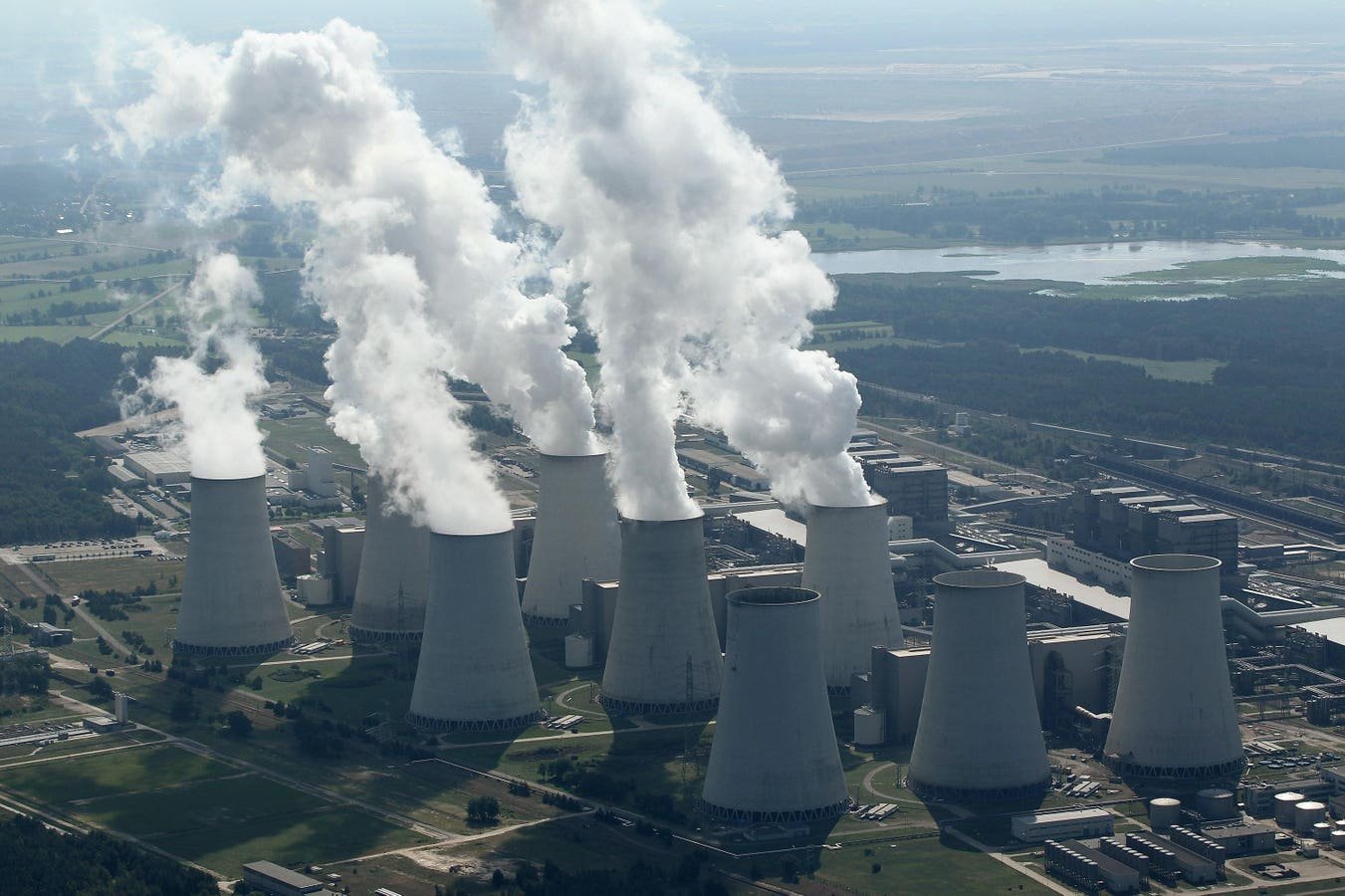
JAENSCHWALDE, GERMANY – AUGUST 20: Steam rises from the cooling towers at the Jaenschwalde coal-fired power plant on August 20, 2010 in Jaenschwalde, Germany. The Jaenschwalde power plant is one of the largest single producers of CO2 gas in Europe. The region of northern Saxony and southern Brandenburg is marked by active and former coal mines that feed local power stations such as Jaenschwalde, and a large-scale project is underway to flood the huge pits and turn them into lakes for tourism. The Lausitz and Middle German Mining and Administration Association (LMBV) is turning a total of 51 former mines into lakes, and a similar project is planned for former mines in neighboring Poland. (Photo by Sean Gallup/Getty Images)
Getty Images
The pace and scale of progress to combat the climate crisis and limit global warming around the world is “worryingly insufficient”, according to a new analysis.
THE Climate Action Report 2025published in the Systems Change Lab warns that the world is stalling progress on limiting average temperature increase to 1.5 degrees Celsius, as outlined in the Paris Agreement, with none of its 45 climate action indicators on track for 2030.
According to the study, while progress is moving in the right direction for most of the 45 indicators assessed, none are on track to meet the 2030 Paris Agreement goals.
It claims the pace of change is “promising, albeit very slow” for six indicators and well below the required speed for another 29.
And five indicators are headed completely in the wrong direction, requiring urgent course correction, and the remaining five lack sufficient data to assess progress.
For example, the share of electric vehicles in global passenger car sales, previously the only “on track” indicator, has been downgraded to “off track”.
The report notes that this is because while electric vehicles are still growing rapidly, accounting for a record 22% of global passenger car sales in 2024, up from 4.4% in 2020, growth has slowed in some major markets such as Europe and the United States.
But it also finds another indicator, that private climate finance has been upgraded from “well off track” to just “off track”.
It claims funds have grown from around $870 billion in 2022 to a record $1.3 trillion in 2023, with individuals, businesses and investors, particularly in China and Western Europe, driving much of the gains.
Beyond the jump in private climate finance, the report also highlights how the global share of electricity from solar and wind has more than tripled since 2015, making solar the fastest-growing energy source in history.
And he says that emerging technologies that were little more than ideas or small-scale pilot projects a decade ago, such as green hydrogen and technological carbon dioxide removal, could approach breakthrough with the right support.
The report is a joint effort between the Bezos Earth Fund, Climate Analytics, the ClimateWorks Foundation, Climate High-Level Champions and the World Resources Institute.
Clea Schumer, a researcher at WRI and co-lead author of the report, said there’s no question that “we’re largely doing the right things, we’re just not moving fast enough” during an online news conference.
Schumer added that while the share of global electricity generated by coal declined slightly in 2024, overall coal use reached a record high due to rising overall electricity demand.
He said coal remains by far the largest source of greenhouse gas emissions in the energy sector, along with gas.
“The problem here is that a fossil fuel-based electricity system has huge, negative impacts. Decarbonising buildings, industry and transport depend on a decarbonised electricity grid.
“The message in this is clear. We simply won’t limit warming to 1.5 degrees if coal use continues to break records. The world needs to phase out coal power generation more than 10 times faster than current rates, which is equivalent to closing nearly 360 medium-sized coal plants each year and scrapping every project in the pipeline.”
And Kelly Levin, head of science, data and systems change at the Bezos Earth Fund, said while much progress has been made over the past 10 years, it’s still “not fast enough for what’s needed for 2030” and beyond, during the news conference.
Levin added that climate change “continues to move forward” as greenhouse gas emissions continue to climb, temperatures rise and wildfires decimate homes and ecosystems around the world.
“The question is not whether change can happen, it’s really whether we can make it happen in time,” Levin said.


