




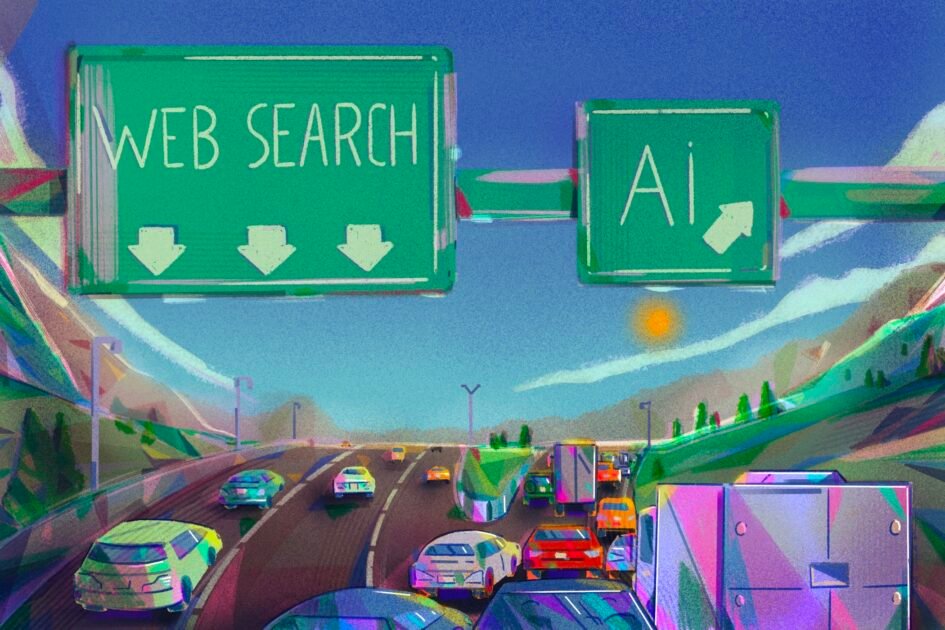
But Kelly Cutlerassociate professor at the Medill School of Journalism and a lecturer in the Kellogg Executive Education program, says the search reset is just the latest seismic shock in an ever-changing Internet ecosystem.
“This industry has seen these changes many, many times over the last 20-25 years,” says Cutler. “So this isn’t something I’m going to panic about or assume SEO is dead or the search engines are done. The sky is not falling. That’s okay, but marketers have to evolve.”
As such, businesses and publishers will need to rethink their strategies and adapt to the ways AI is changing search, just as they did for the rise of Google or the growth of mobile browsing.
From focusing on new metrics and SEO strategies to pushing hard on personalization and alternative traffic sources, it’s time to experiment, says Cutler.
“Engagement is changing,” he says. “I know that’s not what anyone wants to hear, but it’s a fact. I think in a way that brings us back to where we should be, which is that it’s all about the user.”
Here are three tips for navigating the new search environment.
Track metrics with more nuance
Beneath the alarming decline in search traffic, some sites have reported a silver lining: while fewer people are visiting, those who do land on a site are more engaged. For retailers, this means higher sales conversions. for content publishers, this means more articles read or videos watched.
If AI summaries are bypassing visitors by providing the “easy answers” that previously drove a lot of casual web browsing, the remaining traffic is at least made up of more motivated customers, Cutler says.
“What many of my clients are seeing is that impressions and conversions are actually up, even though clicks may be down,” says Cutler. “The quality is high, which is great. So you have to take the baby out with the bathwater. You can’t throw it all out. You really have to dig deeper.”
A key realignment Cutler suggests is to stop obsessing over clicks and refocus on deeper metrics. Metrics like time on page and user journeys within the site have always been a more granular measure of a site’s true success than raw clicks—and they matter even more in the new age of search AI.
“Tracking engagement metrics is key,” says Cutler. “Once users come to the site, how long do they spend? What do they do? How do they interact with your content?”
Because Google remains the leading search engine by far, most of these tools should be familiar to people who have used Google Analytics for years to track traffic, he says.
“There’s a lot of opportunity for marketers who have the data, who look at Google Search Console on a regular basis, to understand how their traffic is changing, so they can be nimble and flexible and try things out.”
Adjust your SEO strategies
For decades, websites have been pursuing traffic through a variety of SEO strategies. From tweaking headlines and keywords to installing plugins, these approaches were meant to increase a website’s visibility on Google and other search portals, attracting more visitors.
But as “zero-click” searches—where users get their answer from a summary or AI response instead of clicking a link—take a big bite out of website traffic, there’s a new game in town: GEO, or genital engine optimization. Despite the new acronym, Cutler says GEO is in many ways a continuation of classic SEO principles.
“It’s a new version of SEO that really takes into account the fact that we’re definitely going to see these drops and other AI companies come into play and take some of Google’s traffic,” he says. “It’s a way of optimizing it to be included in AI answers or AI reviews.”
The general idea is, if you can’t beat ’em, join ’em. By making your content more likely to be used in an AI summary, readers who want to learn more may find themselves clicking through to your site anyway as they dig into the references provided by the model.
In the early days of AI search, it is not yet clear why and how these models decide to use certain types of content in their responses. Frameworks like Google’s EEAT guidelines — experience, expertise, trustworthiness, credibility — probably still hold up in predicting what search engines and their newer AI tools will prioritize, says Cutler.
However, specific optimization for large language models will be important in the future, which means focusing on serving content in AI-powered searches, not just search engine results pages. This creates a “new Wild West”, where it is important to experiment.
“The biggest case I make right now with my clients is to budget for testing, learning and optimization. I think that’s key right now, because we don’t know what we don’t know, so we have to try things.”
One company that Cutler advised used an AI-powered optimization tool that guided them to adjust keywords and structure in their content, increasing their Google AI Reviews impressions by 61%. As a result, they saw increases in blog impressions and clicks despite a decline in industry-wide traffic.
“They’re piloting new tools to see how they can breathe new life into SEO,” says Cutler. “They are by no means giving up on SEO.”
Spread the personalization
With organic search traffic on the decline, companies should also expand their approach to customer targeting, says Cutler. While not new, paid search and social media are still effective ways to reach specific audiences—and artificial intelligence is making these tools even better at finding users based on age, location, occupation, intent, and other characteristics.
But the real untapped potential may lie in thinking beyond segmentation to get even more granular, giving each potential reader or customer exactly what they want.
“People expect more personalization,” says Cutler. “They’ve been trained by Netflix and Spotify and all the platforms they use every day, which allows them to create a very curated, personalized experience.”
Along these lines, increasing engagement can mean reaching people in their inbox instead of their search engine.
“Personalization is a huge opportunity with email marketing, especially newsletters, where you can really create opportunities for personalized messages and deliver dynamic content to users based on their preferences, their behaviors and the data you have.”
Beyond customizing content, websites should also consider providing it in different formats rather than a one-size-fits-all style. Readers may trust your site in opaque or mild AI summaries, but only if they can find it at the level of detail they desire. Some may prefer just a few sentences or bullet points, while others may delve into long primary sources or prefer video content.
This, too, is in line with EATA best practices, which emphasize a mix of content that conveys expertise and thought leadership in multiple modes—audio, video, and text—and in various formats such as testimonials, case studies, interviews, product reviews, demos, FAQs, and more.
But even if users aren’t clicking away from AI summaries or personalized newsletters, Cutler believes that adapting to this new age of optimization may simply mean returning to the original purpose of websites: connecting people with information.
“We’re so used to the be-all and end-all of website traffic. But I really think that might not be the be-all, end-all,” he says. “At the end of the day, I’m trying to help people. So when I can get them information that they care about, that helps them move forward on that journey that they’re on, that’s good for me.”
