




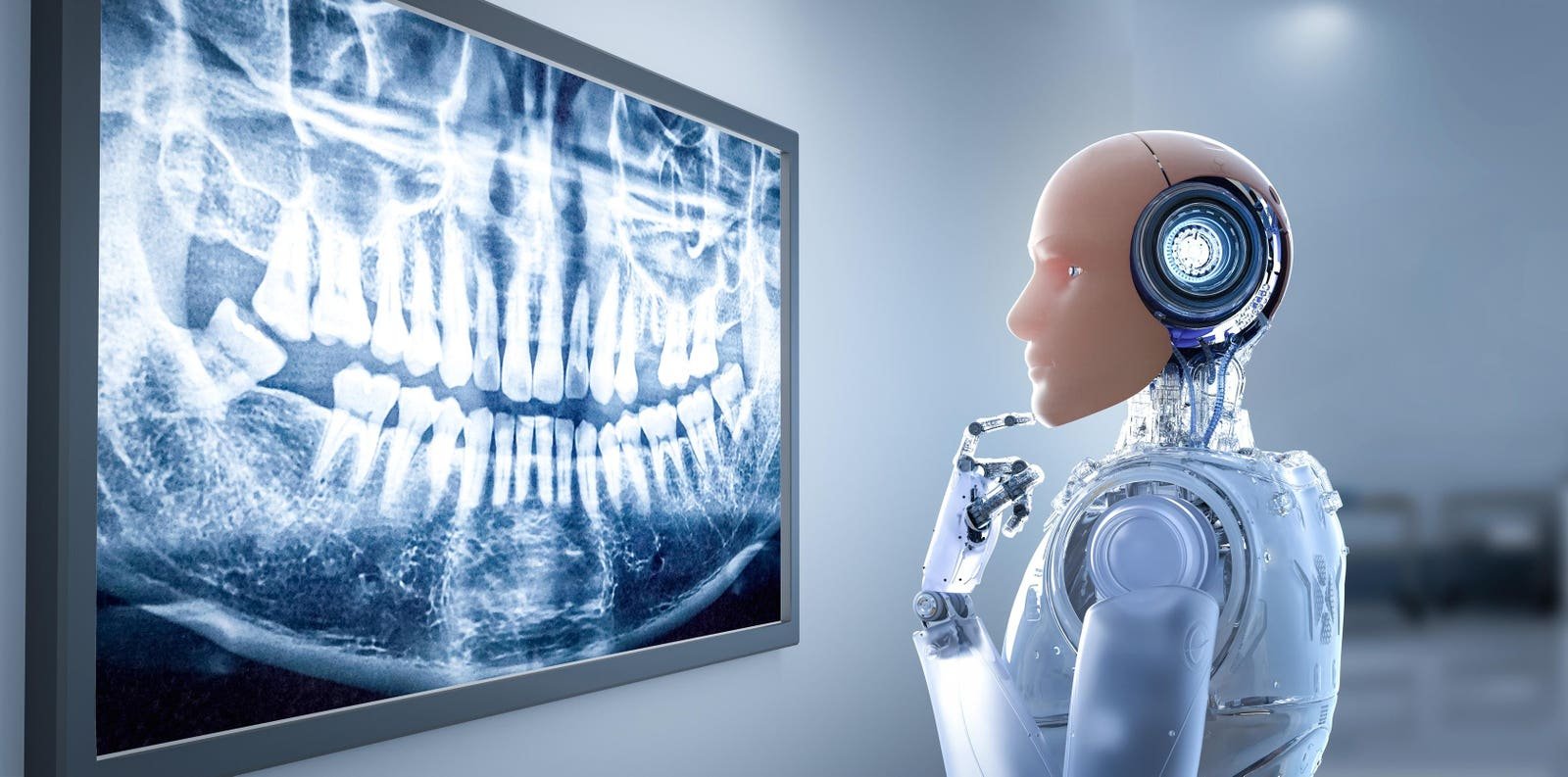
Medical technology concept with 3D rendering of artificial skin robot analyzes tooth x-ray tomography
getty
We’re getting a lot of information from AI that previously eluded even modern generations of scientists – and some of the most important are coming back to oral health.
This is revolutionizing an area of medicine that, by most accounts, could use some modernization. Dental work has been largely the same for the past 30 or 40 years – but that is likely to change soon. Artificial intelligence is changing almost everything about how professionals deal with “caries” or missing teeth or protect moths from decay in other ways. And this will have amazing results for our overall health and longevity.
“Artificial intelligence (AI) … offers innovative tools and techniques to optimize diagnosis, treatment planning and patient management.” write a group of study writers in a piece from the National Library of Medicine. AI technologies such as machine learning, deep learning, and computer vision are increasingly being incorporated into dental practice to analyze clinical images, identify pathological conditions, and predict disease progression.
OR see this article from JADA or the Journal of the American Dental Association, where author J. Tim Wright, DDS, begins with a nod to history in a way I’m all too familiar with:
“At the dawn of the computing age, artificial intelligence (AI) quickly became a concept,” Wright begins. “John McCarthy, who coined the term at the Dartmouth Conference in 1956, defined artificial intelligence as the science and engineering of building intelligent machines. Fast forward to today, and we’re seeing how artificial intelligence is transforming the healthcare industry.”
Wright describes some of these main use cases:
“Some commercially available tools, such as voice recognition software, which enable electronic mapping of dental exams and the use of AI-generated patient notes for health status and treatment recommendations, have the potential to change the way we approach patient-centered care.
More about teeth and saliva
At a recent set of Ted Talks associated with wearable device company WHOOP, there were not one but two speakers talking about the mouth and how dental and oral health lead to outcomes in the rest of the body. Both of these speakers had personal stories to tell: Mariya Filipova recounted her own bout with cancer and a kidney tumor named “Bertha” and Stephen Thorne, founder and CEO of PDS Health, recounted his health education from the loss of his mother following various interventions.
The extreme nature of Filipova’s cancer case led her to dig deeper into aspects of clinical care:
“Berta was 29cm by 18 by 22,” he explained, “five pounds of friendly tissue taking up half of my belly. To give you some perspective, that’s about the size of a newborn baby, only in this case, it could bleed sporadically, wreak havoc on my internal organs, or worse. And even worse. complex, so much beyond what my doctors at the time had seen before, that she couldn’t be handled with the conveyor belt care that was standard at the time.”
Eventually, he noted, nearly a dozen different experts came together to figure out not only how to treat the tumor, but how to use the hypothesis for medical research. And she had to keep both of her kidneys.
“Nephrologists and geneticists were talking to each other, asking how did this happen?” she said. “So over the course of 18 months, those brilliant minds that normally live in separate worlds came together, created a computer model of Bertha, reduced her to size, and during a six-hour surgery at Mass General, safely removed her.”
Siled Care and other obstacles
“Since my experience with Berta,” Filipova continued, “I have dedicated my career to studying healthcare transformation for convergence situations where, when we break down silos, we deliver higher quality care.”
Referring to overlooked and underfunded areas of health care, she noted that in the past, women’s medical research took a back seat.
“For decades, we’ve been considering treatment for women based on men,” he said. “It took growing evidence, clinical, reliable evidence to understand that women had different symptoms when it came to heart attack, drug interactions and disease progression.”
Back to Stoma
In her talk, Filipova finally revealed that work on biomarkers and other researchers has shown us that oral health is fundamentally related to our longevity.
“Slowly, we’re starting to connect the dots between adverse outcomes in the operating room or chronic disease or chronic disease management costs and oral health interventions,” he said. “Ask your dentist about your diabetes, your heart condition, your medications. Tell your doctor about your toothache, your bleeding gums, or your dry mouth. Start a conversation. Expect convergence, and don’t wait for our technology or regulatory or other systems to catch up.”
Thorne came to similar conclusions about the power of oral health, but also emphasized that saliva can tell us a lot about the state of our bodies.
“Our saliva is full of all kinds of enzymes, inflammatory mediators and more than 200 species of bacteria,” he said. “The science has exploded in recent years and it’s now indisputable. Our mouths are a gateway to so many of the chronic inflammatory diseases we’re talking about here today.”
Some silent signals, he suggested, can tell us what the future holds.
“Chronic inflammation is not curable,” he said. “It hurts. Chronic inflammation really destroys our health and is a silent killer. And what most people don’t realize is that chronic inflammation and many of the diseases and health problems associated with it start in the mouth. … The reality is today, we can’t be healthy without good oral health, and your dentist can literally change your life.”
This is a lot to understand – should you rush to the dentist?
Well, a lot of this advice is more holistic than direct. But it makes a lot of sense, and we’ll probably get a lot of new interventions that tomorrow’s doctors will find vital. Today’s standard of care is likely to soon seem archaic, a “dark age” of medicine where the powerful insights that come with artificial intelligence were unknown secrets.
This is good news, in a way, but it is also a heavy responsibility. Each of us should continue to read, keep up with trends and decide how to interact with rapidly evolving technologies. As we do, though, we’re likely to live longer with AI.
