




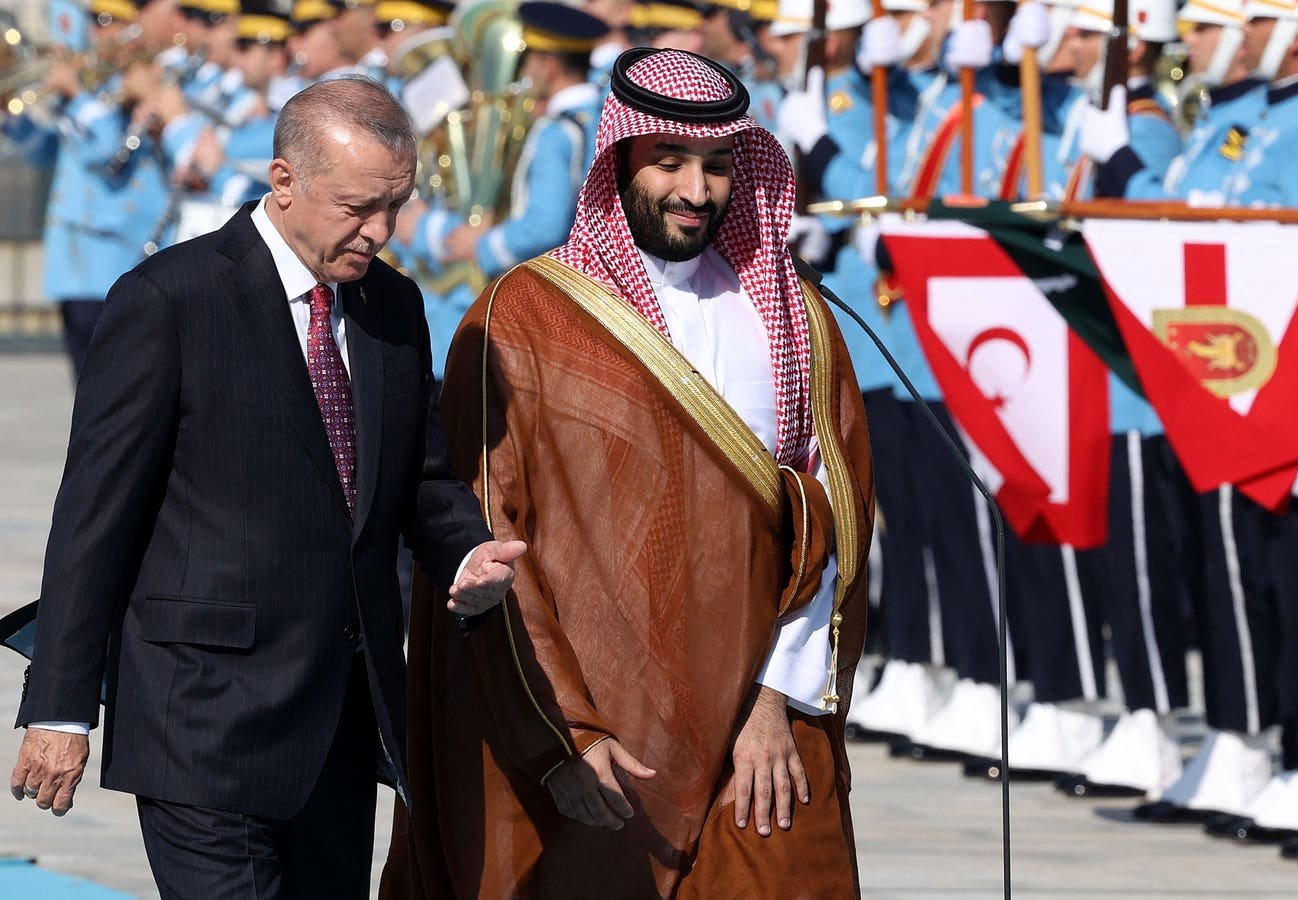
Turkish President Recep Tayyip Erdogan (L) gestures as he welcomes Saudi Arabia’s Crown Prince Mohammed bin Salman (R) (Photo by Adem ALTAN / AFP) (Photo by ADEM ALTAN/AFP via Getty Images)
AFP via Getty Images
With the confusing turmoil in the Middle East erupting erratically without any clear outcome or timetable, the question arises – what will the balance of power ultimately look like? Currently, President Trump has agreed to provide the Saudis with nuclear technology under US protection. Meanwhile, the Houthis in Yemen have mocked Saudi Arabia’s alternative to Hormuz, the Red Sea port of Bab el Madab. About 4% of the world’s oil normally flows from there.
Meanwhile, Iran is getting hammered and the Saudis are launching repeated airstrikes against Houthi targets in Yemen. They have been doing this for years, yet the Houthis are still able to launch ballistic and other missiles against Saudi Arabia’s oil infrastructure. So far the US has failed to protect its Gulf allies from harm. So how will it all play out – on a map teeming with rivalries, shifting alliances and reshuffles?
Currently, the main beneficiary appears to be Turkey and Erdogan. And the Israelis don’t take kindly to it. Let’s clarify. As the Shiite arc of the alliance weakens from Iran to Lebanon due to the destruction of Tehran’s power by the US/Israel, the Sunni states appear poised to fill the void. The neo-Ottoman world of Erdogan’s dreams is slowly being realized. The diplomatic and security pact announced earlier this year between Pakistan, Turkey, Egypt and Saudi Arabia, also known as “R4,” promises a Sunni arc of solidarity to displace the Shia.
Two quick observations. Pakistan’s accession opened the door for the transfer of nuclear technology from there to the Saudis. No doubt this is what prompted President Trump to intervene and offer a US substitute. That deal soon fell apart with Trump publicly setting new terms and the Saudis reneging on them. Nevertheless, Riyadh has now effectively distanced itself from acquiring Pak and possibly even American nuclear technology.
Meanwhile, Erdogan and the Saudis disagree on who should lead the Sunni world. Indeed, they are adversaries on the issue, because Erdogan’s neo-Ottoman vision places Turkey at the center of Sunnism that goes south to Arabia and north to Central Asia, while the Saudis see themselves as the heirs of Mecca and the prophet.
Notable here is the non-participation of any Central Asian or Turkic state in R4, even though they are all Sunni and theoretically part of any geohistorical Ottoman renaissance. Why the absence? They are particularly sensitive to any destabilizing religious fervor, influenced by Afghanistan nearby. And they have good relations with both India and Israel, which has close ties with Azerbaijan. Additionally, India is the only non-Chinese influence eastward trading option for Turkish ‘Stans. (China effectively owns Pakistan’s ports.) The ‘Stans want to maximize trade and stay out of geopolitical rivalries. Thus the Turkish states will stay away from the affairs of the Middle East.
How effective does the Sunni Crescent look different? Promising at first glance but with caveats. Don’t expect any immediate conflict between Iran and Turkey. Both countries depend on each other to quell Kurdish separatism. In other words, each can destabilize the other by allowing the Kurds of others. But that still leaves plenty of room for competition. Turkey has effectively already placed Syria under the Ottoman renaissance umbrella. Syria was a kind of Iranian satrapy in the Assad era.
Now it is a matter of reorienting Iraq away from Iranian rule. Here, the influence of illicit finance plays a central role. Just as Tehran funded Shiite militias in Iraq and Lebanon, Ankara is quietly courting Iraqi tribes and Kurds to replace the protection of the Mullahs in Iran. Meanwhile, Iraq’s relatively new prime minister has shifted the economic balance with a massive anti-corruption campaign that will shake the pro-Iranian grip on the country’s finances. Here is an article describing how the crackdown on graft is combined with anti-militia crackdowns.
So far the amounts that have been confiscated exceed 100 million dollars. Add to that the Iraqi prime minister’s recent meeting with Trump at the White House and the balance is starting to shift in Baghdad – not least because pro-Iranian militias have been involved in shelling US bases in the latest US-Iran hostilities. None of this reorientation will happen smoothly, peacefully, or overnight. But the general trend is already felt in the region.
There are limits and red lines that will keep Erdogan’s ambitions in check, unless he wants his country to end up like Iran. As mentioned above, he has repeatedly shown public support for Hamas in a myriad of ways (hosting leaders, etc.) and has provoked spikes in Israel. Which responded by strengthening its contacts with the Kurds and especially by intensifying them budding alliance with Greece and Greek Cyprus – including military exercises and the sharing of advanced weapons.
There are also limits to Israel’s options. After all, Türkiye is a member of NATO. Furthermore, Greek society as a whole tends to be rather left-wing and traditionally sympathetic to the Arab side. So the strategic deals, so far anyway, happen among the elites without much vocal excitement from the street. Having common enemies doesn’t always make for the warmest friendships.
In some ways, the situation resembles Israel-Armenia relations. Israel’s recent bid to pass an explicit law recognizing the Armenian Genocide was met with disbelief in Armenia itself. This after many years of estrangement between the two countries and Armenia’s new recession with Turkey. Furthermore, Jewish and Eastern Christian frictions go back deep into the Ottoman era, courting the Sultan’s favor in the millet system.
Most shocking – at least for Washington – is the continued revelation of the Iran-US deals. The US has offered all sorts of concessions to no avail. Keep power, keep the money and oil flowing, no regime change, return to the JCPOA nuclear treaties, trade with the West – and yet Tehran will not stop the provocations. They’re not getting the message, and the White House can’t figure out why. They were even tacitly told that a Shiite regional resurgence could only follow (as a countermeasure to Erdogan) without nukes and no threat to Israel.
Why won’t Tehran buy it? Many reasons. Internal factionalism. A belief that Trump is vulnerable (midterms etc). Suffering will unite the people with the regime. Maximalist notions of grandeur dating back to antiquity. Successful damage to US allies. Veto on oil trade waterways. Deep-seated mistrust of Israel and the US for decades. Promises of support from Russia and China, so far very effective. Witness ideology. Restrained, stable, Iran will lead to the overthrow of the regime. Make your choice.
In short, Iran will not back down anytime soon. But its weight will be inexorably reduced in the region as financial leverage declines. Erdogan’s star will continue to rise – up to a point. He is 72 years old and ailing without a clear successor. He is unlikely to win another election fairly, as the poor economy and high inflation alienate the public. Turkey will benefit from the flow of oil and gas with direct regional supply lines collapsing. But not in time to finally save him from Orban’s results. As the US loses regional influence, under Erdogan Ankara will increasingly embrace Beijing.
