




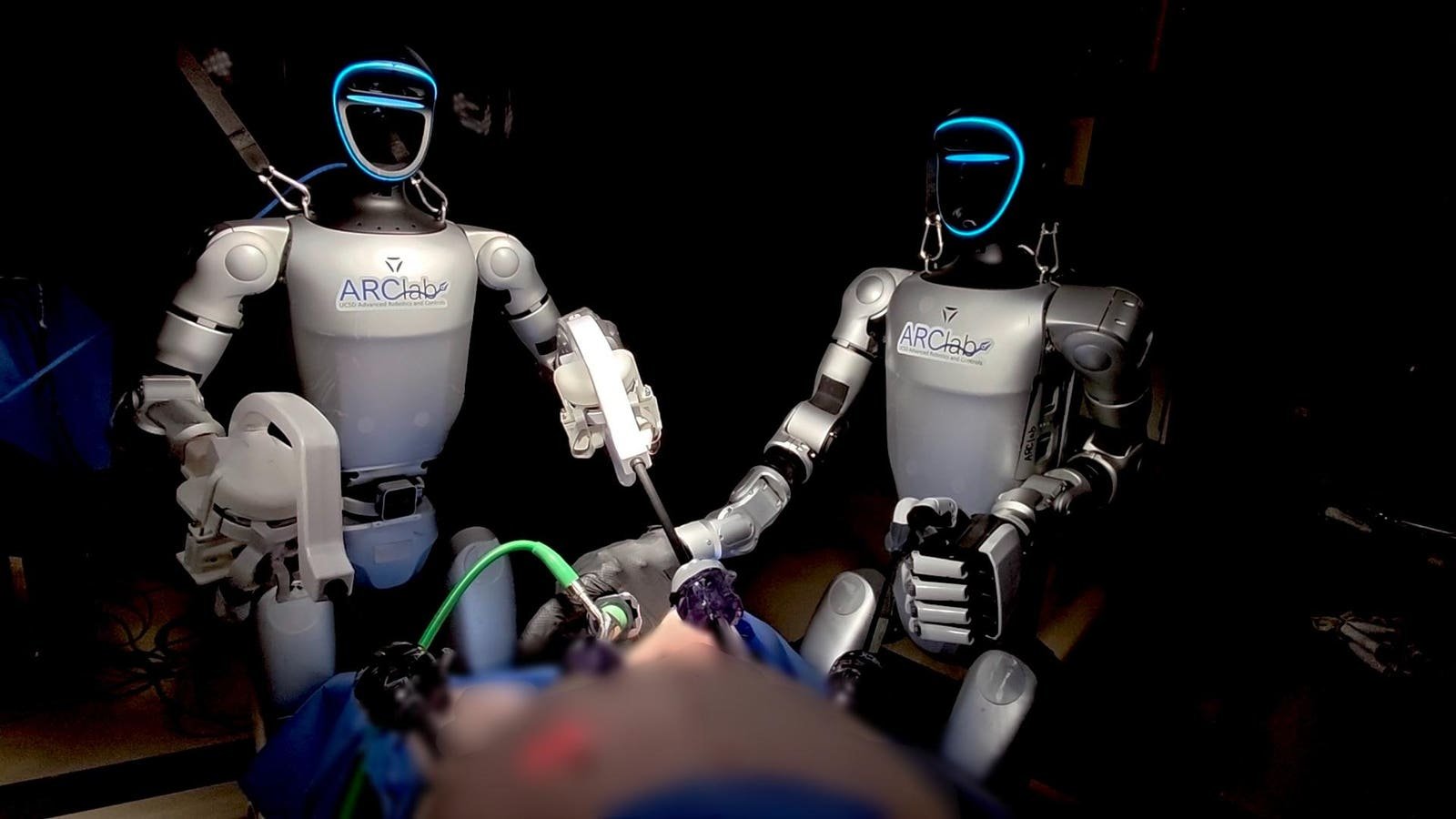
Two Unitree G1 robots perform live surgery in a new study from the University of California, San Diego.
ARClab
In a world first, two humanoid robots performed surgery on a live patient. The robots performed laparoscopic cholecystectomies, or gallbladder removal: tissue retraction, dissection, scissoring, and elevation of the gallbladder from the liver bed. The two big caveats: the patient was a pig, and the robots were fully operated on by trained human surgeons. Another caveat: as you can see in the image above, the robots were tethered so they couldn’t accidentally fall and injure their porcine patient.
Still, it’s an impressive achievement and a major milestone.
This was essentially an experiment conducted by a team from the University of California, San Diego. The goal: to understand whether humanoid robots are useful for expanding medical care in the physical absence of human doctors. The answer, after all, is not yet… but probably soon.
“Humanoid agents offer unique possibilities, particularly for assisting in surgical operations,” the team was mentioned in the Github overview. “Traditionally, robotic systems for surgery have been purpose-built platforms, such as Intuitive Surgical’s da Vinci Surgical System, and it remains unclear how close today’s humanoid systems are to meeting the precision, control and safety requirements of minimally invasive surgery.”
What they learned is really important: a humanoid robot completed an actual surgery on living tissue. That said, people were still deeply involved, and the group’s paper in Nature states that there are still “key technical challenges that need to be addressed before clinical development.”
The team from UC San Diego’s medical school and ARClab, an advanced robotics lab at the university, didn’t build a robot for the job. Instead, they used two off-the-shelf Unitree G1s. These are small, inexpensive robots: four to five feet tall, only about 70 pounds, and can be had for less than $20,000, though it’s possible that these particular robots had Unitree’s three-fingered “Dex3” dexterous hands complete with a thumb, index and middle finger, each with multiple actuated joints. They also feature extra articulation at the wrist and waist, making this version capable of holding and wielding tools. Also available with 3D LiDAR and depth camera: very useful for surgical work.
That in itself is cause for optimism if you’re interested in performing humanoid robot surgeries in the near future: they used an extremely cheap, basic robot. If they used a more advanced robot – perhaps 1X’s Neo, with 25 degrees of hands-freedom enabled – the operation would be even more feasible.
That said, the benchmark here is Intuitive Surgical’s da Vinci, the robotic system that has defined the category for two decades and is in thousands of operating rooms. But the da Vinci is a solid, purpose-built platform. It’s rotatable, dockable, and does one thing extremely well. It doesn’t walk down a hallway and probably isn’t affordable for a small town or country hospital because it costs on the order of two million dollars.
The humanoid bet is different.
A general-purpose robot is unlikely to beat Da Vinci at surgery, but it could, in principle, walk through a hospital built for humans, use tools designed for human hands, and take on many embedded tasks instead of just one. In addition, roughly half the world lives in a place with too few surgeons, and “medical deserts” aren’t just a problem in the developing world: rural areas in the US and Canada routinely send patients hours away for procedures that a robot and a remote specialist can handle locally.
In addition, there are other extreme cases: a crew wintering in Antarctica … an astronaut on the International Space Station … a traveler on a future Mars transit mission.
A low-cost, general-purpose humanoid that can be remotely operated by a specialist thousands of miles away is not just a hospital gadget. It could be essential infrastructure for places medicine can’t currently reach.
Eventually, we learned that even basic, cheap humanoid robots can perform surgery. Today it is remote controlled, for sure. Tomorrow… who knows? Maybe we’ll have bots that can download a surgical AI foundation model for a small fee and – Shazam! – you have a surgeon.
With health care costs and availability where they are right now, surely that’s at least a positive.
