




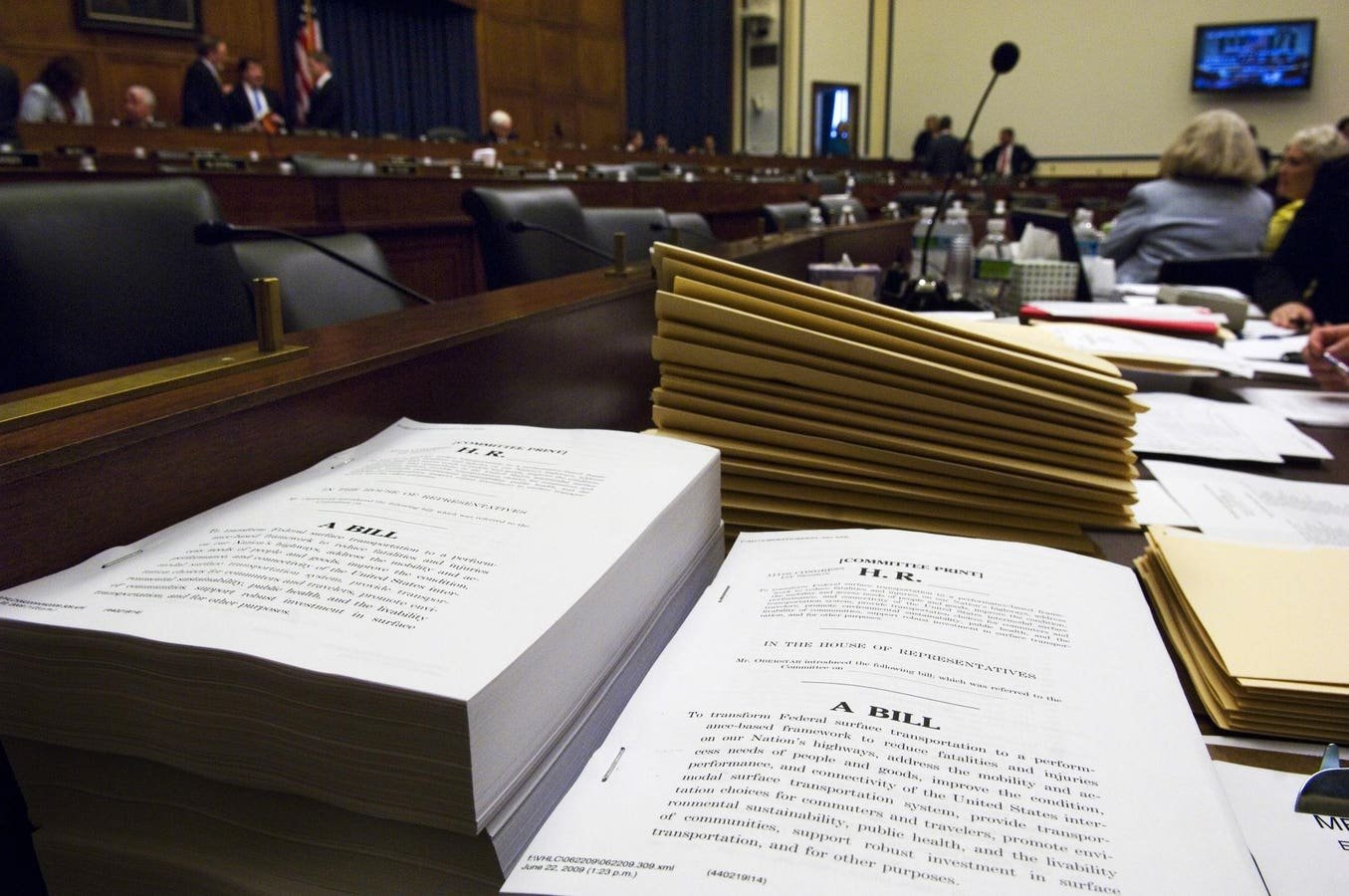
WASHINGTON, DC – June 24: Copies of the Surface Transportation Authorization Act of 2009 are stacked on a staff table during the House Transportation and Infrastructure Subcommittee’s markup of the bill on the Subcommittee on Highways and Transit. (Photo by Scott J. Ferrell/Congressional Quarterly/Getty Images)
CQ-Roll Call, Inc via Getty Images
“And think carefully about that because if by writing an article that’s negative you’re effectively discouraging people from using autonomous vehicles, you’re killing people.” As the title of this piece already suggests, the words in quotes are Elon Musk’s.
Here’s hoping Musk’s thinking will be heeded by Congress as the Surface Transportation Bill (aka “The Highway Bill”) works its way through both chambers. While a bill trucking lobbyists will love, at some point lawmakers have to ask if what helps the trucking industry is good for drivers, and for that matter the trucking industry itself.
For background, the New York Times recently reported that in 2023, “5,472 people died in accidents involving large trucks.” The easy, emotional answer might be that trucks are a threat. This is because those who die in large truck accidents are generally not the people inside the large trucks. That is not the argument to be made here.
As terrifying as one traffic death is, let alone thousands, it’s easy to forget that as you read this, trucks move “nearly three-quarters of the nation’s freight.” In other words, if you despise what Michael Gorman described in Washington Examiner as “the deadliest, most polluting, most congested and heavily publicly subsidized mode” of moving goods on the market (by truck), think how miserable you’d be without it.
Which means the goal of this opinion piece is not to silence trucking, but rather a call for a freer market defined by fierce competition for freight transportation in the U.S. Unfortunately, the highway bill does not enhance market competition. Instead, it heavily favors trucking over other transportation options. The railroad looms large here.
The bill includes plans to allow 91,000-pound trucks onto interstates, more truck parking nationwide and a clearer path for driverless trucks. The last part is desired. See Musk again.
However, the problem is that what is good for trucking is obviously not good for rail despite the obvious safety improvements provided by the latter. While there were again 5,472 road deaths in 2023, by comparison rail deaths in the same year stood at five.
Based on the wide difference, logic dictates that unlike a surface transportation bill whose implicit goal is to get more trucks on the road, Congress would at least look for ways to smooth the way toward more trucking competition. Except that’s not the case.
Instead, the bill increases the regulatory burden on the rail industry. And while trains are clearly more conducive to driverless automation since they operate on fixed, closed networks, the bill requires a two-person crew for rail transportation.
All of that aside, let’s not forget what the Highways Bill is ultimately about, which is highway funding. It may be said here that while the railroad provides its own “highways” as it were, the trucks that the legislation aims to increase in size are a significant cost burden for highways, the burden of which is not borne by the trucking industry.
That is why the Highway Bill in its present incarnation must be retained. It’s not just that it’s unnecessarily expensive, it’s not just that it stifles market competition, it’s going to kill people. This isn’t just bad for America, it’s bad for the trucking industry who will rightly be blamed if lobbyists succeed in getting more and bigger trucks on the road not because the markets demand it, but because the trucking industry has better lobbyists than its competitors.
