




Current Climate brings you the latest sustainability business news every Monday. Sign up to get it in your inbox.
Copyright 2026 The Associated Press. All rights reserved
WCome back to Current Climate. Solar power continues to have a moment as a quick, cheap way to boost electricity supplies, particularly as electricity demand rises and the war in Iran sparks spikes in oil and gas prices. It is also finding its way into farms as a new beneficial source of income for farmers.
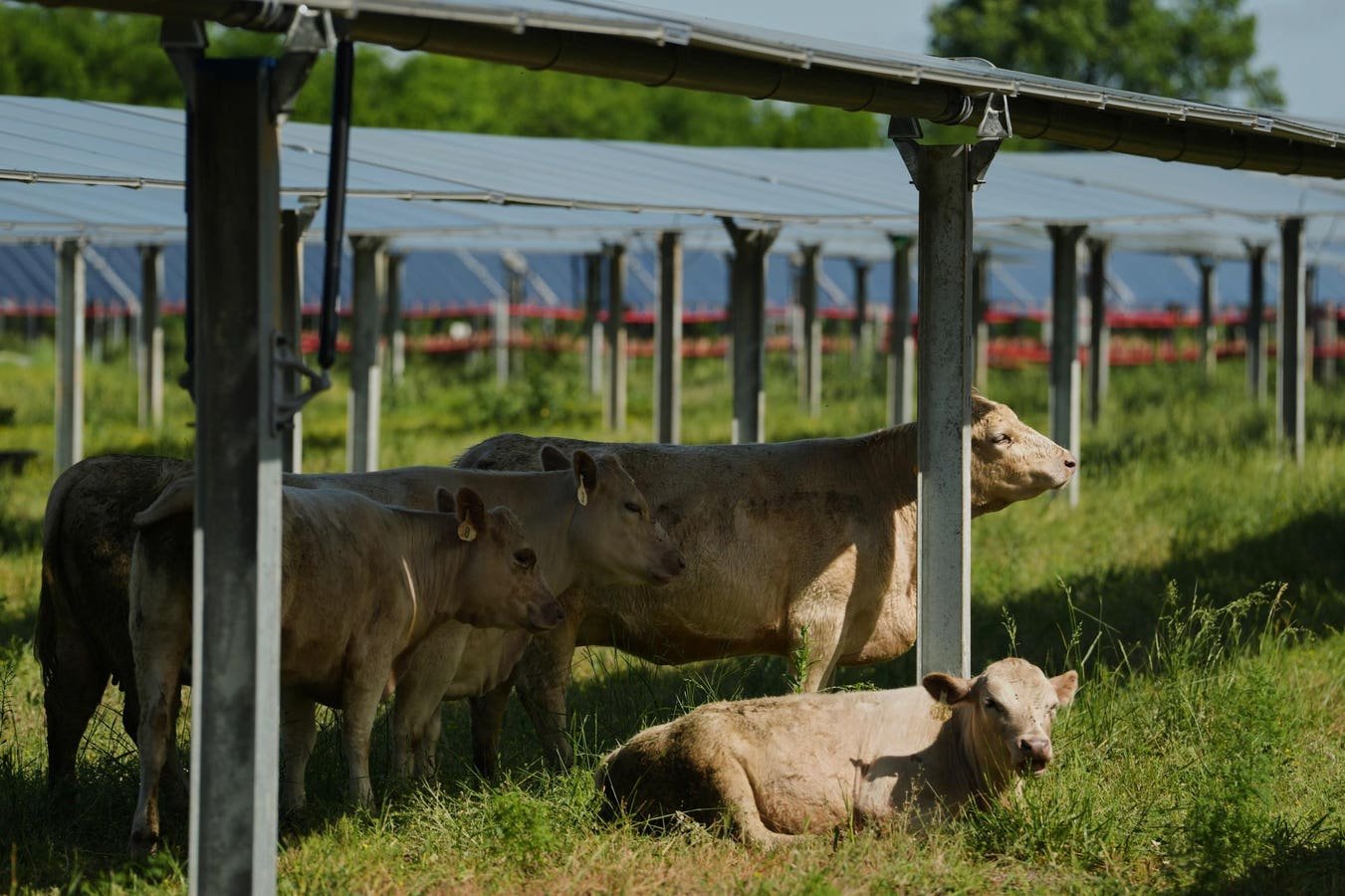
While California is looking to use tens of thousands of acres of fallow land for massive solar fields, idled by dwindling water supplies, in other parts of the country, solar power is being incorporated into fields that are actively growing crops or raising livestock. In the emerging field of agrovoltaics, university and government researchers are finding that solar energy is a surprising fit. Positives include shading provided by solar panels built on farms, spaced to provide enough sunlight for crops to grow while protecting them from the strongest sunlight and heat of the day.
The panels also help prevent water from evaporating from the ground and provide shade for animals during the hottest hours of the day. In return, the plants growing under them emit water vapor that helps cool the frames below, improving their performance, according to the U.S. Department of Agriculture.
A farm near Nashville operated by Solar Ranch is even testing whether solar panels designed to rotate to capture the maximum amount of sunlight during the day can go a long way for ranchers. The 40-acre project in Christiana, Tennessee, is spending the next year determining whether, as expected, cattle thrive under solar panels as well as different crops do—and whether ranchers and dairy farmers are willing to give up swaths of farmland in exchange for a steady new revenue stream.
Earlier this year, the Trump administration completely halted the Rural Energy for America Program, or REAP, which was created in 2008 to provide assistance to farmers or farm cooperatives to install their own solar and wind energy systems, resulting in large savings in energy costs as well as reductions in greenhouse gas emissions. Agrivoltaic projects in which private companies lease land from farmers to install solar energy systems, without disrupting growing operations, could help mitigate the loss of REAP funds. But if a new farm bill succeeds in restoring them, which has bipartisan support, farm-based solar could become an important energy source.
The big read
Energy security is the real driver of the clean energy transition
Can you imagine yourself and your life without access to energy? Rising prices have long dominated the renewable energy debate. But recent geopolitical upheavals are shifting the focus to something more fundamental: security of supply and who controls it.
For years, the transition to renewable energy has been criticized for raising costs and introducing instability into energy systems. These concerns have intensified following the disruption of Russian gas supplies to Europe following the sabotage of the Nord Stream pipeline. In countries such as Germany and the UK, rising electricity prices have often been linked to the rapid expansion of renewable energy sources, reinforcing the perception that the transition has entailed an economic penalty.
The argument gained further traction following Mario Draghi’s report on European competitiveness, which highlighted higher energy costs as a structural disadvantage compared to the US and China.
But price is only part of the story. Recent events are forcing a broader reassessment of what matters most in energy systems. Availability, durability and control are now at the fore.
Read more here
Hot topic
Trek Bicycles CEO John Burke on growing e-bike business and cost impact from Iran war
E-bikes have been the biggest development in the cycling industry for several years. What part of your sales is now electric?
It is somewhere between 40% and 50%. It’s a big number.
Given the technology involved – batteries and motors – how has this changed the company?
The key word is evolution. We have a lot of really smart people here and we develop the best bikes in the world. We also love making consumers happy. And when we look at e-bikes, we use the same product development process on e-bikes that we use on racing bikes. We’ve managed to come out with some really good e-bike products and you’ll be seeing a lot more of them in the coming years.
Are you getting into the delivery e-bike market, making them for Amazon and FedEx like some of your competitors are?
No. We will remain focused on consumers.
There are many different things we could do. We want to focus on where we can be the best in the world. This is a bit of a different animal. I mean, sure we could do it, but we have a lot of other things on our plate right now.
What are the best growth areas for Trek?
Pick a card, any card. I think e-bikes are a big growth opportunity for Trek. Europe is a huge opportunity for Trek. Asia is a really big opportunity for Trek mountain bikes.
Are there still many opportunities in the e-bike space?
I think this market will continue to grow. If you take a look, it started in Europe, and Europe was five to 10 years ahead of the US. It continues to grow in Europe. If you step back and zoom out, we’d be much better off if people cycled more often. It’s a healthy way to travel. It’s environmentally friendly to do. We have seen since the pandemic that governments are increasingly investing in cycling and pedestrian infrastructure. It takes you away from a phone. We have a mental health crisis in this country and anything that gets people outside and exercising is good for society.
You rely on an international supply chain for materials and components. Is the fighting in Iran and the closing of the Strait of Hormuz affecting your costs?
Yes. I think every supplier is asking us for price increases. I just received an email about how much shipping costs have increased in the last month. It’s off the charts. … This e-mail was located right inside the United States, simply transporting merchandise from Trek warehouses to retailers.
Are the costs of aluminum, steel and other materials affected?
It is. Some more than others – the carbon fiber stuff, the stuff that needs to be moved has had a big impact. I don’t think people fully understand the global economy we live in. We have a large factory in Europe located outside Dresden and all these goods move through the Strait of Hormuz.
What else are we reading?
Capital Market Commission moves to repeal the Biden-era climate risk reporting rule (Reuters)
China truck drivers are going electric as gas prices soar (Bloomberg)
Europe’s quest for green steel. It all depends on green hydrogen (Canary Media)
Looking at Earth’s climate past it gets weirder and weirder (Scientific American)
