




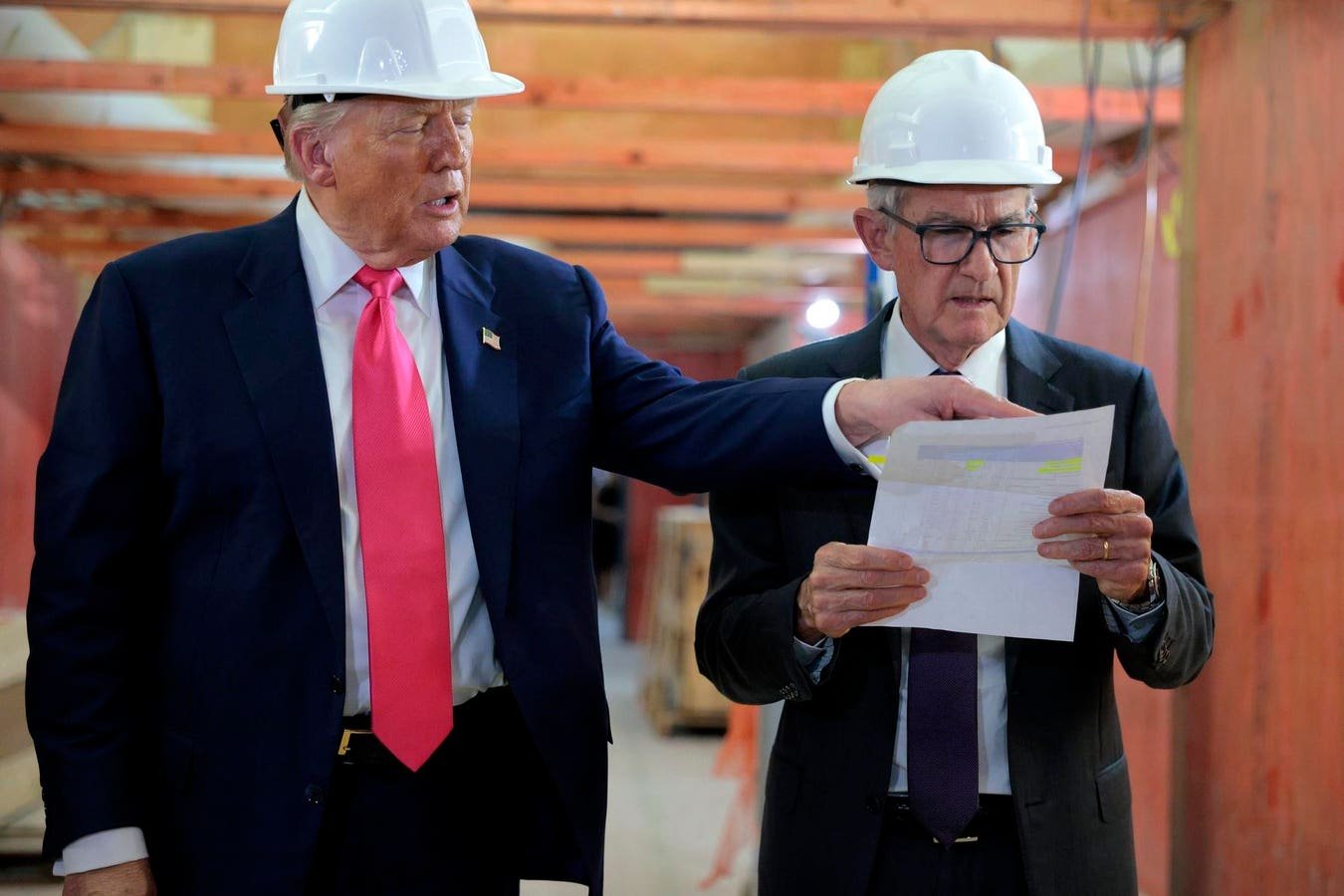
WASHINGTON, DC – JULY 24: US President Donald Trump and Federal Reserve Chairman Jerome Powell tour the US Federal Reserve’s $2.5 billion headquarters renovation project on July 24, 2025 in Washington, DC. The Trump administration has been critical of the cost of the renovation and Federal Reserve Chairman Jerome Powell. (Photo by Chip Somodevilla/Getty Images)
Getty Images
On financial matters, Donald Trump and Jerome Powell are not far apart, if at all. This would probably annoy both of them, but it’s true.
But before we get to why Trump and Powell are economic junkies, it’s helpful to get the basics of their rivalry out of the way. Powell certainly wants an admission from Trump that he did nothing criminal and that any pretense of an investigation will cease immediately. And in a recall of FDR, Trump wants Powell’s seat at the Fed to “pack the Fed.” What do they say about the “difference” between Democrats and Republicans?
Trump clearly has the upper hand over Powell when we remember that Powell’s proverbial clock is ticking. In other words, his value as a former Fed chairman is higher right now in the speaker circuit sense and the memoir sense. The same in an advisory sense. The longer Powell stays, the less his story will matter to domestic and global audiences, the less readers will be interested in his memoir, and the fewer people he will seemingly know at the Fed on the way to selling that knowledge to global clients.
Of course, those close to Powell will say he has the upper hand in that he can continue to vote against Kevin Warsh’s wishes for lower rates, and by doing just that Powell’s profile will, if anything, rise. And then Trump, being Trump, will keep Powell in the news with routine criticisms of his troublesome ways in a way that will keep Powell in the conversation much longer while extending the life of Powell’s books, speeches, and supposed insights into what the Fed will do in the future.
The bet here is that both sides will blink soon. Trump wants another Fed appointment, and Powell will want to capitalize on what he endured as a Fed appointee. A deal will be made.
Which brings us to the silliness of the whole Trump vs. Powell debate and how similar their economic views are. To see why, a basic principle of lending must be developed: no one borrows money, but borrows with what can be exchanged for money.
It is a reminder that money borrowers borrow production for a price. Trucks, tractors, computers, offices, fasteners and labor in exchange for the principal paid plus interest. In other words, all loans are production in exchange for production. Lenders offer output through the medium of exchange that is money, and borrowers return output through the same medium of exchange.
In Trump’s case, his desire for low interest rates is an implied desire for cheaper access to resources. Powell’s reticence is rooted in the idea that cheaper access to resources leads to inflation.
Both express their Keynesian mysticism when we remember that governments have no resources. Implicit in an “easy” Fed that Trump prefers is that govt do they have resources, after which Powell’s reticence about “ease” implies the same. Both are wrong. Just as government spending is not stimulative, since governments don’t have resources they haven’t already taken from us, neither does the Fed have the ability to unload resources without substituting the market the way government spending does.
It is a comment that the Fed deals with interest rates, like government spending, rooted in the belief that governments can draw resources from an economy only to allocate them more efficiently and more encouragingly than the private economy in which they were created. Which is nonsense. Keynesianism is nonsense.
All of this explains the battle between Trump, Powell and their partisans on both sides. After all they are all Keynesians now, and that is sad.
