




AI has boosted the fortunes of US tycoons like Google parent Alphabet’s Sergey Brin and Nvidia’s Jensen Huang to stratospheric levels—and now it’s boosting Chinese tycoons, too. Wang Weixiu, founder of Zhongji Innolight, has seen his own net worth rise 400% this year to $13 billion as demand for his company’s optical devices soars.
Wang, who stepped down as chairman of Zhongji Innolight in 2023, still derives his net worth largely from a stake in the company, according to Forbes estimates. The 75-year-old had a fortune of $2.6 billion when Forbes tallied his fortune for the World’s Billionaires List in March. Since then, Zhongji Innolight’s Shenzhen-listed shares have risen more than fivefold.
The wave recently created a second billionaire from the company, which is based in Yantai, east China’s Shandong province. Zhongji Innolight Chairman and CEO Liu Sheng, 54, saw his own net worth rise to $2.7 billion, based largely on the executive’s stake in the company, according to Forbes estimates. Zhongji Innolight is preparing for a share sale in Hong Kong, the company announced in November stock market deposit. It plans to raise over $3 billion, according to Bloomberg News. The company did not respond to requests for comment.
Behind the impressive rally is soaring demand for its optical transceivers used in data centers worldwide, Arthur Lai, Hong Kong-based head of technology research at Macquarie Capital, said by phone. Customers, including Google and Nvidia, are scrambling to ensure adequate supply as AI-related spending — including that on infrastructure like data centers — is forecast to grow to $375 billion by the end of the year and $3 trillion in 2030.
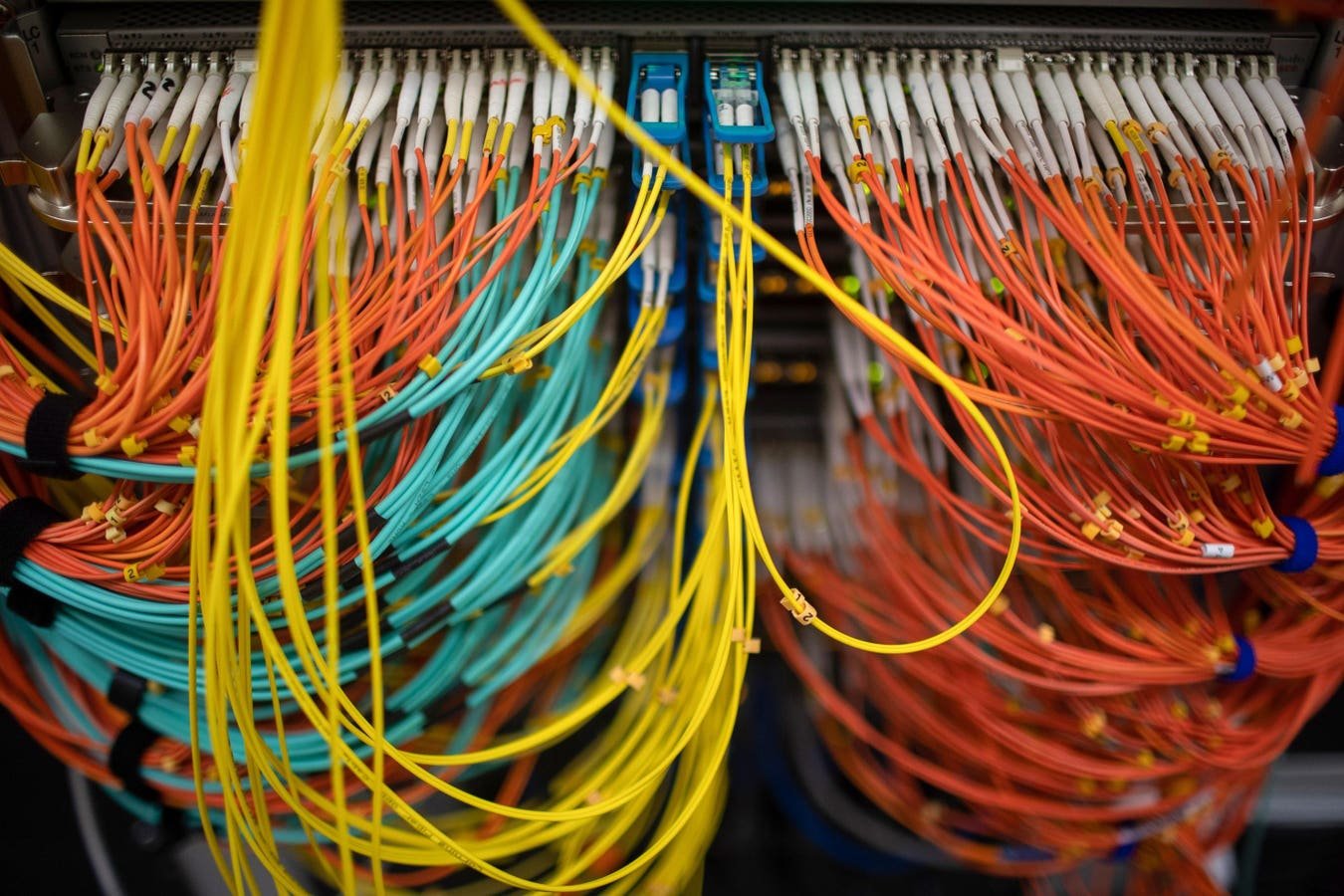
Transceivers, or electronic components usually the size of a USB flash drive, convert electrical signals to optical and back for data transmission that is much faster than traditional copper cables. As training AI requires the processing of massive amounts of data, hardware – consisting of tiny circuit boards and laser drivers – plays an increasingly critical role in helping to increase speed and reduce latency. Such products are especially important today because data centers can reach millions of square feet in size – requiring reliable data transmission over longer distances.
Zhongji Innolight’s technology is the best in the world in terms of speed and reliability, Lai says. Its competitors include Eoptolink and TFC Communication in China and Lumentum in the U.S. In an October research note, Nomura analysts Duan Bing and Ethan Zhang called the company “the world’s No. 1 data center transceiver manufacturer” and said it would “outperform its peers” in the third quarter of 2025.
“Zhongji Innolight will continue to outperform the industry and gain more market share,” says Macquarie Capital’s Lai, pointing to the company’s current scale and continued demand for its products.
In the first nine months of this year, the company’s sales rose 44.4 percent year-on-year to 25 billion yuan ($3.5 billion), according to its latest financial results. Net profit rose 90 percent to 7.1 billion yuan from a year ago, the results show. The global transceiver market will grow at an annual rate of 70% to reach $40 billion by 2028, Macquarie Capital estimates.
Billionaire Wang probably has a 2016 deal that has Google as a key client to thank. A former technician at a state-owned factory, he founded Shandong Zhongji Electrical Equipment nearly four decades ago in 1987. The company didn’t have much to do with high technology back then, mainly making motors used in washing machines, according to local media reports.
But as profits fell in an increasingly saturated market, depressing the company’s share price after a 2012 Shenzhen initial public offering that raised 1.6 billion yuan, diversification was on Wang’s mind.
Then, in 2016, Wang’s company acquired optical device maker Innolight Technology, founded by current Zhongji Innolight Chairman and CEO Liu, in a 2.8 billion yuan deal. The startup—Google Capital first– always investing in China – still needed additional funding to sustain its research efforts. Liu, an engineer educated at China’s prestigious Tsinghua University and the Georgia Institute of Technology in the US, became CEO of the merged entity in 2017 and chairman in 2023. The company also changed its name to Zhongji Innolight in 2017. Wang’s son, Wang Xiaodong, is the company’s executive director.
Innolight Technology counted Google as a customer as early as 2011 as the US tech giant built more data centers around the world, according to article published this October by Tsinghua University to honor its alumni. Working closely with Google has probably helped the company improve its technology over the years, says Macquarie Capital’s Lai.
But Shen Meng, chief executive of Beijing-based boutique investment bank Chanson & Co., warns in messages sent via WeChat that demand for Zhongji Innolight’s products may not last forever. Concerns are growing about the high valuations of AI companies and their investments in related infrastructure may not pay off.
Amid the rivalry between China and the US, CMB International highlighted geopolitical and tariff uncertainties as key risks in a November research note. Macquarie Capital’s Lai believes such risks can be addressed as the company supplies overseas customers from its factory in Thailand, which began operations in 2022.
Lai believes that an emerging technology can disrupt Zhongji Innolight’s business. So-called co-packaged optics (CPO), which involve bundling several optical transceivers together to improve performance, may reduce the need for the actual product. However, he stresses that the technology – currently led by Nasdaq-listed Broadcom – is still at an early stage. “If that happens, which I don’t think will happen in the near future, then it will affect transceiver manufacturers,” he says.
