




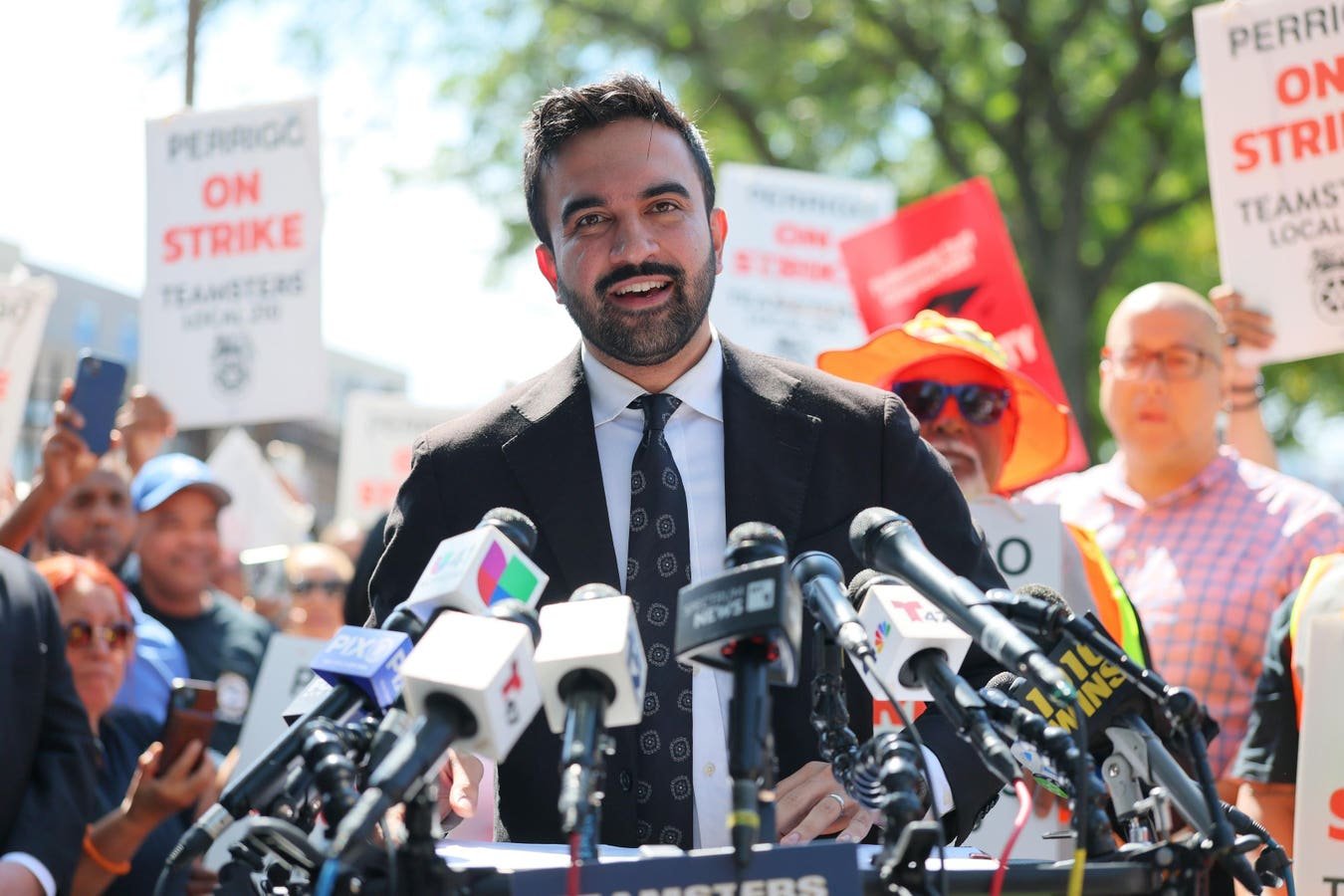
NEW YORK, NEW YORK – SEPTEMBER 15: New York City mayoral candidate Zohran Mamdani speaks as he joins striking members of Teamsters Local 210 outside the Perrigo Company on September 15, 2025 in New York City. Zohran, Assemblywoman Amanda Septimo and State Senator Rivera joined Teamsters Local 210 and 175 Perrigo workers who have been on strike since September 2 demanding fair wages, secure pension funding and protection from forced weekend work without overtime. (Photo by Michael M. Santiago/Getty Images)
Getty Images
Zohran Mamdani is the favorite to become the next mayor of New York, a prominent position on the political landscape. He is widely expected to win due, in part, to his embrace of a socialist agenda that revolves around raising taxes on the rich and corporations to pay for more social services for all. The only problem is that his policies for raising these funds tend to be based on statements that may lack merit or realism. As New Yorkers head to the polls tomorrow, they’ll have to decide whether they agree with his vision, even if it’s unclear whether he has a reasonable path to realizing that vision. This article digs into statements from his own publicly available ones tax platform to highlight some of the biggest concerns.
Zohran Mamdani Tax Platform:
“Our state corporate tax rate is lower than all of our neighboring states – New Jersey, Connecticut, Massachusetts, Pennsylvania, Vermont, Rhode Island and even New Hampshire.”
Mamdani’s statement is actually correct as New York has a state corporate income tax of 7.25%, which is less than some of the states he chose as examples (Rhode Island actually only has a 7% corporate income tax, which is less than New York).
However, if we were to expand this circle a little further, we would see that New York has one of the highest corporate income tax rates in the country. For example, the other East Coast business hubs of Virginia, North Carolina, Georgia and Florida have corporate tax rates ranging from 2.25% to 6%. Additionally, New York’s 7.25% aligns well with most of the Northeastern and West Coast states. To make it seem like New York is giving companies a discount is misleading, at best.
Mamdani’s tax platform clearly shows a plan to raise the corporate tax rate to 11.5%, which would make it the most expensive tax state for companies operating in the U.S. Like individuals, companies are mobile, as seen with 18 Fortune 500 companies between 2018 and 2023 escaping the high corporate tax in Jersey, New York, New York, California, New York. more economically advantageous states such as Texas, Florida and Georgia, according to Visual Capitalist.
His tax plan does not take into account companies that choose to move outside of New York. More troubling, his tax plan fails to consider that if some of these companies left, they would take many jobs with them. As these corporate jobs are often high-paying, they can have a significant negative impact on New York’s tax revenues.
Mamdani’s basis for comparing New York State’s corporate income taxes to the corporate income taxes of New York’s surrounding states not only involves a factually flawed comparison, but also fails to consider the bigger picture of how companies can move to the U.S.
Zohran Mamdani Tax Platform:
“The Mamdani administration will support raising the top corporate tax rate to 11.5 percent — the same rate as New Jersey — which would raise $5 billion a year…. He will support a 2 percent tax on all income over $1 million, raising $4 billion.”
Not only does Mamdani’s platform provide no mathematical support for where the $5 billion and $4 billion came from (a point I made in a previous Forbes contributor article), it is also not clear what jurisdiction he has to make such wide-ranging changes. The same tax platform has been available on his website since he won the Democratic nomination in June. Despite constant criticism of the platform’s lack of substance, no updates have been made and it is unclear whether these ambitious tax revenue increases of nearly 10% can be realised.
Even beyond whether the numbers will add up, there is the question of whether Mamdani has the power to raise taxes as much as he claims. Typically, an increase in the corporate or personal income tax rates is led at the state level by the Governor (Kathy Hochul) and approved by the New York Legislature. However, Hochul criticized Mamdani’s plans, saying it would drive New Yorkers out of the state, according to PIX 11leading to questions about whether state-level politicians will be receptive to such a large tax increase.
Whether or not the New Yorkers leave is a clear concern facing Mamdani. But the bigger issue may be that he doesn’t seem to have the support of New York state officials to implement his agenda.
Zohran Mamdani Tax Platform:
“As the city’s economy grows, the city’s revenue naturally increases by another $2-3 billion.”
When looking at a budget of $90 billion for 2025, it is reasonable to expect tax collections to increase by about $2-3 billion per year. More specifically, this is due to inflation, which increases wages and expenses annually. However, what is missing from Mamdani’s tax plan is the notion that inflation increases New York’s tax revenue and government spending equally. In other words, while some of the increased tax revenue could be due to growth, it is more likely due to inflationary pressures.
The reason this idea is important is that Mamdani’s platform is selling the idea that these policies will lead to an influx of taxpayers who will contribute to the economy and increase the tax base. Rolling Stone recently commented that if New York’s wealthy are taxed at a higher rate, then they will stay, an idea that plays directly into Mamdani’s expected results.
However, one key issue with the Rolling Stone The article is that there is little to no causal evidence to support that the rich do it not they move when they face higher tax burdens. In fact, in a Forbes companion article, I point to a large body of academic literature that tests research questions about whether taxpayers relocate due to tax burdens. The clear consensus of this literature, which uses advanced analyzes and builds causal evidence, is that the rich do, in fact, flee when faced with higher tax burdens.
The reason this is important is that the wealthy contribute significantly to New York’s underlying tax revenue. For example, if a wealthy taxpayer pays $500,000 in taxes in New York and lower-income taxpayers pay only $1,000, if that wealthy person leaves the city, it will take 500 lower-income taxpayers to replace that lost revenue.
Perhaps more troubling for New York City is that the concept of capital flight is likely to be a greater concern when the tax is levied at the city level against wealthy taxpayers. Many of these targeted taxpayers already own other properties and have connections to lawyers and accountants (perhaps even a team of them) to help manage their finances. Given this, it stands to reason that the wealthy can use their resources to appear no longer a New Yorker, even if that means they still spend a significant amount of time in the city.
Like the New York Times reports, Zohran Mamdani has a big lead in the latest polls and looks to be his race to lose for mayor of New York. His vision is new, and many are optimistic about the promises he says he will deliver, including free child care, free transportation, higher minimum wages and rent-controlled housing. However, these programs have large price tags and it is, at best, unclear whether it can raise enough revenue to cover these costs. What New Yorkers will have to decide is whether they believe in his vision enough to withstand the uncertainty of how he will pay for it all.
