











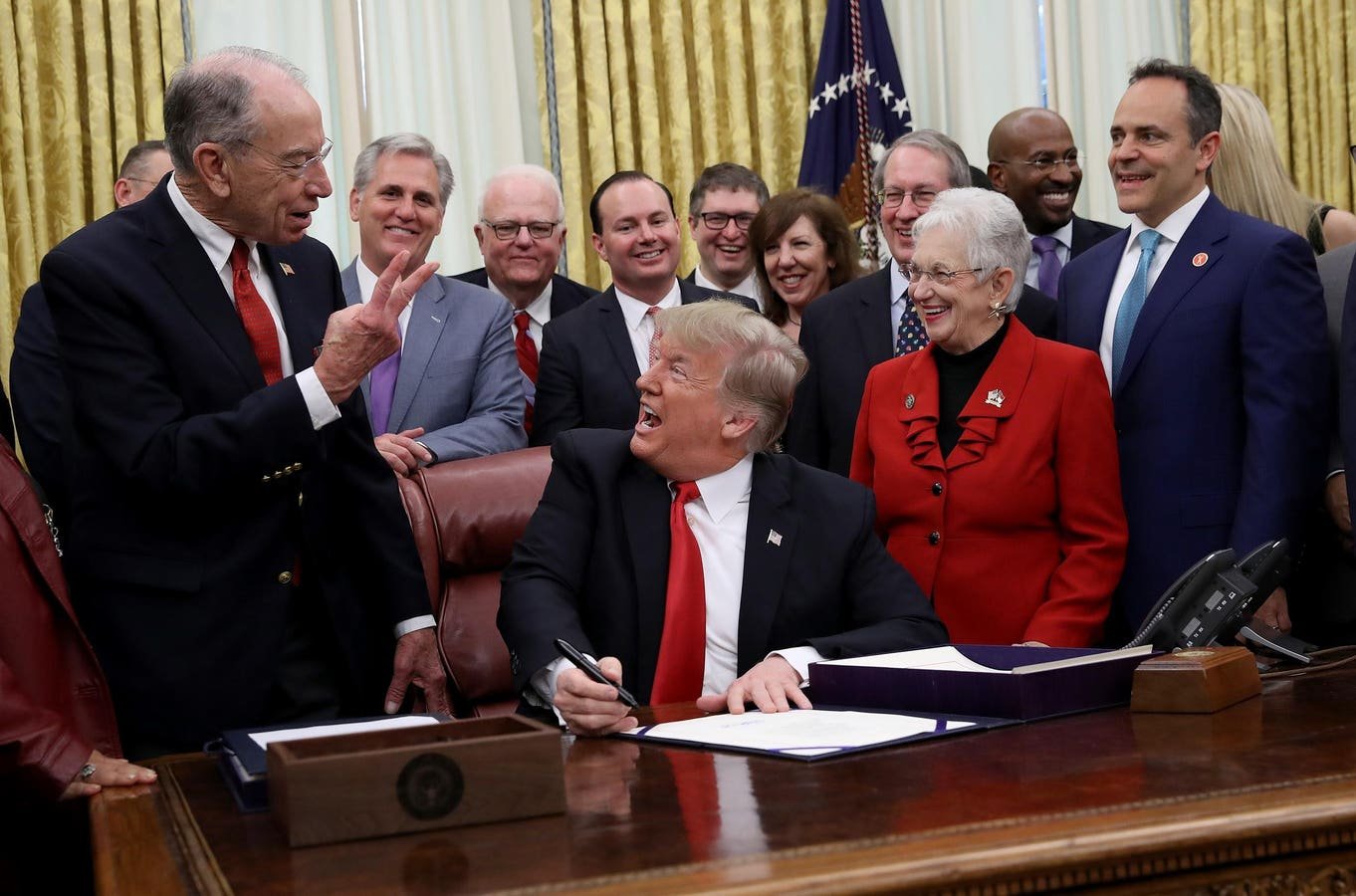
WASHINGTON, DC – DECEMBER 21: Senate Judiciary Committee Chairman Chuck Grassley (L) (R-IA) attends the signing of the First Step Act with President Donald Trump in December 2018.
Getty Images
The idea that criminal justice reform is exclusively a liberal project has never been entirely accurate. While progressive advocates have long been associated with reform efforts, conservative lawmakers have also played an important and sometimes leading role in reforming the system. From landmark federal legislation like the Second Chance Act and the First Step Act to a growing wave of state-level reforms, the reality is more bipartisan than the conventional narrative suggests.
Rethinking the political narrative around reform
“The conventional wisdom is that because Republicans are pro-law enforcement, they also reflexively oppose criminal justice reform. Add to that the backlash caused by the rise in crime during and immediately after Covid and one might assume that justice reform is dead. recent analysis from Princeton Professor Udi Ofer gives a much more positive picture.
Ofer’s study acknowledges that the environment has been difficult for federal criminal justice reform in Trump’s second term. But the Princeton professor notes that sensible reforms continue at the state level, where 90 percent of the nation’s prisoners are incarcerated. In fact, 35 states passed at least one criminal justice reform bill in 2025. Between 2021 and 2025, 634 pro-reform bills were enacted in states across the country.
A closer look shows that reform continues, particularly at the state level where most incarcerations occur. Thirty-five states passed at least one criminal justice reform bill in 2025, and more than 600 such laws were passed between 2021 and 2025. This level of legislative activity suggests that reform is not only alive but evolving, often outside the forefront of federal politics.
The Conservative Case for Reform
Conservative support for criminal justice reform is rooted in principles that resonate deep within the movement. Fiscal responsibility, limited government, public safety and second chances all play a role.
One of the clearest examples at the federal level is the Second Chance Act, which was originally signed into law in 2008 under President George W. Bush. The law focused on re-entry programs, aimed at reducing recidivism by helping formerly incarcerated people reintegrate into society through job training, housing assistance and support services. He won strong support from religious and conservative groups who saw redemption as a core value.
A decade later, the First Step Act, ssigned by President Donald Trump in 2018, marked another important milestone. Championed by a coalition of conservative and progressive lawmakers, the law introduced sentencing reforms, expanded earned time credits and improved prison conditions. It reflects a growing recognition among conservatives that overly harsh sentencing policies have been costly, ineffective and often counterproductive to public safety.
These federal efforts helped legitimize the reforms in conservative circles and created momentum for similar initiatives at the state level.
Innovation and leadership at the state level
While federal reform is often stalled by partisan gridlock, states have become laboratories of policy innovation. Conservative leaders have been particularly active in promoting practical reforms that balance accountability with opportunity.
Advocates like David Safaviana longtime conservative political figure who is now COO Integratea public policy organization, have worked to promote reforms in traditionally red states such as Arkansas, Idaho, Oklahoma, Mississippi, Missouri and Tennessee. His perspective reflects the practical mindset that drives many of these efforts. “Because they can’t print money like their federal counterparts, state officials are always looking for better ways to reduce crime and make neighborhoods safer,” he explained to me in an interview.
He also highlighted how different the conversation is outside of Washington. “Beyond the zone, crime policy isn’t just a talking point or a partisan issue. It has real consequences. State lawmakers feel not just for victims, but for people who once made a mistake and are trying to put their lives back together.”
Texas, almost a blue state, is perhaps the best example of a state that embraces criminal justice reform without abandoning its commitment to public safety. Beginning in 2007, Republican and Democratic lawmakers worked together to avoid spending billions on new prisons, investing instead in treatment programs, diversion efforts, suspension reforms and re-entry services. Conservative groups such as Right on Crime helped frame the issue not as “soft on crime” but as smarter and more fiscally responsible. Since its prison population peaked around 2010, Texas has reduced that population by nearly 20 percent while closing many prisons and continuing to see crime rates decline. The reforms showed that a deeply conservative state could reduce incarceration through targeted policies that focused resources on violent offenders while creating alternatives for low-level, nonviolent offenders.
Why bipartisan reform still matters
Despite ongoing political tensions, criminal justice reform remains one of the few areas where bipartisan agreement is still possible. As Safavian noted when debating Congress, “crime is a tough issue because it has partisan implications on a national scale. Both sides want to use it as a weapon to win elections. Unless they want to give the other side a political victory, little gets done.”
However, at the same time, there are signs of progress. Measures like the Safer Supervision Act have received support from conservative organizations and lawmakers, as well as Democrats, reflecting a common understanding that some parts of the system need to work better.
Looking ahead
The story of criminal justice reform in the United States cannot be told as a one-sided story. The Conservatives have not only been involved in reform efforts but have helped shape some of the most important policies of the past two decades.
From the Second Chance Act to the First Step Act and ongoing state-level initiatives, the conservative contribution is clear. As new proposals continue to gain ground, the future of reform may depend less on ideology and more on a shared commitment to what works.
The way forward is not who gets the credit. It’s about building a system that’s more efficient, fairer, and ultimately safer for everyone.


