










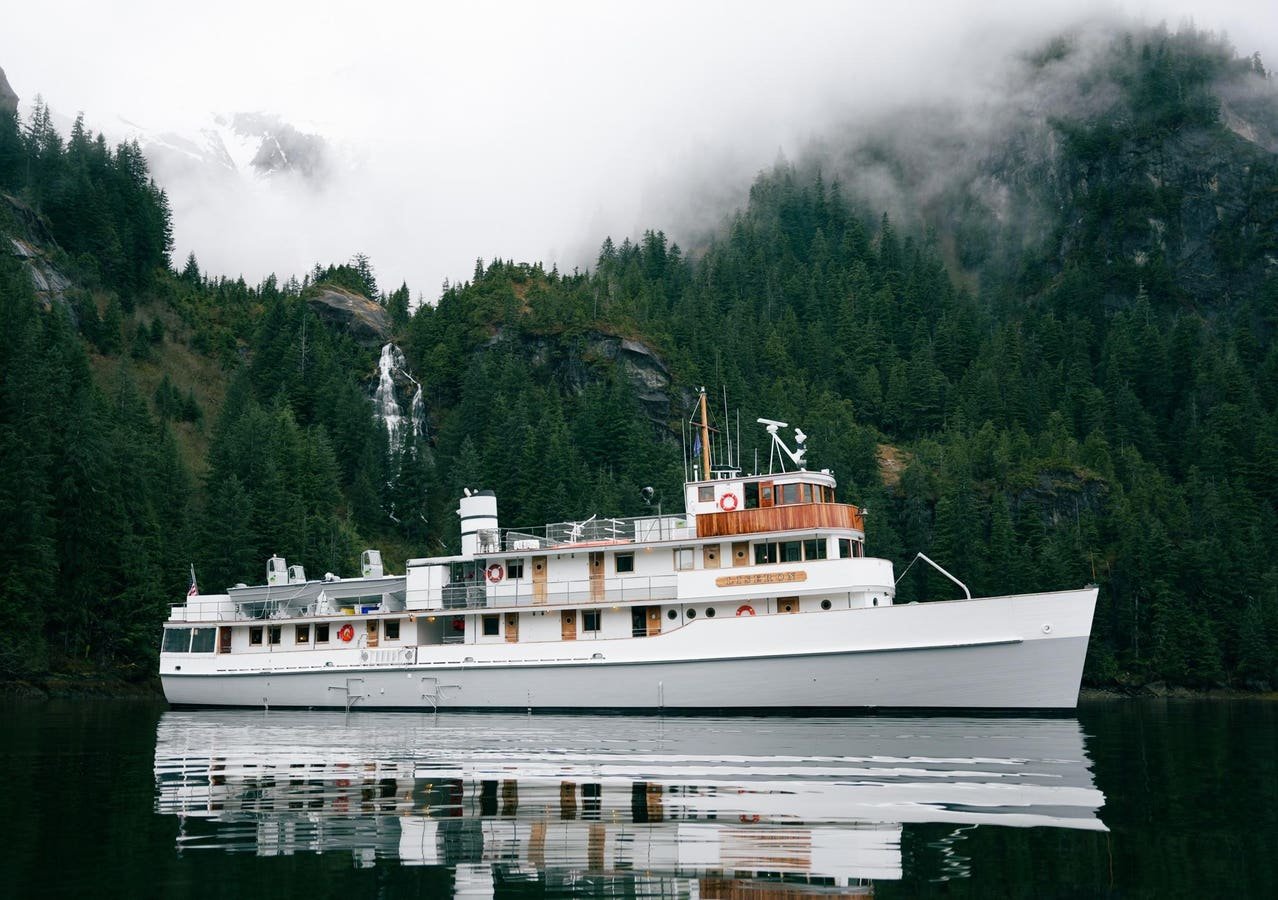
M/V Liseron along the coast in Alaska.
The Boat Company
Cruising tends to evoke skepticism, often associated with giant ships and busy ports rather than conservation. However, industry can also create lasting ties to a place.
A recent one Report of the World Travel and Tourism Councilpublished on April 10, 2026, found that more than 60% of cruise travelers return to destinations they first discovered on a cruise.
In Southeast Alaska, a nonprofit operator of small cruise ships has spent decades working to ensure that those first encounters do more than inspire awe or a return visit and turn travelers into conservation advocates.
I interviewed Hunter McIntosh, its president and CEO The Boat Companyand Kate Glover, senior counsel at Earth justiceto investigate how an environmental law firm working alongside a non-profit cruise line is defending Alaska’s Tongass National Forest.
A small Alaskan cruise line that chose conservation over profit
Nearly 50 years ago, Michael McIntosh, Hunter’s father, and several leaders of major environmental organizations in the United States, including Natural Resources Defense Counciltook a sailing trip to southeast Alaska to observe the effects of logging on the Tongass National Forest.
Clearcuts on company-owned land adjacent to the Tongass National Forest in Alaska.
David Herasimtschuk for Earthjustice
During that trip, these leaders approached Michael and said, “Hey, Michael, you need to start a cruise line so we can bring all our big donors here and show them what’s going on.”
He said yes and founded The Boat Company, as part of the McIntosh Foundation, in 1979.
“Now we’ve evolved,” Hunter said in a Zoom interview. “We’ve grown into our own non-profit with two ships operating during an 18-week season. We bring in 20-25 travelers from the lower 48 states, as well as Europe, to show them the same landscapes my father saw 50 years ago,” he added.
For Hunter, this story isn’t just the company’s story. It’s why he resisted turning The Boat Company into something bigger and more conventional.
He explained that the company’s non-profit status is why their guests choose his company. Although part of the fare is tax deductible, visitors also know that another part of their money is helping to protect the very place they came to see. He also added that 70% to 75% of customers return, a level of loyalty he considers unusual in the cruise industry.
Hunter McIntosh, president and CEO of The Boat Company on one of their ships.
The Boat Company
He described The Boat Company as “very much a legacy” and “a project of passion,” adding that the payoff comes from seeing families experience the same bears, whales and wilderness that first moved his father decades ago.
Hunter hopes The Boat Company will grow, but only if it can do so as a nonprofit with its conservation legacy intact.
The partnership behind the fight to protect the Tongass
The connection between The Boat Company and Earthjustice dates back to the early days, when it was still known as the Sierra Club Legal Defense Fund and when his father, Michael McIntosh, funded the opening of the organization’s Juneau office through the McIntosh Foundation.
“Earthjustice is a nonprofit law firm that works with other environmental groups, tribes and communities to take on some of the most important environmental issues today,” Kate explained during our Zoom interview.
The Boat Company is not the only partner. is part of the broader coalition represented by Earthjustice in the fight for the Tonga National Forest.
During our interview, Kate described their relationship with the cruise line as a bond that goes beyond donations.
“I think the most important thing is that the tourism industry supports the economy of the area and allows people to come and see this place so they understand why we need to protect it,” he said.
“I think we are gaining Tongan warriors from people coming here and visiting,” he added.
Because the Tongass race is about more than trees
Kate laid out the climate stakes clearly: “The old Tongass is a coal powerhouse, storing 20% of the carbon stored in all US national forests combined. It’s a climate life raft for us and we need to keep those trees standing.”
Old growth trees on Kuiu Island, Tongass National Forest, Alaska.
David Herasimtschuk for Earthjustice
However, the fight for the Tongass National Forest is not just about saving its trees. It’s also about jobs, local culture and the future of Southeast Alaska.
Local and indigenous communities rely on the Tongass for food, cultural traditions and daily life through hunting, fishing and gathering. At the same time, these intact landscapes protect fisheries, drinking water and healthy watersheds.
But the Tongass race is also an economic one, and not in the way logging advocates often frame it. “The economy in Southeast Alaska is heavily based on tourism and commercial fishing. It’s not a logging economy,” Kate explained. For example, he reported that a quarter of the salmon on the entire US West Coast come from Tonga streams.
Pink salmon spawning in Maybeso Creek, near Hollis, Alaska, Tongass National Forest.
David Herasimtschuk for Earthjustice
THE 2025 Southeast Alaska by Numbers report also confirmed what Kate explained. In 2024, the tourism industry supported 8,589 jobs, while the seafood industry supported 3,109, together accounting for about a quarter of the region’s workforce. Lumber, in contrast, accounted for just 274 jobs, which is about 0.6% of the total workforce.
Hunter made a similar point. He said what’s happening in the Tongass Ripples is far beyond an industry. “At the end of the day, what happens in the Tongass affects every team in one way or another,” he said.
The Tongass is not just a beautiful setting, but a functional infrastructure for ecosystems, livelihoods and communities. “What we’re all about is keeping the Tongass alive,” Hunter noted.
Tongass National Forest, Alaska
David Herasimtschuk for Earthjustice
Because not all tourism helps in the same way
Big ship cruising and mission-driven small cruise tourism should not be treated as the same thing. Both Kate and Hunter experience the difference in their impact firsthand.
Kate said Southeast Alaska has seen a significant increase in cruise ship tourism and that growth has created tensions in communities. Locals try to balance economic benefits with quality of life and access to places they also use.
M/V Mist Cove of The Boat Company skirts Alaska’s pine-forested coast.
The Boat Company
Hunter’s view was more blunt as he described it as a “definite antipathy” in local communities towards these larger ships, even though people also understand the money they bring.
The difference is not in size, but in purpose. Both models are bringing people to Alaska, but what are they leaving behind? More pressure on ports and communities or deeper understanding and long-term support for the place itself? Do they treat the wilderness as a backdrop or as something worth defending once the journey is over?
What’s next?
The fight is far from over. “We have worked so hard over the last two decades defend the no-road ruleKate said. However, we are at another turning point.
The magnificent rainforests of the Tongass National Forest, Ketchikan, Alaska.
getty
The US Forest Service plans to review the Tonga National Forest plan and repeal the Roadless Rule of 2001, which would reopen currently protected areas to road building and timber harvesting. So Earthjustice, along with The Boat Company and other coalition members, prepare for the next round.
Clearcut in the Tongass National Forest
getty
Hunter said readers interested in Tonga should not underestimate the importance of public pressure. “Our voices endure if our voices are heard,” he said.
He urged advocates to stay involved, watch for opportunities to provide feedback and contact elected officials when protections are threatened.
“Don’t be afraid to call your senator’s office, call your congressman’s office and say, I don’t agree with repealing the No Road Rule.”


